
The Most Contrarian Business Book I’ve Ever Read!
Some books teach you how to start a company. Others teach you how to manage one. Then there’s Zero to One Peter Thiel—a book that teaches you how to think. And that, in my opinion, is why it remains one of the most influential startup books ever written.
Unlike many business books that are filled with motivational stories and vague advice, Zero to One is unapologetically intellectual. It challenges assumptions, questions conventional wisdom, and forces readers to rethink how innovation actually happens.
Even years after its publication, many of its ideas feel more relevant than ever in the age of AI.
The Core Framework of Zero to One Peter Thiel
The central idea of the book is surprisingly simple:
- Going from 0 to 1 means creating something entirely new.
- Going from 1 to n means copying or scaling what already exists.
China building more factories? That’s 1 to n.
Inventing the smartphone? That’s 0 to 1.
Launching yet another food delivery app? Probably 1 to n.
Creating the first large language model? That’s 0 to 1.
Peter Thiel argues that real progress happens when companies create new things—not when they merely imitate existing models.
Competition Is for Losers (Yes, He Actually Says That)
This is perhaps the most controversial idea in the book.
Thiel argues that the best businesses aren’t those competing fiercely in crowded markets. Instead, the best businesses create monopolies. Before you gasp, he isn’t advocating anti-competitive behavior.
His point is this: The best companies become so unique that they have no real competition.
Think about it:
- Google dominates search.
- Nvidia dominates AI chips.
- OpenAI created an entirely new category of consumer AI.
Their success didn’t come from being slightly better. It came from being fundamentally different. As a marketer, I find this idea incredibly powerful.
Too many businesses ask: “How can we be better?”
Few ask: “How can we be different?”
The Future Is Built by Optimists

One of the book’s underrated themes is optimism. Thiel distinguishes between:
- Definite optimism: Believing the future can be planned and built.
- Indefinite optimism: Hoping things somehow work out.
Silicon Valley thrives because entrepreneurs actively build the future they imagine. This resonated deeply with me.
Whether in AI, digital marketing, or education, the people who shape industries are rarely passive observers. They’re builders.
Secrets Exist Everywhere
Perhaps my favorite chapter in the book revolves around a simple question: What important truth do very few people agree with you on?
This question alone is worth the price of the book. Every startup, innovation, or breakthrough often begins with a hidden truth that others overlook.
Airbnb saw value in strangers staying in each other’s homes. Uber saw value in turning cars into on-demand networks. OpenAI saw value in making AI conversational.
The future belongs to those who identify secrets before everyone else does.
Reading This Book in the AI Era Hits Differently
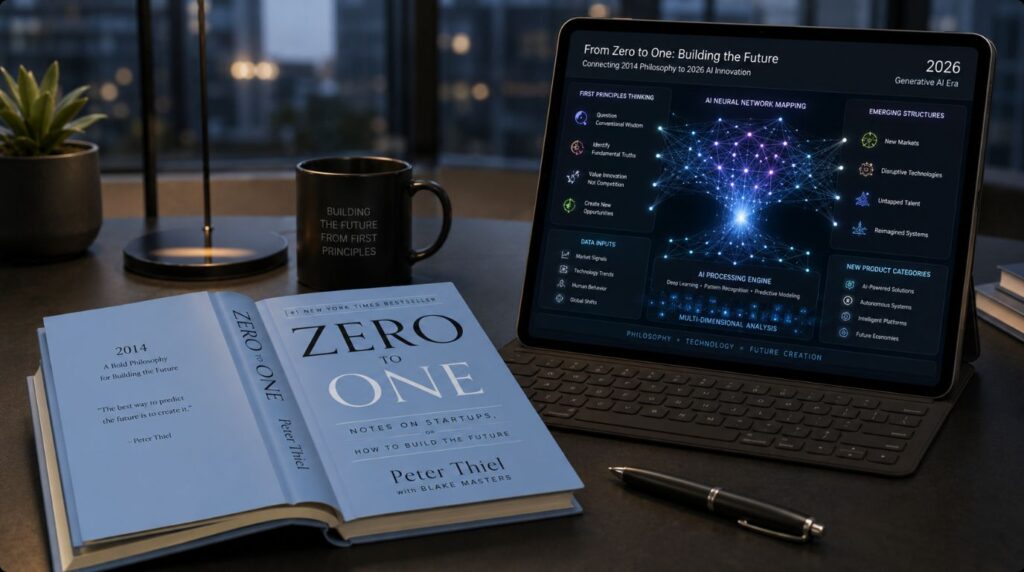
When Zero to One Peter Thiel was published, generative AI didn’t exist. Yet many of its ideas seem tailor-made for today’s world. We’re living through one of the largest “0 to 1” moments in human history.
AI isn’t merely improving workflows. It’s creating entirely new categories of products, businesses, and professions. The biggest winners of the AI era may not be companies using AI. They may be companies building entirely new experiences around AI.
That’s pure Zero to One thinking.
What I Loved in Zero to One Peter Thiel
✔ Thought-provoking ideas
Few business books make you pause every few pages and rethink your assumptions.
✔ Timeless principles
The lessons apply equally to startups, careers, marketing, and technology.
✔ Contrarian thinking
Whether you agree with Thiel or not, the book forces you to think independently.
What I Didn’t Love
✖ Some arguments feel extreme
The “competition is for losers” thesis can feel oversimplified in certain industries.
✖ Silicon Valley bias
Many examples come from the tech startup ecosystem and may not directly apply everywhere.
✖ Easy to understand, hard to execute
The ideas are elegant. Implementing them is another story entirely.
Final Verdict on Zero to One Peter Thiel
Zero to One isn’t just a startup book. It’s a framework for thinking about innovation.
Every entrepreneur, marketer, founder, and professional should read it at least once—not because it provides all the answers, but because it asks better questions. And in a world increasingly shaped by AI, those who ask better questions often build better futures.
Rating: 9/10
Would I recommend the book Zero to One Peter Thiel? Absolutely. Because if everyone is racing from 1 to n, the real opportunity may still lie in going from 0 to 1.
Looking for your next impactful read? Check out our curated selection of reviews to find principles that can elevate your career and business strategy.