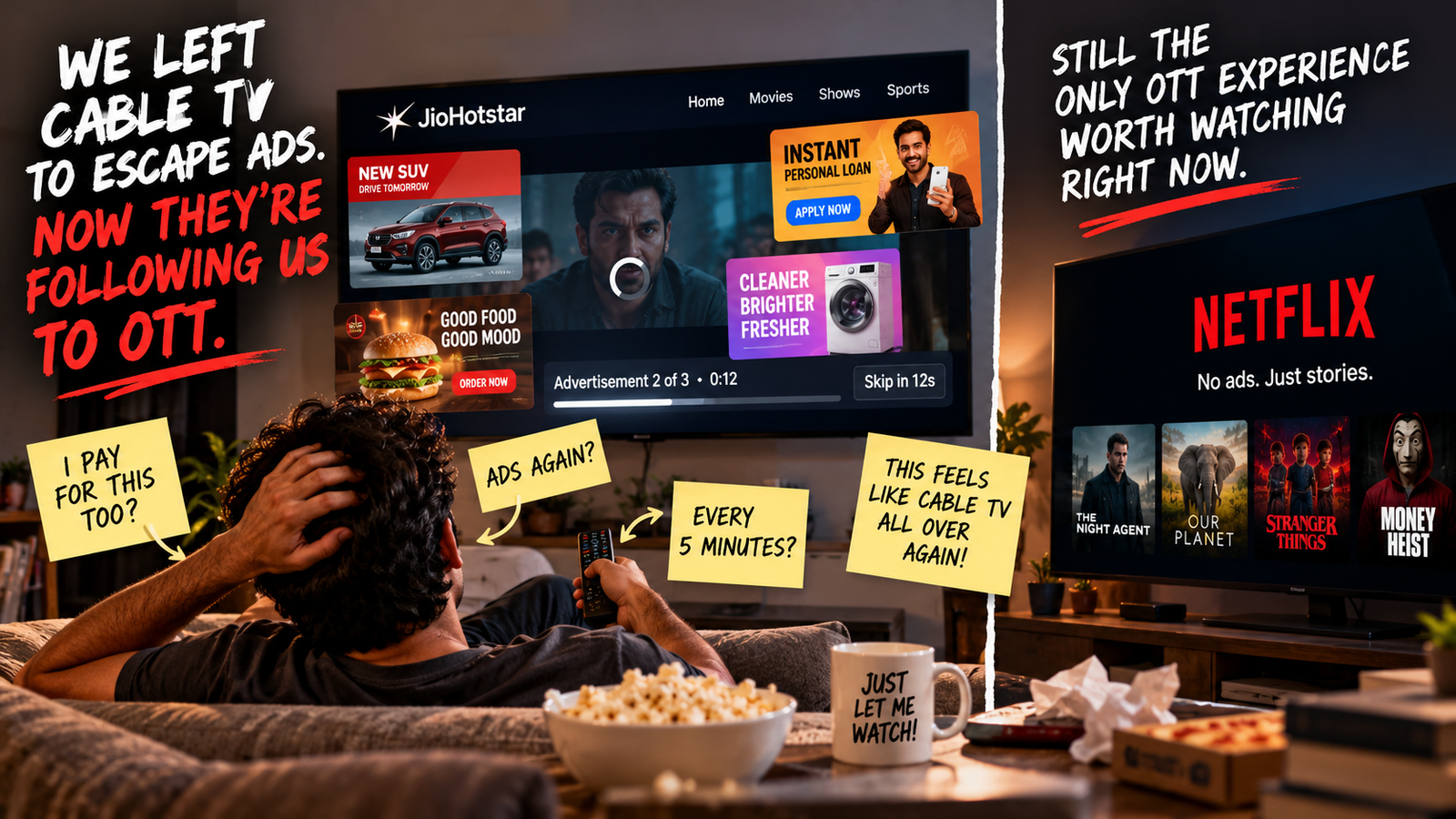

We Left Cable TV to Escape Ads. Now the Ads Have Followed Us to OTT
There is something almost comical about what has happened to television in India.
For years, we complained about cable TV.
Too many channels.
Too many advertisements.
Too many interruptions.
Too little control.
Then came OTT.
And it felt like liberation.
I remember the appeal very clearly. Pay a subscription, open an app and watch what you want, when you want, without someone suddenly interrupting the climax of a movie to sell you detergent, insurance or a pressure cooker.
That was the promise of streaming.
And, for a while, it actually worked.
Today, I sometimes wonder whether we have slowly travelled all the way back to where we started.
Only this time, we are paying for the privilege.
JioHotstar Is Where My Frustration Peaks
My biggest irritation right now is JioHotstar.
I understand the business model. I really do.
Content costs money. Sports rights cost enormous amounts of money. Original programming costs money. Technology, bandwidth and production all cost money.
And advertising is an important source of revenue.
In fact, JioHotstar is very openly building a massive advertising business. Its own advertising platform offers brands pre-roll, mid-roll and other formats, while its connected-TV offering is specifically designed to put advertising on the big screen.
From an advertiser’s perspective, I completely understand why this is attractive.
From a viewer’s perspective?
It is exhausting.
The Whole Point of OTT Was Control
This is what bothers me most.
Cable television controlled what I watched and when I watched it.
OTT was supposed to give me control.
I could pause.
I could rewind.
I could binge.
I could stop watching whenever I wanted.
Most importantly, I wasn’t supposed to be trapped inside somebody else’s advertising schedule.
But now I’m increasingly seeing the same interruption mentality creeping into streaming.
You start a programme.
Advertisement.
You get into the story.
Another advertisement.
The story reaches an important moment.
Another interruption.
And suddenly the experience starts feeling less like a premium entertainment service and more like television with a better interface.
JioHotstar’s own advertising documentation confirms that its platform supports non-skippable pre-roll and mid-roll advertising.
That is technically understandable.
But technically understandable doesn’t necessarily mean good user experience.
And Here’s the Irony: We Are Already Paying
This is where I struggle with the OTT advertising model.
I understand advertising on a completely free platform.
YouTube’s free experience? Fine.
Free streaming? Fine.
A free news website? Fine.
But when I am already paying a monthly or annual subscription, my expectation changes.
I am not saying every subscription must be completely advertising-free.
But there has to be a meaningful difference between:
“I am using your service for free.”
and
“I am paying you every month.”
JioHotstar actually does have different tiers. Its current Premium plan is positioned as ad-free entertainment, except for live sports and other live shows, while Mobile and Super are ad-supported.
And this is an important distinction.
But as a consumer, I still think the industry needs to be careful about how aggressively it pushes advertising into paid experiences.
Because eventually the consumer starts asking:
“What exactly am I paying for?”
The OTT Industry Is Slowly Rebuilding Cable TV
And JioHotstar isn’t alone.
This is becoming an industry-wide direction.
OTT platforms discovered something that television figured out decades ago:
There is money in advertising.
And lots of it.
The advertising ecosystem around streaming is becoming increasingly sophisticated — targeting, audience segmentation, connected-TV advertising, contextual advertising, pause ads, sponsorships and more.
From a marketer’s perspective, it is brilliant.
From a viewer’s perspective, it can become unbearable.
There is a danger that OTT companies become so focused on monetising every available second that they forget why consumers moved to OTT in the first place.
We didn’t move because we wanted better advertising.
We moved because we wanted better entertainment.
I Am Beginning to Use Netflix Differently
And this is where Netflix has become interesting for me.
At this point, when I pick up the remote and don’t really know what I want to watch, I increasingly find myself opening Netflix.
Not because Netflix has everything.
It doesn’t.
Not because every Netflix show is brilliant.
It isn’t.
But because the experience still feels relatively straightforward:
Open Netflix → choose something → watch.
No advertising circus.
No constant feeling that I’m being asked to watch something other than the thing I actually selected.
Netflix’s current India site continues to advertise its service around watching without ads, with plans listed from ₹149 to ₹649 per month.
And I sincerely hope Netflix keeps it that way in India for as long as possible.
Interestingly, Netflix does have an ad-supported plan in some markets. Its global help centre confirms that the ad-supported experience includes commercial breaks during shows and movies.
So I am not naïve enough to believe Netflix is permanently immune to the advertising temptation.
But I hope they resist it here for as long as they can.
Because Advertising Changes the Psychology of Streaming
This is something marketers should understand.
Advertising isn’t simply an interruption.
It changes how the consumer feels about the platform.
Imagine I spend ₹300 on a restaurant.
The restaurant gives me my food.
Then, halfway through my meal, somebody walks over and says:
“Before you take the next bite, here are three advertisements.”
And then does it again.
And again.
I’d probably leave.
Yet that’s essentially what happens when advertising becomes excessive in a paid entertainment experience.
The viewer doesn’t necessarily hate the advertiser.
The viewer starts hating the interruption.
And eventually that irritation can transfer to the platform itself.
That’s dangerous.
As a Marketer, I Also See the Other Side
The irony is that I work in digital marketing.
I understand why brands want OTT inventory.
It offers reach, video, targeting, premium environments and increasingly valuable connected-TV audiences.
JioHotstar itself promotes its ability to reach large CTV audiences and offers formats specifically designed for the big-screen environment.
So I completely understand the commercial opportunity.
But I would still argue that advertising effectiveness and advertising volume are not the same thing.
More ads don’t automatically mean better advertising.
In fact, after a certain point, more advertising could mean:
less attention + more irritation + weaker brand recall.
If I am desperately waiting for an ad to finish so I can get back to my movie, I am not exactly in the mood to love the brand appearing on screen.
OTT Needs to Remember One Important Thing
The product isn’t advertising inventory.
The product is the viewing experience.
Advertising is the monetisation layer sitting on top of it.
That distinction matters.
If OTT platforms destroy the viewing experience while trying to maximise advertising revenue, they may eventually discover that consumers have alternatives.
Piracy.
YouTube.
Social media.
Short-form video.
Gaming.
Or simply cancelling subscriptions.
And consumers today have more entertainment choices than ever before.
I Don’t Want to Go Back to Cable
This is probably the simplest way I can put it.
I left cable because I was tired of somebody else deciding when my entertainment should stop.
I moved to OTT because I wanted control.
I wanted convenience.
I wanted choice.
I wanted to watch something without being bombarded with advertisements every few minutes.
I don’t want to pay a subscription fee and slowly watch OTT become cable TV with a faster internet connection.
And that’s why Netflix currently feels like my default.
Not because it is perfect.
Not because it has every piece of content I want.
But because, increasingly, the absence of annoyance has become a feature.
And perhaps that’s the strangest thing about the streaming business today.
We once paid for cable and complained about the advertisements.
Then we paid for OTT to escape the advertisements.
Now we’re paying OTT platforms again while they try to bring the advertisements back.
Maybe the next big differentiator in streaming won’t be who has the most content.
Maybe it will simply be:
Who respects my time the most?
For me, at least for now, that’s Netflix.
And I sincerely hope they don’t decide to ruin that advantage.
Because when I pick up the remote these days, I don’t want another advertising platform.
I just want something good to watch.