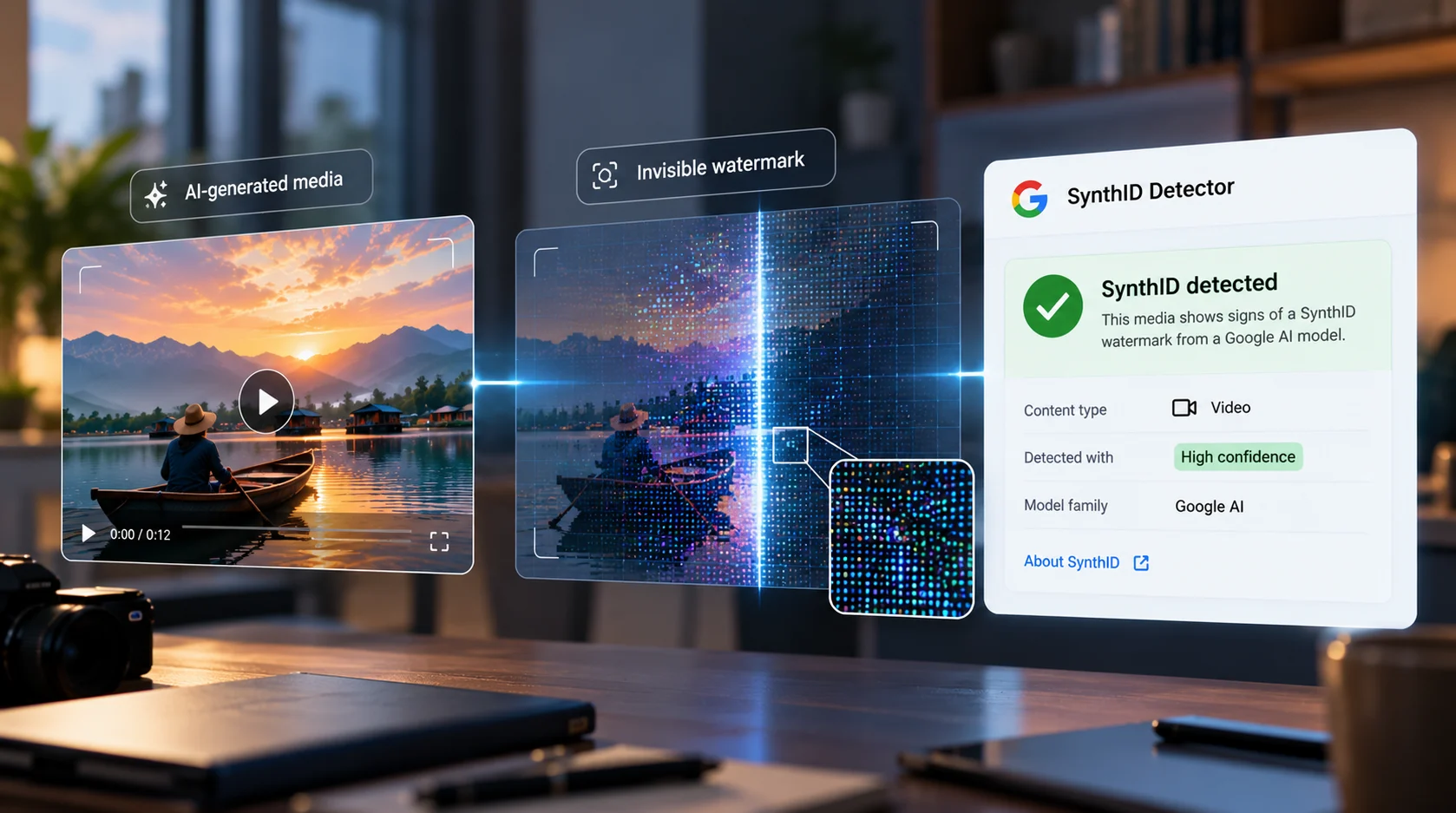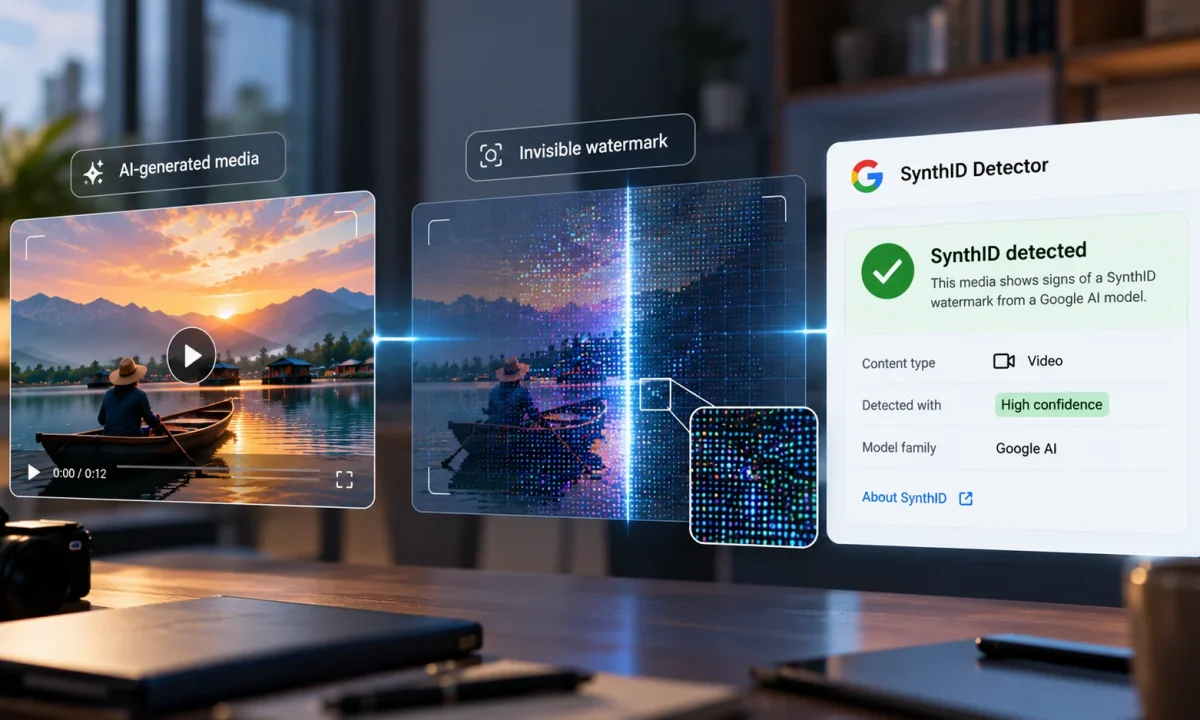

A strange problem is emerging on the internet: creating convincing digital media is getting easier, while figuring out whether it’s real is getting harder.
Google is now giving everyone a new way to deal with that problem. Its SynthID Detector, previously available to a limited group of media professionals, is now publicly accessible and can check images, videos and audio for invisible AI watermarks.
Quick answer
Google has opened SynthID Detector globally, allowing anyone to upload supported images, videos or audio and check whether they contain a SynthID watermark. The system can identify watermarks associated with Google and participating partners including OpenAI, NVIDIA and Kakao, with Apple support planned.
What Happened?
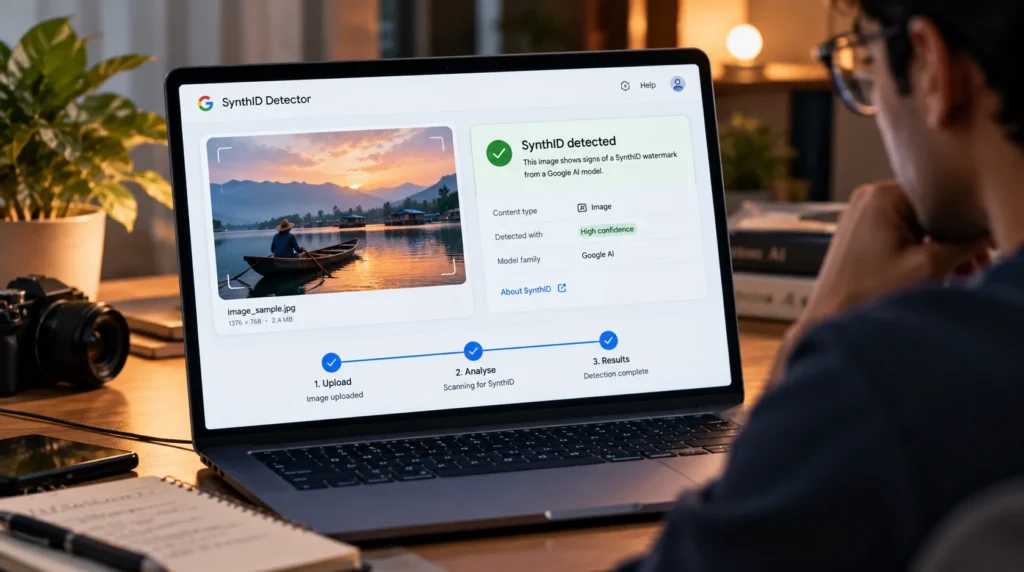
Google DeepMind announced the public expansion of SynthID Detector on October 7, 2026. SynthID is Google’s watermarking technology for AI-generated media. Instead of placing a visible label over an image or video, the system embeds an invisible signal into the content itself. For images and video, that signal is embedded into the pixels. For audio, it is embedded into the waveform.
Google first introduced SynthID in 2023 and launched an early version of its Detector for journalists and media professionals in 2025. Now the verification portal is available to everyone globally in English. Google says it can check media created with its own AI systems as well as content from partners including OpenAI, NVIDIA and Kakao. Apple is expected to join the system in the future.
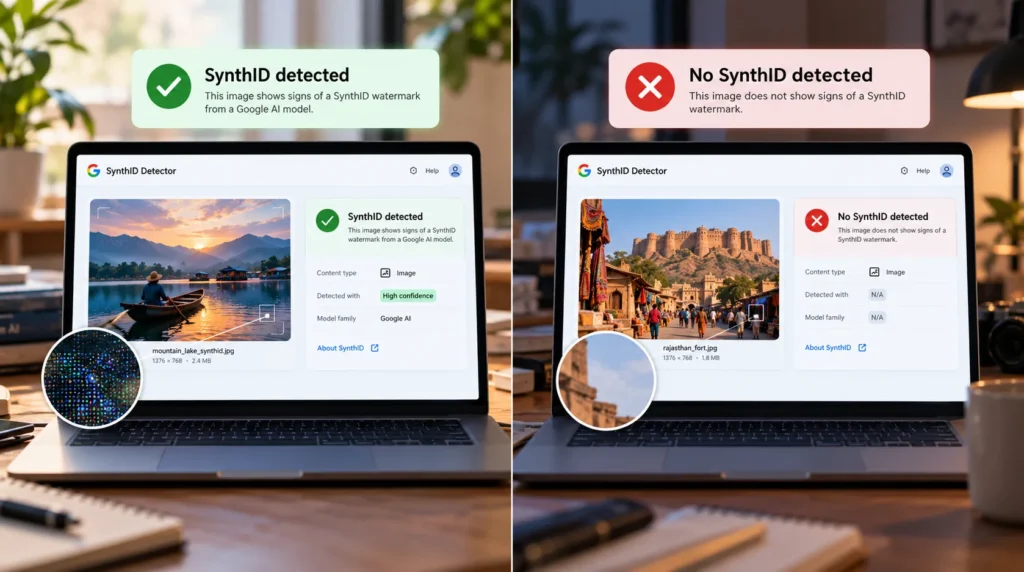
The detector also joins existing verification features built into Google Search, Gemini and Chrome, which Google says now handle more than one million verification requests every day. But there is an important catch. SynthID is not a universal AI detector. It looks for the specific watermark it knows how to identify. If no SynthID watermark is found, that does not automatically mean the content was created by a human.
Why It Matters?
The internet is entering a phase where the question is no longer simply: “Can AI create this?” Yes, it can. The more important question is: “Can I trust where this came from?” This is what matters for news publishers, marketers, brands, creators and businesses.
An AI-generated image can now look realistic enough to be mistaken for a photograph. A synthetic video can appear convincing. AI-generated audio can imitate voices and environments. Read more about: How AI is changing Digital Trust.
For marketers, this creates a new challenge around content provenance. Brands increasingly use AI to create advertising assets, product visuals, social content and video. As that usage grows, knowing whether a piece of media was AI-generated, and potentially where it came from, can become useful for internal approvals, publishing workflows and transparency.
Google’s approach is interesting because it moves verification away from trying to guess whether something “looks AI” and toward checking whether the content carries a machine-readable signal, which is a much more concrete approach.
What Businesses and Marketers Need to Know
1. Don’t treat an AI detector as an authenticity certificate.
A SynthID result can tell you whether the system found a supported watermark. It cannot establish that every unmarked piece of content is human-made.
2. Provenance is becoming part of content management.
Marketing teams may increasingly need to know how an image, video or audio asset was produced before it reaches a campaign, website or social channel.
3. AI disclosure could become a competitive trust signal.
Consumers do not necessarily object to AI-generated content. What can create a problem is uncertainty about what they are looking at.
4. The ecosystem needs common standards.
Google’s decision to support watermarks associated with other AI companies is significant because a verification system becomes more useful when it does not stop at one company’s own models.
Google says more than 180 billion images and videos have been watermarked with SynthID since the technology launched, alongside audio content equivalent to 240,000 years. This scale is what makes this story bigger than the launch of another AI tool.
Watermarking only becomes useful for verification if it exists across a meaningful amount of content. Google is effectively saying that the infrastructure for identifying AI-generated media is already operating at enormous scale. The public detector is now opening another layer of that system to ordinary users.
What Happens Next?
The next development to watch is whether more AI companies adopt compatible watermarking and provenance systems. Google already names OpenAI, NVIDIA and Kakao as partners for SynthID detection, with Apple support coming. The bigger question is what happens outside that ecosystem.
There will still be AI models that do not use SynthID, along with existing content that has no watermark. That means no single detector is likely to answer the broader question of whether something online is “real.”
Instead, the internet may move toward a combination of signals: watermarks + metadata + platform disclosures + source verification + human judgment.
This seems like a more complicated system, but probably a more realistic one.
DMT Take on SynthID Detector
The interesting part of Google’s announcement isn’t really the detector. It is the fact that verification is becoming a product category of its own. For years, the internet was built around creating and distributing more content. AI has made that incredibly easy.
Now the industry has to solve the other side of the equation: figuring out what that content is, where it came from and how much confidence we should place in it.
For marketers, this could eventually change the way digital assets are produced and approved. A campaign image may not just need a creative brief and brand approval. Its origin and AI involvement could become part of the content record.
For consumers, the most useful lesson is simple: A detector saying “no watermark found” is not the same as saying “this is real.” Google’s SynthID Detector is a step toward a more transparent internet, but it is not a magic button for separating truth from AI.
The bigger battle will be over whether the web can build enough reliable signals to keep pace with the machines creating its content.
Sources
- Public expansion of SynthID Detector and current watermarking scale. blog.google
- Technical explanation of SynthID and how the watermarking system works. Google DeepMind
- Independent reporting on the public launch and the detector’s limitations. Ars Technica
- The supplied news report on Google’s new public AI-content detection website.