
When Advertising Meets Culture: How Far Is Too Far?
Date: 27 August 2026
Theme: Advertising, Culture & Brand Responsibility
I have always believed that the best advertising should make people stop scrolling.
But there is a very thin line between making people stop and making people angry.
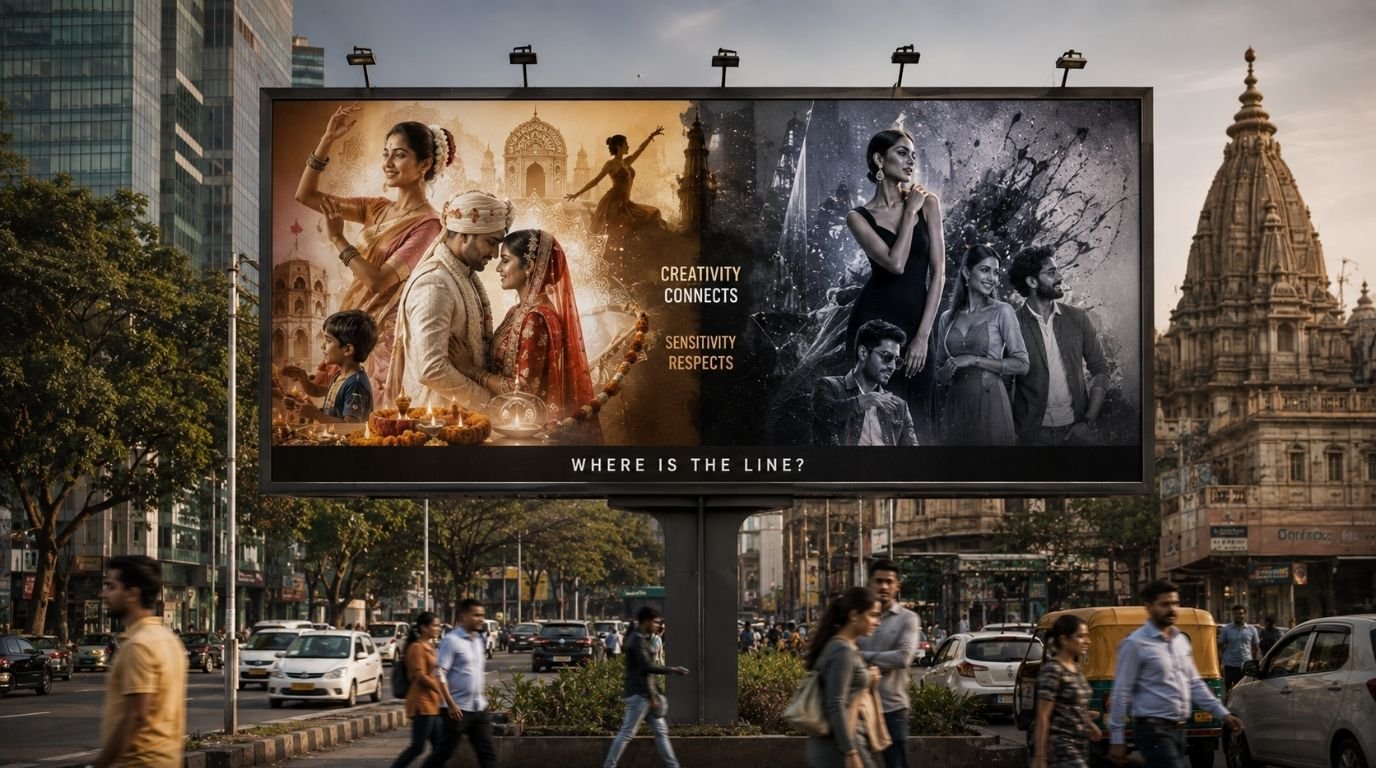
The image shared above is a fascinating snapshot of that line.
It looks at several Indian advertising campaigns that entered what I would call “tricky terrain” — campaigns that touched religion, marriage, culture, gender, relationships and deeply established social customs.
Some were taken down.
Some stayed.
And that difference is what makes this conversation particularly interesting for marketers.
The problem isn’t controversy. It’s context.
Let’s be honest.
Brands want attention.
Nobody spends crores on advertising hoping people will politely look at an ad for three seconds and move on.
The objective is to create a reaction.
But there is a difference between:
“Wow, that’s an interesting ad.”
and
“How dare they say this?”
The first creates conversation.
The second can create a crisis.
The campaigns highlighted in the image demonstrate just how quickly that line can disappear.
Manyavar’s KanyaMaan, Fabindia’s Jashn-e-Riwaaz, Zomato’s Mahakal, Dabur’s Glow with Pride and Tanishq’s Ekatvam all faced controversy around cultural, religious or social representation.
Meanwhile, campaigns such as Bharat Matrimony’s Holi campaign, AU Small Finance Bank’s Badlaav Humse Hai and Surf Excel’s Rang Laaye Sang remained.
So what determines whether an ad becomes progressive or provocative?
Sometimes, it isn’t simply the idea.
It is how the audience interprets the idea.
Marketers don’t advertise in a vacuum
This is something I repeatedly try to explain when I teach advertising.
A creative team may spend weeks developing an idea.
They understand the strategy.
They understand the brand objective.
They understand the consumer insight.
They know exactly what the campaign is trying to communicate.
But the audience doesn’t have that context.
They see the 30-second film.
They see the headline.
They see the visual.
And they bring their own experiences, beliefs and cultural understanding to it.
That creates an important lesson:
The meaning of an advertisement isn’t completely owned by the brand.
Once it enters the public domain, interpretation belongs to the audience.
And in today’s social media environment, that interpretation can spread much faster than the original campaign.
The “controversy = success” strategy is dangerous
There is a school of thought in advertising that says:
“If people are talking about the campaign, it worked.”
I disagree.
Attention is not the same thing as effectiveness.
A campaign can generate 100 million impressions and still damage the brand.
It can trend on X.
It can dominate LinkedIn conversations.
It can generate thousands of Instagram Reels.
And yet consumers may remember only one thing:
“That was the brand that offended people.”
That isn’t necessarily brand building.
It is brand awareness with potentially negative sentiment attached.
As marketers, we need to measure more than reach.
We need to ask:
What are people remembering?
But should brands stop taking risks?
Absolutely not.
In fact, I think the opposite is true.
Brands should continue challenging stereotypes.
They should talk about inclusion.
They should question outdated traditions.
They should represent different communities.
They should start uncomfortable conversations.
Some of the most memorable advertising campaigns have succeeded precisely because they challenged conventional thinking.
The problem isn’t challenging culture.
The problem is doing it without understanding culture.
There is a huge difference.
Cultural intelligence should be part of creative strategy
Before launching a campaign around religion, festivals, marriage, gender or social traditions, I would ask five questions.
1. What exactly are we challenging?
Is the campaign challenging a harmful stereotype?
Or are we simply using a cultural symbol because it will generate attention?
There is a difference.
2. Who could feel represented?
And equally importantly:
Who could feel misrepresented?
Creative teams need to consider both sides.
3. What happens when the context disappears?
Imagine someone sees only a screenshot from your campaign on WhatsApp.
Would the idea still make sense?
This is incredibly important today because campaigns rarely remain in their original format.
A 60-second film can become a 15-word tweet.
A beautifully crafted narrative can become a single controversial frame.
4. Are we prepared for disagreement?
If the answer is no, perhaps the campaign hasn’t been stress-tested enough.
5. Is the controversy helping the brand?
This is the most important question.
Not:
“Will this go viral?”
But:
“Will this make people think better about the brand?”
Social media has changed the risk equation

Earlier, an advertisement could appear in a newspaper or television commercial and disappear after the campaign ended.
Today, nothing really disappears.
Someone can screenshot it.
Someone can repost it.
Someone can create a reaction video.
Someone can remove the original context.
And within hours, the brand may be responding to a narrative it never intended to create.
This is why I think modern creative strategy needs something that wasn’t always considered essential:
a controversy simulation.
Before launch, ask:
“If someone wanted to criticise this campaign, what would they say?”
Then ask:
“If that criticism went viral, would we still stand by the creative?”
If the answer is yes, launch confidently.
If the answer is no, go back to the drawing board.
The marketer’s job isn’t to avoid discomfort
I don’t think brands should become boring because they are afraid of criticism.
That would be the easiest — and least interesting — solution.
The real skill is learning to create productive discomfort.
Make people question.
Make people discuss.
Make people rethink.
But give the audience a reason to respect the brand after the conversation.
Because there is a difference between:
“This brand made me think.”
and
“This brand used my culture to get attention.”
The first can build loyalty.
The second can destroy it.
My takeaway
Looking at these campaigns, I don’t think the lesson is that brands should stay away from religion, festivals, traditions or social issues.
The lesson is much simpler:
If you’re going to enter culturally sensitive territory, do your homework.
Creativity without cultural intelligence can become provocation.
Purpose without sensitivity can become preaching.
And controversy without a strategic reason is simply expensive noise.
As marketers, we often talk about breaking the clutter.
But perhaps we need to add one more question to that statement:
“What kind of clutter are we creating?”
Because getting people to notice your brand is relatively easy.
Getting them to respect it after they’ve noticed it is the real marketing challenge.
And in 2026, I think that distinction matters more than ever.
Source: The accompanying visual/article provided for this post, highlighting Indian advertising campaigns that faced controversy over cultural, religious and social representation.
As the industry shifts, staying informed about the latest tech news is essential for anyone. Click through to read another thread!