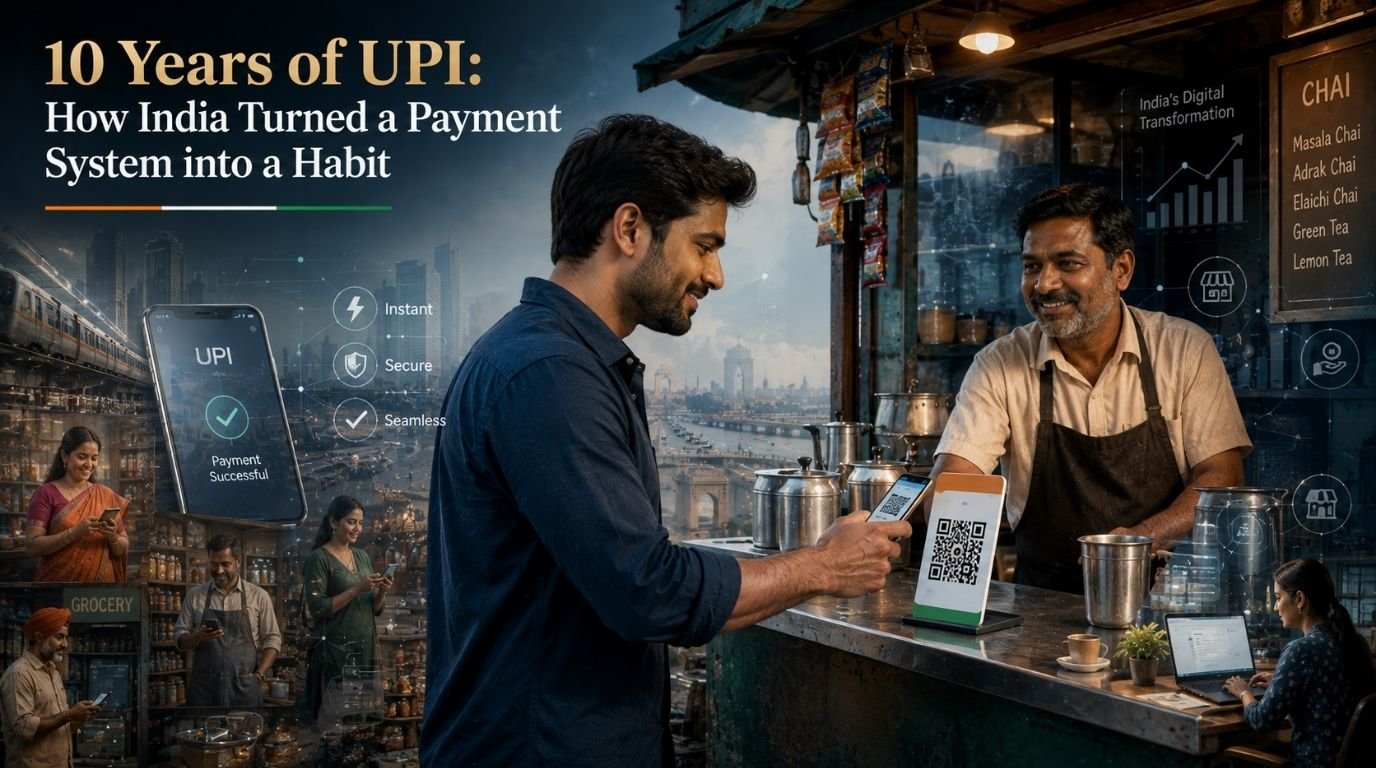
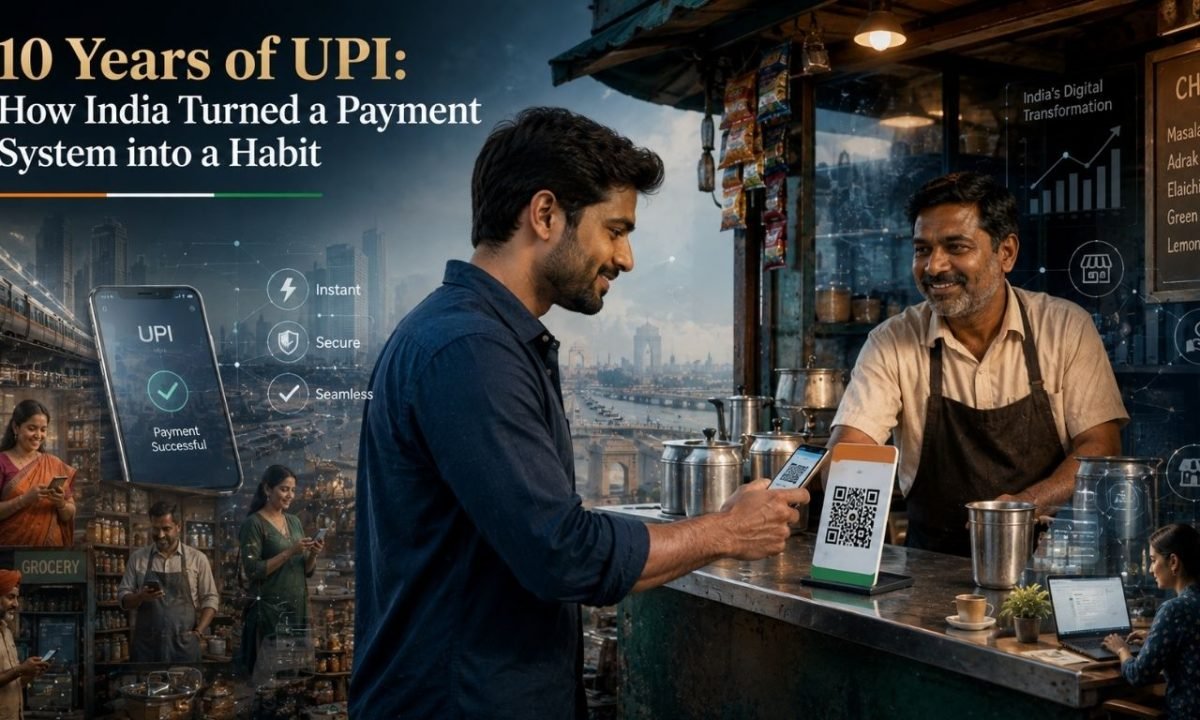

10 Years of UPI: How India Turned a Payment System into a Habit
Date: 26 August 2026
Theme: UPI, Digital Payments & India’s Digital Public Infrastructure
There are very few technologies that have genuinely changed everyday behaviour.
UPI is one of them.
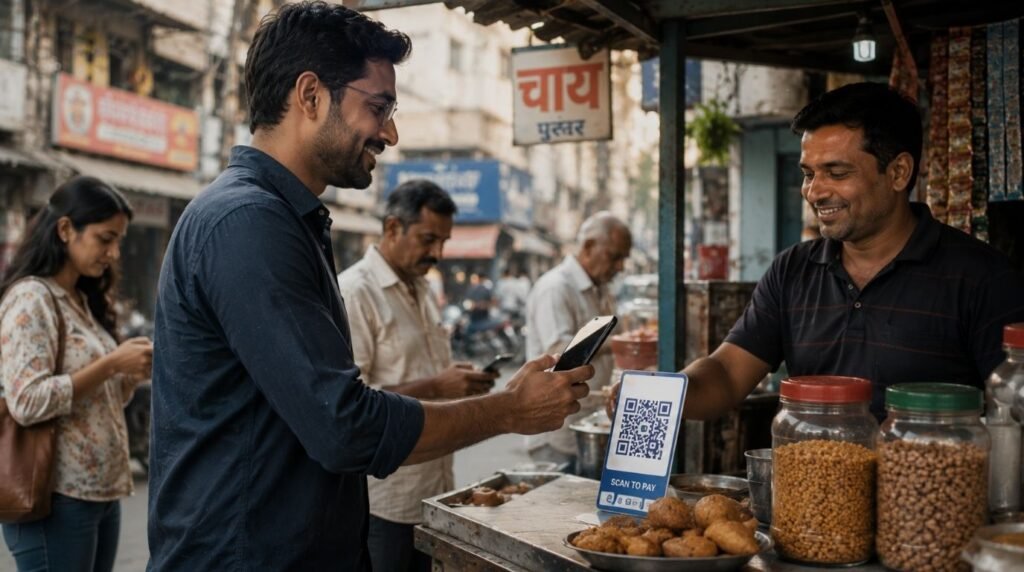
Ten years ago, making a digital payment in India could still feel like a process. Today, I can buy a cup of tea, pay a street vendor, split a dinner bill, send money to a friend or pay a business simply by scanning a QR code.
I don’t really think about the technology anymore.
And that, in my opinion, is the biggest measure of UPI’s success.
UPI completed 10 years in August 2026, and the numbers are almost difficult to comprehend. Annual transaction volume has grown from 1.78 crore transactions in FY2016-17 to more than 24,162 crore in FY2025-26 — nearly a 13,000-fold increase. Transaction value has gone from ₹0.07 lakh crore to around ₹314 lakh crore.
But I think the real UPI story isn’t in the numbers.
It is in the behavioural change behind them.
From “How do I pay?” to “Just scan it”
What UPI did brilliantly was remove friction.
Previously, digital payments often required us to think about the payment method first.
Card?
Net banking?
Wallet?
Bank details?
Today, the conversation has changed.
“UPI hai?”
That’s it.
A QR code has effectively become a universal payment interface.
The beauty of UPI is that consumers don’t necessarily care which bank the merchant uses or which bank the recipient uses. Interoperability happens behind the scenes.
The customer simply pays.
That simplicity is incredibly powerful.
UPI now accounts for roughly 84% of India’s digital payment volume, with more than 700 banks connected to the system. It also represents around 49% of global real-time payment volume.
That’s no longer just a successful Indian fintech product.
That’s infrastructure.
The QR code may be India’s most successful piece of marketing
As a marketer, this is the part I find particularly fascinating.
Think about what happened.
There wasn’t a massive consumer education campaign explaining the technical architecture of UPI.
Instead, the QR code simply appeared everywhere.
At supermarkets.
At restaurants.
At vegetable stalls.
At taxis.
At roadside tea shops.
At tuition classes.
At small businesses.
And gradually, consumers learned by doing.
This is an important lesson in adoption:
Sometimes the best user education is simply making the product incredibly easy to use.
UPI didn’t ask consumers to understand payment infrastructure.
It gave them a camera, a QR code and a reason to use it.
UPI didn’t just digitise payments. It changed expectations.
This is perhaps the bigger transformation.
Once people become accustomed to instant payments, they start expecting everything else to become instant too.
I can send money in seconds.
So why does a refund take seven days?
I can pay instantly.
So why does onboarding take three days?
I can open an app and transfer money immediately.
So why is another financial process still dependent on paperwork?
UPI has therefore created something beyond a payment network.
It has created a new consumer expectation around speed and convenience.
And every fintech, bank, e-commerce company and digital business now has to operate within that expectation.
The biggest success may actually be financial inclusion
One of the things I find most impressive about UPI is that it didn’t remain a metro-city phenomenon.
It reached small merchants and consumers across the country.
The infrastructure has expanded from just 21 banks at launch to 741 banks by July 2026. The government says more than 55 crore users were onboarded by June 2026.
This is where the concept of Digital Public Infrastructure becomes important.
India didn’t simply build another private payment app.
It built a common rail on which banks, fintech companies and consumer-facing applications could operate.
That distinction matters.
Because the innovation wasn’t only in the interface.
It was in creating an ecosystem.
But the next decade will be harder
I don’t think UPI’s biggest challenge is adoption anymore.
It is sustainability.
When a payment system becomes this large, maintaining the infrastructure, combating fraud, improving security and continuing innovation becomes increasingly expensive.
There is also the question of economics.
UPI has historically been built around very low-cost transactions, which helped drive mass adoption. But payment companies need sustainable business models to continue investing in infrastructure and customer acquisition.
Recent discussions around merchant fees show that the next phase of UPI may require a different economic model.
And I think that’s perfectly natural.
The first decade was about:
“Can India adopt digital payments?”
The next decade may be about:
“How do we make the world’s largest real-time payment ecosystem sustainable?”
And UPI is no longer just an Indian story
This is perhaps the most interesting chapter yet.
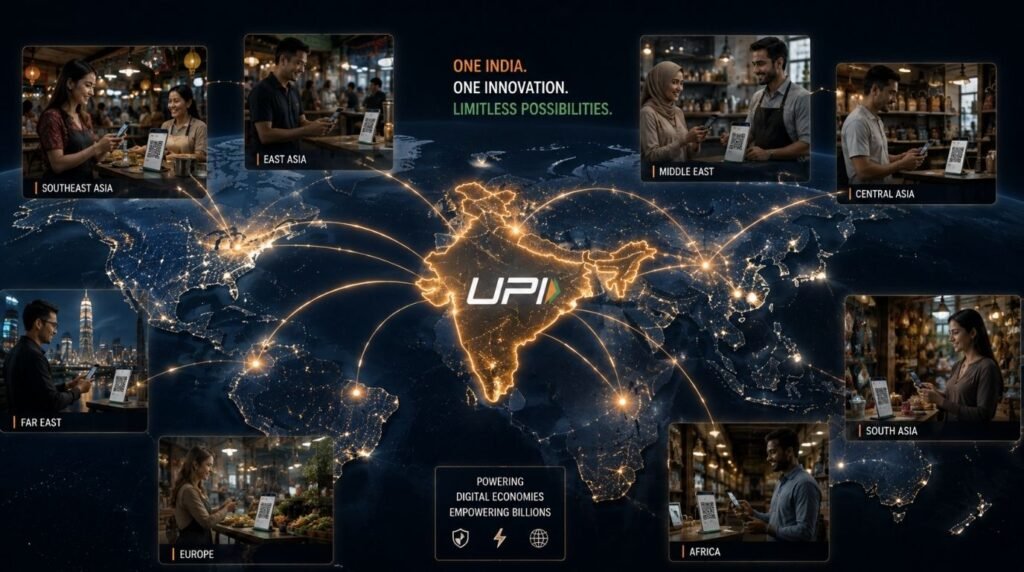
UPI is already being accepted in multiple countries, and the government says it is currently operational in 11 countries.
That changes the conversation.
India is no longer simply importing payment technology.
We are exporting payment infrastructure and, more importantly, a model for building digital public infrastructure.
For a country that has traditionally been viewed as a technology consumer, that’s a significant shift.
What marketers can learn from UPI
For me, UPI offers five very simple marketing lessons.
- Reduce friction before increasing communication: Don’t spend millions explaining a complicated product when you can make the product simpler.
- Build habits, not campaigns: The biggest success of UPI isn’t that people remember an advertisement. It’s that they use it without thinking.
- Make the technology invisible: Consumers don’t care about the underlying payment rails. They care that the payment works.
- Design for everyone: UPI succeeded because it wasn’t designed only for the premium digital consumer. It worked for the large merchant and the roadside vendor.
- Infrastructure can become a brand advantage: When something becomes part of everyday behavior, it stops being merely a product. It becomes an ecosystem.
My biggest takeaway
I think we sometimes look at technological success through the wrong lens.
We ask:
How innovative was the technology?
I would ask a different question:
How invisible did the technology become?
Because when millions of people stop thinking about the technology and simply use it, you know something fundamental has changed.
Ten years ago, UPI was a payment system.
Today, for millions of Indians, UPI is simply how you pay.
And perhaps that is the ultimate definition of successful technology:
When the innovation disappears and the habit remains.
Source: Ministry of Finance / PIB, NPCI data and recent reporting on UPI’s 10-year milestone.
As the industry shifts, staying informed about the latest tech news is essential for anyone. Click through to read another thread!