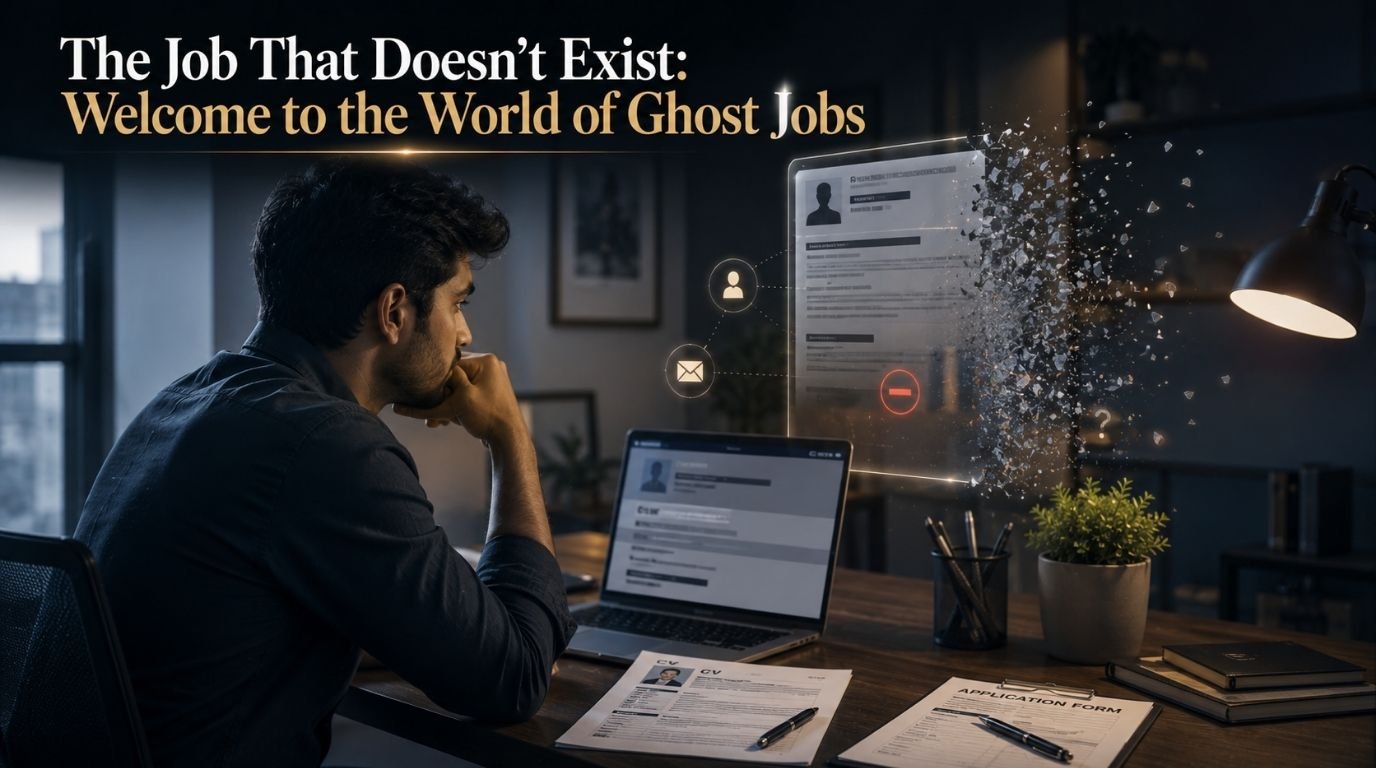

The Job That Doesn’t Exist: Welcome to the World of Ghost Jobs
Theme: Recruitment, Ghost Jobs & the Changing Candidate Experience
There is a particular kind of rejection that job seekers have become very familiar with.
It is the rejection that never arrives.
You find a job posting. The salary looks good. The role sounds exciting. You spend an evening rewriting your CV, adjusting your LinkedIn profile, writing a customised cover letter and filling out an application form that seems to have 47 questions.
Then you click Submit.
And nothing happens.
No rejection.
No interview.
No email.
Sometimes, not even an acknowledgement.
Initially, I assumed this was simply another example of how inefficient recruitment processes have become.
But the growing conversation around “ghost jobs” makes the situation far more uncomfortable: sometimes, the job itself may not actually exist.
The vacancy that is permanently vacant

The article highlights a particularly frustrating phenomenon where companies advertise positions that they have no immediate intention of filling.
Some job advertisements remain online for months. Candidates continue applying, recruiters continue collecting applications and the position continues to look like an opportunity.
Except there may be no actual hiring happening behind it.
According to the report, as many as one in five job postings may fall into this category.
That number, if accurate, should make every job seeker pause.
Because applying for a job isn’t simply clicking a button.
There is a hidden cost involved.
Candidates spend time researching the company, understanding the job description, tailoring their CV, writing cover letters, preparing for interviews and sometimes completing assignments.
When the position was never genuinely available, all that effort was effectively spent on a fictional opportunity.
And that is where I think the real problem begins.
Recruitment has become a performance
I have always believed that marketing and recruitment have more in common than companies realise.
Both are about attracting attention.
Both involve carefully crafted messaging.
Both use platforms, algorithms and targeting.
And both can create a very polished experience on the surface while the reality underneath can be completely different.
A beautiful job description can create the impression that a company is hiring aggressively.
It can make a company appear to be growing.
It can signal that exciting opportunities are available.
But if the company isn’t actually hiring, the job advertisement becomes something else entirely.
It becomes communication without intention.
And that is dangerous because job seekers don’t have access to the information behind the advertisement.
They don’t know whether the role has been approved.
They don’t know whether the hiring manager exists.
They don’t know whether interviews are happening.
They don’t know whether the company is building a talent pipeline for six months from now.
All they see is:
“We’re hiring.”
So they act accordingly.
The candidate experience is becoming the customer experience
This is where I think recruiters and HR teams need to take a step back.
Companies spend millions trying to improve customer experience.
They measure every click.
They track abandoned carts.
They optimise landing pages.
They test email subject lines.
They obsess over conversion rates.
But when it comes to candidates, many organisations still behave as if submitting a job application is the end of the experience.
It isn’t.
The candidate is also a customer of the recruitment experience.
And even if that person doesn’t get the job, they will remember how the company treated them.
Imagine spending three hours applying for a position only to discover six months later that the same advertisement is still sitting on the company’s careers page.
What message does that send?
Not:
“We are a great company to work for.”
It sends:
“We don’t respect your time.”
And in an era where employees publicly share workplace experiences on LinkedIn, Reddit, Glassdoor and other platforms, that reputation can travel very quickly.
Technology has made the problem easier
Ironically, technology was supposed to make recruitment better.
Applicant tracking systems, LinkedIn, automated screening, AI-powered recruitment tools and job aggregators were all supposed to make the process more efficient.
Instead, they have also made it incredibly easy to publish a job.
One click can distribute a vacancy across multiple platforms.
The problem is that removing a job isn’t always treated with the same urgency.
So we end up with thousands of digital job advertisements floating around the internet, some of which may no longer represent a genuine opportunity.
It’s the recruitment equivalent of stale content.
Except someone is making a career decision based on it.
And then there is the mental cost
I think this part deserves much more attention.
Job hunting is already emotionally exhausting.
Every application carries a small amount of hope.
You imagine yourself getting the interview.
You imagine joining the company.
You start calculating the salary.
You tell a friend that you’ve applied.
Then you wait.
When this happens repeatedly, silence starts affecting confidence.
Candidates begin wondering:
“Is my CV bad?”
“Am I not qualified enough?”
“Why am I not getting interviews?”
Sometimes the problem isn’t the candidate.
The opportunity simply wasn’t real.
That distinction matters.
Because an inefficient recruitment process can make talented people believe they are failing when the system itself is failing them.
Regulation may be coming
The article also points towards something interesting: governments are beginning to take the problem seriously.
Legislators in New York and Pennsylvania have proposed measures that would require employers to provide hiring timelines and remove advertisements once positions are filled.
Some proposals include penalties for companies that fail to comply.
I find this particularly interesting because it represents a broader shift.
For years, recruitment was treated as an internal company process.
Now, governments are beginning to look at the candidate experience as something that may require accountability.
And perhaps that’s not unreasonable.
If a company publicly advertises an opportunity, there should be some responsibility attached to that advertisement.
My takeaway for marketers
There is actually a larger lesson here for marketers.
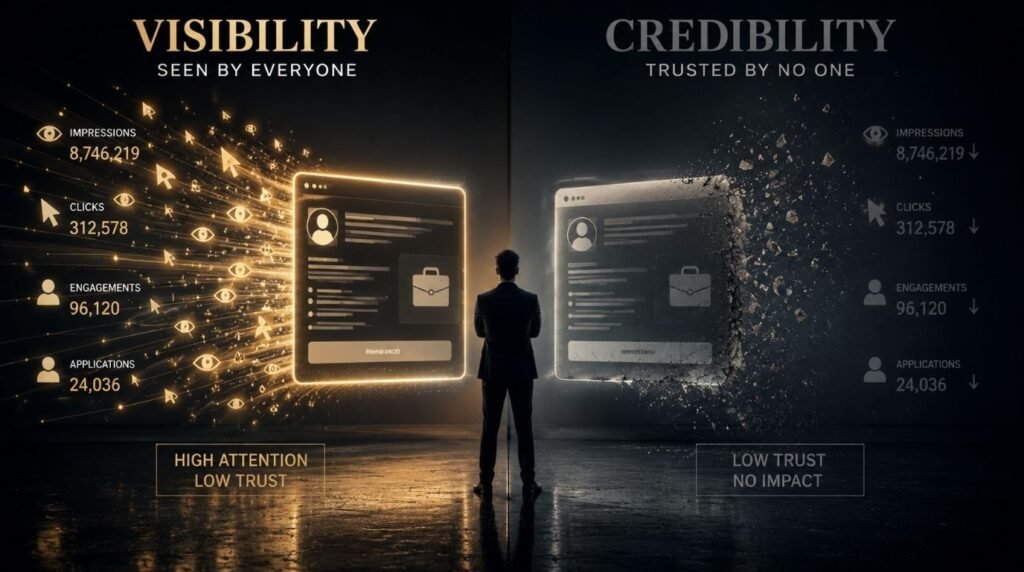
Don’t confuse visibility with credibility.
We spend enormous amounts of time trying to get our brands seen.
More impressions.
More reach.
More clicks.
More traffic.
More leads.
But the moment people realise that what we’re showing them isn’t genuine, the entire communication ecosystem suffers.
A job advertisement is content.
A recruitment page is content.
An employer brand is content.
And just like every other piece of brand communication, it needs to deliver on the promise it makes.
If you say you’re hiring, you should be hiring.
If you’re building a talent pipeline, say that.
If the position is on hold, say that.
If applications are being accepted for future opportunities, communicate that honestly.
Transparency may reduce the number of applications.
But it will dramatically improve the quality and trustworthiness of the applications you receive.
And that is a much better metric to optimise for.
Perhaps we need to stop ghosting candidates
The irony isn’t lost on me.
We have spent years talking about candidates “ghosting” recruiters.
Now we’re discovering that employers may be ghosting candidates too.
Perhaps the recruitment industry needs a new rule:
If the job doesn’t exist, don’t advertise it.
And if it does exist, tell candidates what happens next.
Because behind every application is a real person.
Someone looking for their next opportunity.
Someone trying to pay a bill.
Someone trying to change their career.
Someone hoping that this particular application might finally be the one.
The least we can do is make sure the job they’re applying for is real.
Source: Based on the provided article by Lauren Weber on “ghost jobs” and proposed measures to regulate job postings.
As the industry shifts, staying informed about the latest skills-first hiring news is essential for anyone. Click through to read more such threads!