


AI Spending Is Much Bigger Than the Number on the Balance Sheet
AI spending is becoming one of the biggest corporate investment stories of our time. But when I look at the numbers being reported by technology companies, I think we are still seeing only part of the picture.
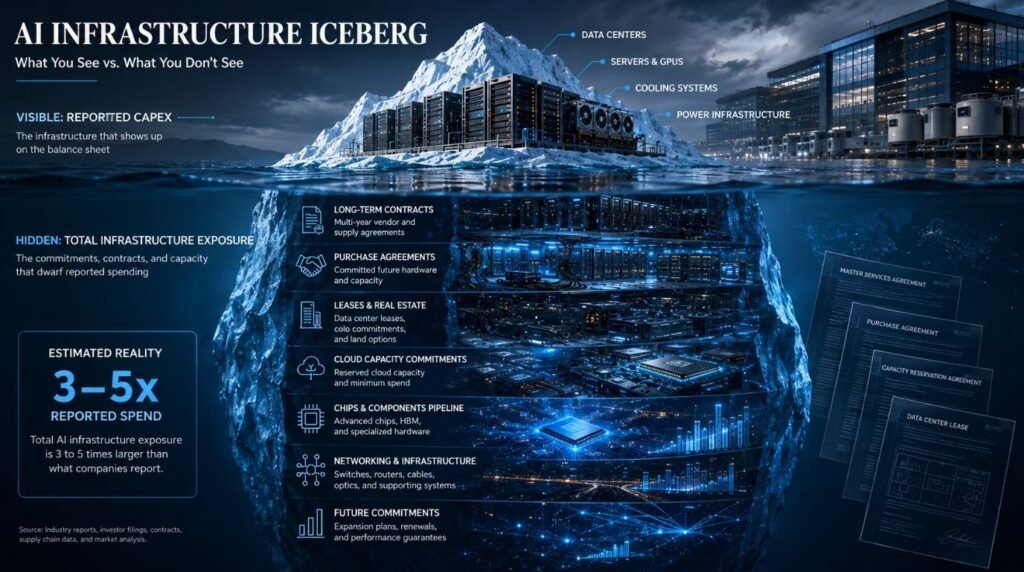
The headline capital expenditure numbers tell us how much companies are spending today.
The commitments buried elsewhere tell us how much they may have already promised to spend tomorrow.
And that distinction is becoming increasingly important.
The Number We See Is Not the Whole Number
Every quarter, companies such as Alphabet, Amazon, Meta and Microsoft disclose their capital expenditure.
These numbers include spending on things like:
- Data centres
- Servers
- Networking infrastructure
- AI chips
- Computing capacity
- Other infrastructure required to build and operate AI systems
But the chart accompanying this story highlights something much bigger: off-balance-sheet commitments.
According to the analysis shown in the article, nine major technology companies had around $3 trillion in off-balance-sheet commitments related largely to AI.
That is a staggering number.
And it tells me something important.
The AI infrastructure race isn’t just about what companies are spending today. It is about what they have already committed to spending in the future.
$1.52 Trillion in Purchase Commitments
One of the numbers that immediately caught my attention is $1.52 trillion in purchase commitments.
These are agreements to buy goods or services at a future date.
For companies building AI infrastructure, that can mean commitments related to computing capacity, chips, infrastructure and other technology requirements.
And the interesting part is that these commitments don’t necessarily appear on the balance sheet immediately.
That creates a fascinating situation.
A company may announce a particular level of capital expenditure, making investors think, “That’s how much they are spending on AI.”
But behind that number could be billions—or even hundreds of billions—of future commitments.
Then There Are Leases
The article also highlights $904 billion in leases that have not yet started.
This is another number I find particularly interesting.
AI isn’t just about buying GPUs.
It requires physical infrastructure.
Data centres need land, buildings, electricity, cooling systems, networking equipment and long-term capacity.
Much of this infrastructure can be accessed through leases and contractual arrangements rather than simply appearing as traditional capital expenditure.
So when I hear that an AI company is spending billions on infrastructure, I increasingly ask:
How much has it already committed to spend?
That is a much more interesting question.
Alphabet, Amazon, Meta and Microsoft Are Playing a Different Game
The visual in the article compares commitments across four of the world’s biggest technology companies.
Microsoft, Alphabet, Amazon and Meta collectively have enormous obligations sitting both on and off their balance sheets.
The numbers shown include:
On-balance-sheet commitments
- Microsoft: $40.3B
- Alphabet: $100.2B
- Amazon: $132.2B
- Meta: $83.7B
But the off-balance-sheet numbers are considerably larger in several categories.
For example, purchase commitments shown in the chart include approximately:
- Alphabet: $811B
- Microsoft: $228.6B
- Amazon: $130.1B
- Meta: $349.3B
These numbers shouldn’t simply be added together and treated as immediate AI expenditure. They represent different types of obligations and commitments.
But that’s precisely the point.
The financial exposure to the AI infrastructure build-out is much larger than the quarterly capex number we usually talk about.
What Does This Mean for the AI Economy?
For me, this changes the way we should think about the AI boom.
AI isn’t just a software story anymore.
It is an infrastructure story.
Every AI interaction requires computing power somewhere.
Every AI model needs infrastructure.
Every AI agent that performs increasingly complex tasks consumes resources.
And as companies compete to build bigger models and AI products, they need to secure that infrastructure well in advance.
This creates a massive ecosystem around AI.
Chip manufacturers benefit.
Cloud providers benefit.
Data-centre operators benefit.
Energy companies benefit.
Networking companies benefit.
Construction and real-estate companies can benefit.
And eventually, marketers benefit too.
Because once AI becomes embedded into products and services at scale, the way companies acquire, retain and communicate with customers will change dramatically.
But There Is Another Side to This Story
There is something I would be cautious about.
Commitments are not the same thing as revenue.
And infrastructure spending is not automatically the same thing as AI profitability.
Companies can spend enormous amounts building capacity before they know exactly how that capacity will translate into long-term returns.
That creates a classic business question:
Will the revenue generated by AI justify the infrastructure being built for it?
We haven’t completely answered that yet.
And this is where I think the next phase of the AI story becomes much more interesting.
The first phase was:
“Who can build the best AI model?”
The second phase became:
“Who can deploy AI at scale?”
The next question could be:
“Who can actually make money from all this infrastructure?”
What It Means for Marketers

As a marketer, I don’t look at these numbers only as finance news.
I see a signal about where the technology industry is heading.
If companies are willing to commit trillions toward AI infrastructure, they clearly expect AI usage to become dramatically larger.
That means marketers should prepare for a world where AI isn’t an additional tool sitting alongside Google, Meta, CRM and analytics platforms.
It becomes the layer connecting all of them.
AI will increasingly influence:
- How we create content.
- How we analyse customers.
- How we personalise advertising.
- How we build campaigns.
- How we automate customer journeys.
- How we measure marketing performance.
And eventually, how consumers discover brands.
My Take
The biggest AI number isn’t necessarily the number appearing in the quarterly capex announcement.
It may be hidden in the commitments companies have already made for the years ahead.
That is why I think marketers, founders and business leaders need to look beyond the usual AI headlines.
The AI revolution is not simply being funded by today’s spending.
It is being pre-funded by tomorrow’s commitments.
And if these companies are right about the future of AI, we are still very early in understanding just how large this infrastructure cycle could become.
As the industry shifts, staying informed about AI trends is essential for anyone. Click through to read another thread!