
Study Smarter, Not Longer
Theme: The PQRST Method and the Science of Active Learning
Source: Deccan Herald article shared above
I have always found it interesting that students often confuse studying for longer with learning better.
We have all seen it.
Books open on the desk. Pages highlighted. Notes everywhere. A formula being memorised five minutes before an exam.
And yet, when the question changes slightly, the answer suddenly disappears.
The problem isn’t always a lack of effort.
Sometimes, it is simply the way we study.
The article I came across on the PQRST method reminded me of this distinction.
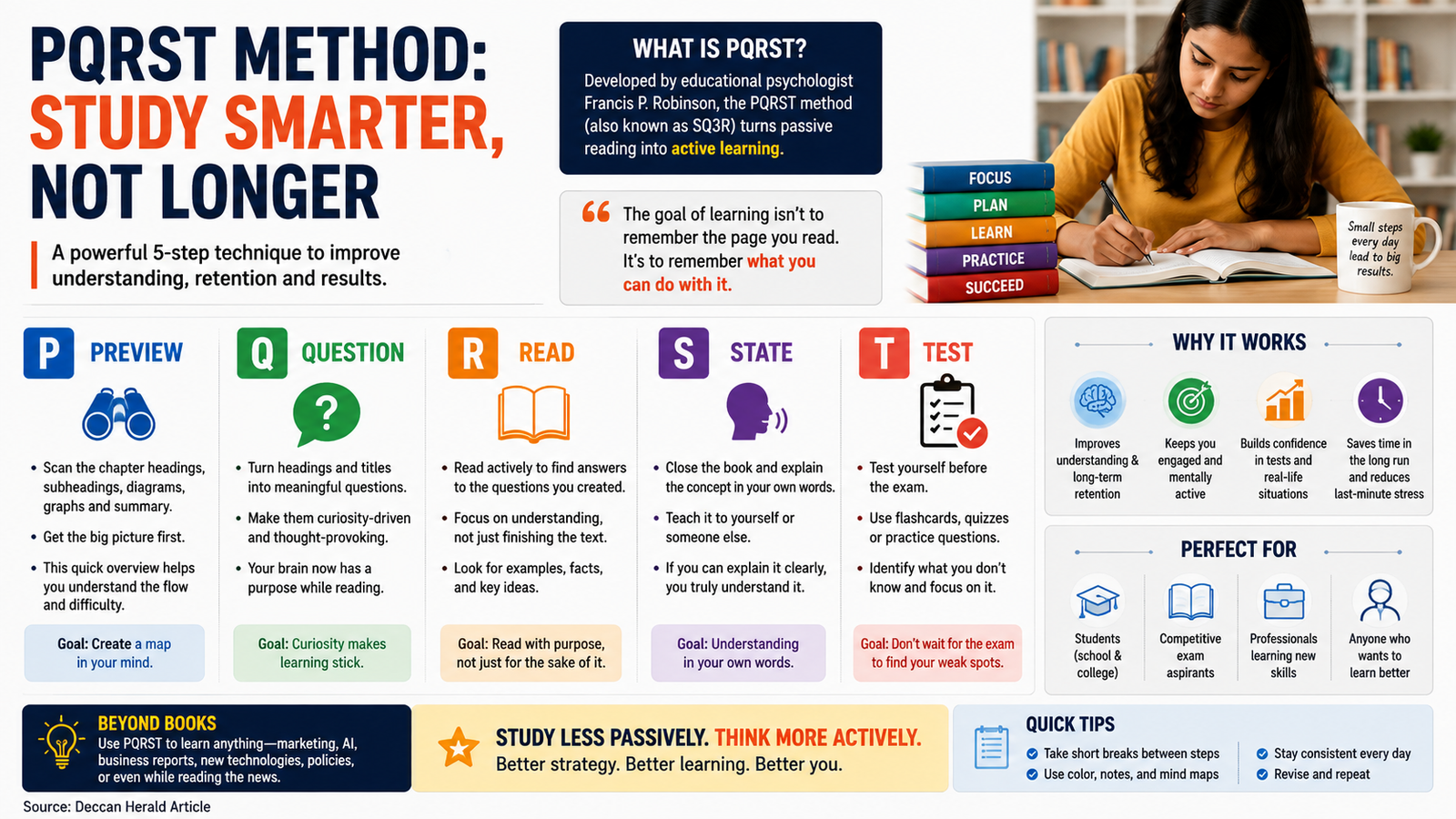
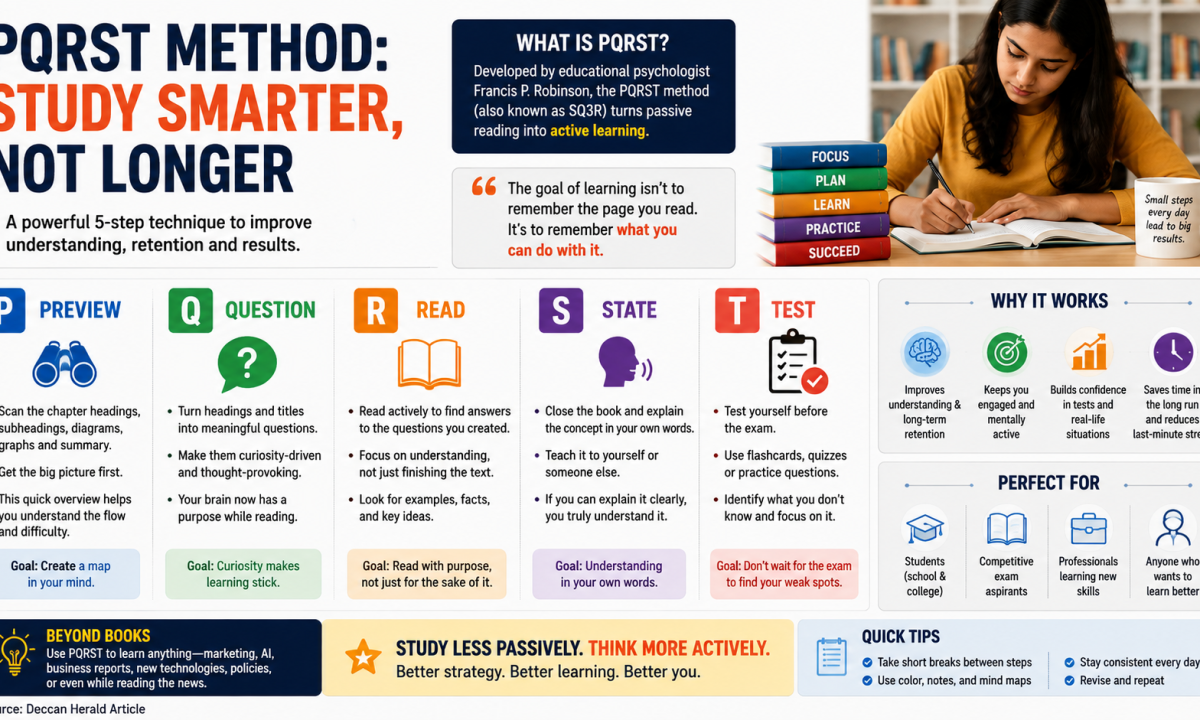
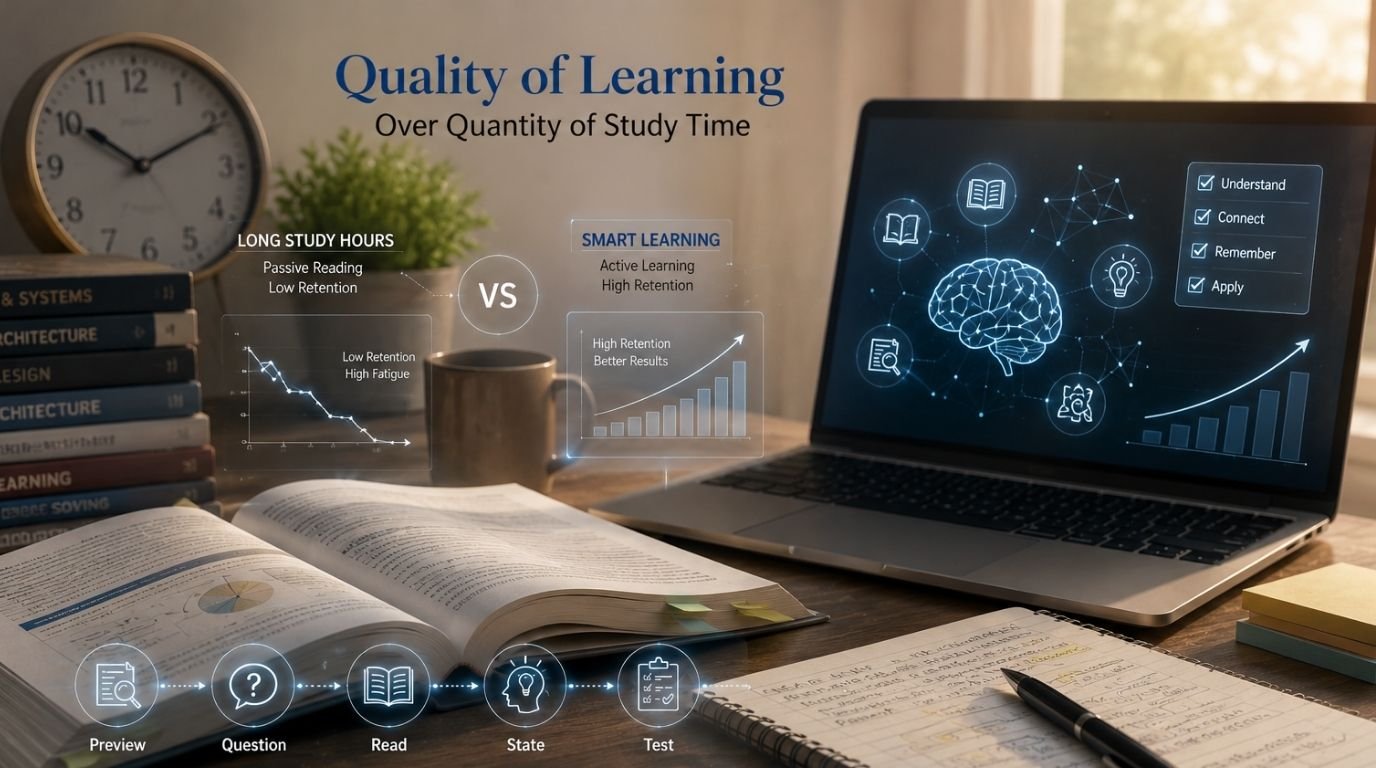
PQRST stands for Preview, Question, Read, State and Test. The idea is simple: instead of passively reading a chapter again and again, students actively interact with what they are learning.
And honestly, I think this approach is useful far beyond school and college.
Preview before you read
The first step is Preview.
Instead of immediately starting from the first paragraph, quickly scan the chapter.
Look at the headings, subheadings, diagrams, graphs, highlighted terms and summary.
I like this idea because it gives your brain a map before you start the journey.
You are no longer reading a random collection of paragraphs.
You are trying to understand how the pieces fit together.
Turn headings into questions
The second step is Question.
Take a heading and turn it into a question.
Instead of reading “Types of Digital Advertising”, ask:
What are the different types of digital advertising and when should each one be used?
That small change completely alters the learning experience.
Now you are not just consuming information.
You are looking for an answer.
And curiosity is a much better learning tool than forced memorisation.
Read with a purpose
Then comes Read.
But there is an important difference.
You are not reading simply to finish the chapter.
You are reading to answer the questions you created.
That forces you to pay attention to the information that actually matters.
For me, this is particularly relevant in professional learning.
Whether I am learning about AI, marketing, technology or business, I find that having a specific question makes the learning process significantly more useful.
State it in your own words
The fourth step is State.
Close the book and explain what you just learned in your own words.
This is probably the most important part.
Because there is a huge difference between:
“I have read this.”
and
“I can explain this.”
If you can explain an idea without looking at your notes, you probably understand it.
If you need the textbook to explain it, you may have only recognised the information rather than learned it.
Test yourself
Finally, Test.
Don’t wait for the exam to discover what you don’t know.
Test yourself before the exam.
Use flashcards. Answer questions. Explain concepts to someone else. Try solving a problem without looking at the answer.
The goal isn’t to prove that you know everything.
The goal is to discover what you don’t know.
And that is incredibly valuable.
Why I think this matters beyond education
The part of the PQRST method that I find most interesting is that it isn’t really just a study technique.
It is a framework for active learning.
We live in a world where information is everywhere.
YouTube can explain almost anything.
AI can summarise almost anything.
Google can find almost anything.
But access to information doesn’t automatically create knowledge.
The real skill is knowing how to process information, question it, explain it and apply it.
That is why I think PQRST is relevant even after college.
Learning a new marketing platform?
Use it.
Reading a business report?
Use it.
Learning AI?
Use it.
Trying to understand a complicated industry?
Definitely use it.
My takeaway
I don’t think the answer to better learning is always another five hours at the desk.
Sometimes, it is simply a better five-step process.
Preview.
Question.
Read.
State.
Test.
Study less passively.
Think more actively.
Because ultimately, the goal of learning isn’t to remember the page you read. It’s to remember what you can do with it.
As the industry shifts, staying informed about digital trends is essential for anyone. Click through to read another thread!