
India’s Startup Funding Is Back — But Is It Really a Recovery?
Theme: Startup Funding, Venture Capital & India’s Tech Ecosystem
Source: Tracxn — Tech Funding Snapshot, August 1–15, 2026
There are numbers that make you pause.
And then there are numbers that make you wonder whether you are looking at a recovery or simply one very large transaction making the entire market look healthier than it actually is.
The latest Indian tech funding snapshot for August 1–15, 2026 falls somewhere in between.

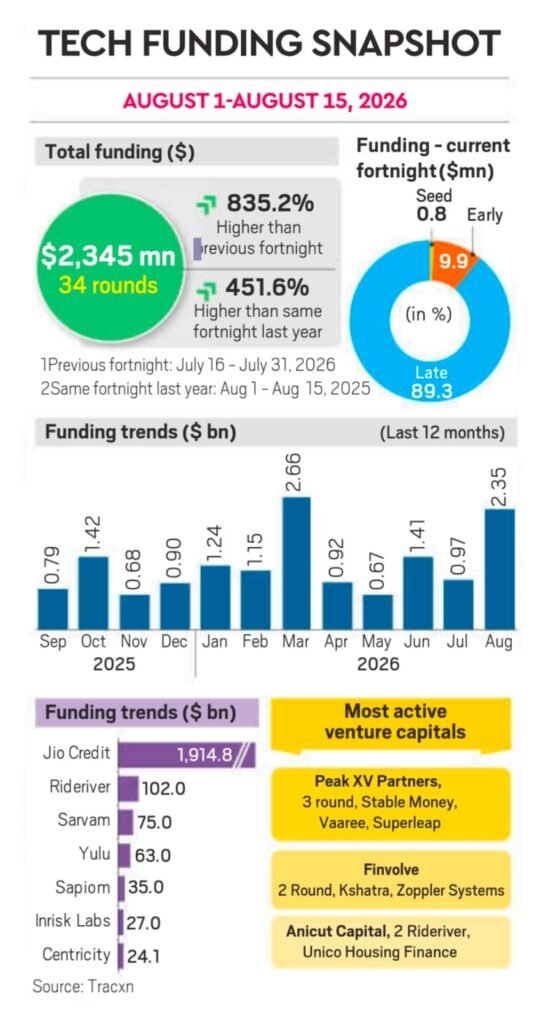
India’s technology ecosystem attracted $2.345 billion across 34 funding rounds during the fortnight. That is an astonishing 835.2% higher than the previous fortnight and 451.6% higher than the same period last year.
On the surface, this looks like fantastic news.
After months of relatively subdued funding activity, the Indian startup ecosystem suddenly appears to have found its appetite for capital again.
But when I look beyond the headline number, the story becomes much more interesting.
One deal changes the entire picture
The biggest number in the snapshot is Jio Credit at $1.9148 billion.
That single transaction accounts for a very significant portion of the total funding recorded during the fortnight.
And this is why I am always cautious when someone tells me that “startup funding is up.”
Up compared to what?
And because of what?
A market can show spectacular growth because of one large funding round without necessarily meaning that hundreds of startups are suddenly finding capital more easily.
That distinction matters.
If we remove the headline-grabbing transaction mentally, the funding environment looks considerably more nuanced.
The other notable deals include Rideriver at $102 million, Sarvam at $75 million, Yulu at $63 million, Sapiom at $35 million, Inrisk Labs at $27 million and Centricity at $24.1 million.
There is certainly activity.
But it is not evenly distributed.
Late-stage capital is dominating
The second number that caught my attention is the stage-wise distribution.
According to the snapshot, 89.3% of the funding went into late-stage companies, while early-stage funding accounted for 9.9% and seed funding just 0.8%.
This tells me something important.
Investors haven’t suddenly become adventurous again.
They appear to be selective.
When capital is uncertain, investors tend to prefer businesses where there is already evidence of scale, revenue, customers, market position or a clearer path to profitability.
And that is exactly what this funding distribution suggests.
The money is moving towards companies that have already crossed several stages of risk.
For early-stage founders, therefore, the funding environment may still be challenging.
The startup funding market is becoming more disciplined
I actually think this is healthy.
The startup ecosystem went through a period where growth was often celebrated more than sustainability.
Raise money.
Hire quickly.
Acquire customers.
Expand aggressively.
Raise another round.
Repeat.
The market has changed.
Today, investors appear to be asking much tougher questions.
How much revenue?
How much burn?
What are the unit economics?
How defensible is the business?
How large is the addressable market?
And most importantly:
What happens when the next round doesn’t arrive?
That last question can completely change how a founder builds a company.
The rise of AI doesn’t mean every startup will get funded
There is another interesting signal here.
Companies such as Sarvam continue to attract significant attention, reflecting the growing interest in India’s AI ecosystem.
But I don’t think we should interpret this as “AI startups are automatically fundable.”
The AI opportunity is enormous.
So is the competition.
Investors are likely to differentiate between companies building genuinely valuable technology and companies simply adding “AI” to their pitch deck.
As someone working in digital marketing and AI education, I see this all the time.
AI is becoming a capability rather than a category.
The question is no longer:
“Are you using AI?”
It is:
“What business problem are you solving better because of AI?”
That is a much harder question.
Venture capital is becoming more concentrated
The snapshot also highlights the most active venture capital firms during the period.
Peak XV Partners appears prominently, with investments including Stable Money, Vaaree and Superleap.
Finvolve and Anicut Capital also feature among active investors.
What this tells me is that the venture capital market is not dead.
It is simply becoming more selective.
The money exists.
The investors exist.
But founders need to demonstrate why their company deserves that money.
And I think that is an important distinction for anyone building a startup in 2026.
What does this mean for founders?
If I were advising a founder today, I would not tell them to chase funding simply because the funding numbers are improving.
I would tell them to build a business that can survive without the next round.
That means focusing on:
Revenue before vanity.
Retention before acquisition.
Unit economics before scale.
Customer value before investor excitement.
And, increasingly, AI-enabled efficiency before simply hiring more people.
A strong funding environment should accelerate a good business.
It shouldn’t be the thing keeping a weak business alive.
What does this mean for marketers?
This is where I think the funding story becomes relevant to my world.
When venture capital becomes more disciplined, marketing budgets become more accountable.
Founders will increasingly ask marketing teams:
“How many leads?”
“How many customers?”
“What is CAC?”
“What is the payback period?”
“What happens to revenue when we increase spending?”
The era of saying “brand awareness” and walking away from the conversation is becoming harder.
Marketing has to connect with business outcomes.
And frankly, I think that is a good thing.
It forces marketers to become better business thinkers.
My takeaway
The $2.345 billion headline is exciting.
The 835.2% fortnight-on-fortnight growth is impressive.
But the numbers underneath the headline tell the more important story.
A large deal has significantly lifted the overall funding figure.
Late-stage companies are receiving the overwhelming majority of the capital.
Seed and early-stage funding remain comparatively small.
And investors appear to be concentrating their bets rather than spraying capital across the ecosystem.
So, is India’s startup funding market back?
I would say yes — but selectively.
The money hasn’t disappeared.
The easy money has.
And perhaps that is exactly what the Indian startup ecosystem needed.
Because the next generation of successful startups may not be the companies that raise the most money.
They may be the companies that know exactly what to do with the money they raise.
As the industry shifts, staying informed about digital trends is essential for anyone. Click through to read another thread!