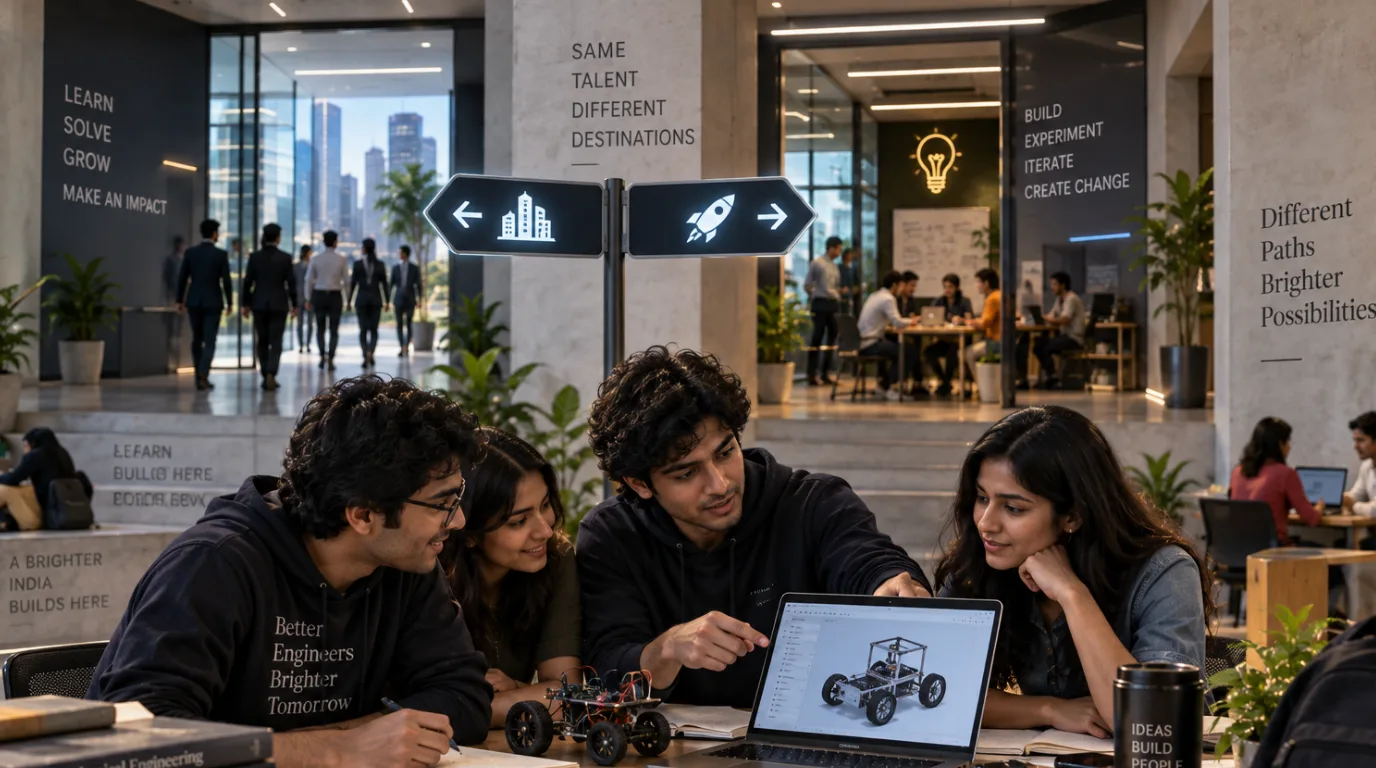

Campus Placements Have a New Choice: Build, Not Just Join
For decades, the conventional engineering-college career journey has been fairly predictable.
Study engineering.
Get placed.
Join a technology company.
Build a career.
For many students, the campus placement season represented the moment when education finally converted into employment.
But I think that equation is beginning to change.
A recent report from Bengaluru points to an interesting shift: more engineering students are exploring entrepreneurship as an alternative to the traditional campus-placement route, helped by an increasingly accessible startup ecosystem and, importantly, by artificial intelligence. Student Entrepreneurship is becoming part of this changing career conversation.
The interesting part isn’t simply that students want to become entrepreneurs.
Students have always wanted to start companies.
What has changed is the cost and complexity of actually attempting it.
Ai has Changed the Economics of Student Entrepreneurship
The biggest change, in my opinion, is that AI is reducing the amount of manpower and resources required to build an early-stage technology product. This is creating new possibilities for Student Entrepreneurship.
Earlier, if I wanted to build a software product, I might need:
- Developers
- Designers
- Researchers
- Product managers
- Content specialists
- Analysts
- Marketing support
Even building a basic prototype could require a reasonably large team.
Today, a small team can use AI across coding, research and product development.
That doesn’t mean AI magically builds a successful company.
It doesn’t.
But it can reduce the amount of repetitive and time-consuming work involved in getting from idea → prototype → first version.
And that changes the risk calculation for a student.
The Old Question: “Who will Hire Me?”
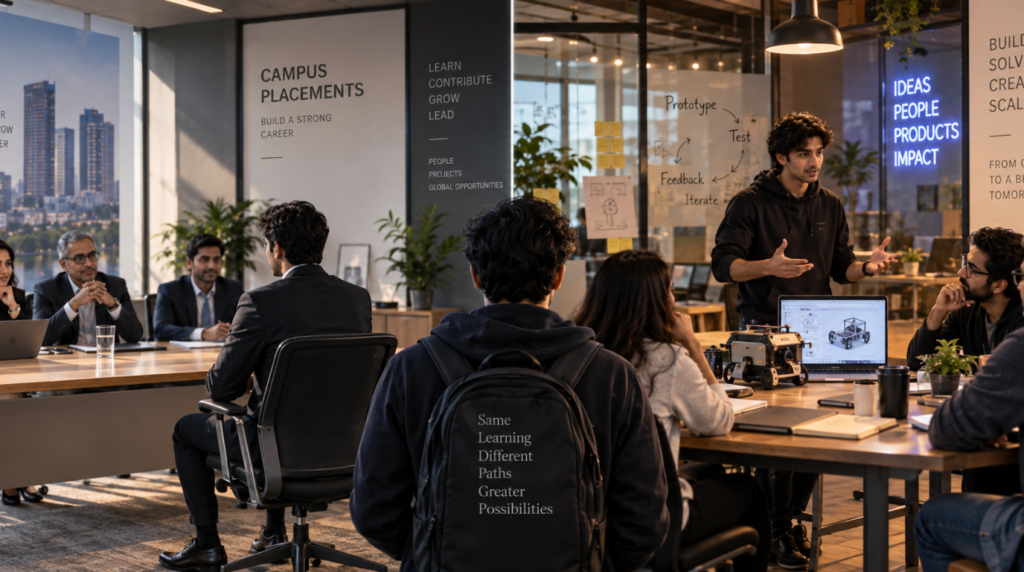
The campus-placement mindset is fundamentally about employment.
The question is:
“Which company will hire me?”
The emerging entrepreneurial mindset asks a completely different question:
“What can I build?”
That is a significant psychological shift.
A student who previously needed a company to provide the infrastructure, technology team and resources to build something can increasingly experiment independently. This is one reason Student Entrepreneurship is becoming more accessible.
They can use AI coding tools to prototype.
They can use AI for research.
They can create presentations and product documentation.
They can test ideas with potential users.
They can build landing pages.
They can analyse competitors.
They can create marketing content.
They can even automate parts of their operations.
The barrier hasn’t disappeared.
But in some areas, the barrier has become lower.
You Don’t Need an Army to Build a Product
One quote highlighted in the article particularly caught my attention:
“You don’t need an army to build something worthwhile anymore.”
I think this captures the change extremely well.
The startup ecosystem has traditionally celebrated the idea of a small founding team.
But AI is potentially making some teams even smaller.
A handful of people can now focus intensely on a problem while using technology to handle tasks that previously required additional manpower.
I think this captures the change in Student Entrepreneurship extremely well.
Instead of starting a company because they have access to a large team, they may be able to start because they have:
An idea + domain knowledge + AI tools + the ability to execute.
That combination can be surprisingly powerful for Student Entrepreneurship.
Entrepreneurship is Also Becoming a Learnable Skill
Another interesting point in the article is the growing demand for AI entrepreneurship courses.
I find this particularly significant.
Entrepreneurship was once largely learned through experience.
You started something.
You made mistakes.
You found customers.
You ran out of money.
You changed direction.
You tried again.
Today, universities and institutions are increasingly creating structured environments around entrepreneurship.
Students can learn about:
- Startup building
- AI product development
- Business models
- Fundraising
- Market research
- Product-market fit
- Incubation
- Mentorship
That doesn’t guarantee entrepreneurial success.
But it can reduce the distance between having an idea and knowing what to do next.
This structured approach can also support Student Entrepreneurship.
Capital is Also More Accessible
The article points to easier access to capital, mentors and incubators as another factor driving student interest.
This is important.
Having an idea is relatively easy.
Building the idea is harder.
Building it into a business is harder still.
And scaling it requires another level of capability.
Access to incubators, mentors and investors can help students understand those different stages.
A student doesn’t necessarily need to figure everything out alone.
This creates an environment where entrepreneurship becomes a more realistic option alongside employment, particularly for Student Entrepreneurship.
But I Wouldn’t Say Campus Placements Are Becoming Irrelevant to Student Entrepreneurship
This is where I think we need some balance.
The rise of student entrepreneurship doesn’t mean everyone should become a founder.
A campus job can provide something that a startup cannot always provide immediately:
Structure.
You get exposure to:
- Teams
- Processes
- Customers
- Corporate decision-making
- Technology infrastructure
- Business operations
- Leadership
- Organisational culture
For some students, joining a company may actually be the best way to learn how businesses operate before eventually starting something of their own in Student Entrepreneurship.
So I don’t see this as:
JOB vs STARTUP
I see it more as:
JOB + ENTREPRENEURSHIP + EXPERIMENTATION
The career paths are becoming less linear.
THE SIDE PROJECT MAY BECOME THE NEW INTERNSHIP
This is where I think things could get particularly interesting.
Imagine a student who spends their final year doing more than attending lectures and applying for jobs.
They build a small AI-powered product.
They launch it.
They get 500 users.
They discover that nobody wants the original product.
They change it.
They get their first paying customer.
Even if that startup eventually fails, the student walks into a job interview with something much more valuable than a certificate.
They have a story.
They can say:
“I identified a problem, built something, launched it, spoke to customers and learned why my first idea didn’t work.”
That is a very different kind of learning.
It also demonstrates how Student Entrepreneurship can create practical learning opportunities.
The New Competitive Advantage May Be Execution
AI is making access to technology more democratic.
That creates an interesting problem.
If everyone can access similar AI tools, then the tools themselves become less of a competitive advantage.
The real differentiator becomes:
What do you do with them?
Two students can have access to the same AI coding tool.
One builds a useless app.
The other identifies a real problem, speaks to users, builds a simple solution and finds a market.
Same technology.
Different outcome.
So I think the future advantage won’t necessarily belong to the person who knows the most AI tools.
It may belong to the person who can identify the right problem and execute consistently.
For Student Entrepreneurship, execution can therefore become an important part of the learning process.
Colleges May Need to Rethink What “Placement Ready” Means

This is perhaps the biggest implication for educational institutions.
For years, colleges have measured employability through placement percentages.
But if students increasingly have multiple career paths, perhaps the definition of career readiness needs to expand.
A student could be:
Job-ready.
Startup-ready.
Freelance-ready.
Product-building-ready.
AI-enabled.
These aren’t mutually exclusive.
A student who understands how to use AI to research, build, market and test an idea may be better prepared for a rapidly changing employment market — whether they eventually join a company or build one.
This broader approach could give Student Entrepreneurship a more visible place within college education.
THE BIGGEST CHANGE IS ATTITUDE
For me, the most interesting part of this story isn’t actually AI.
It is the changing attitude toward risk.
The traditional mindset says:
“First get a job. Then think about starting something.”
The emerging mindset could be:
“Start experimenting while you’re still studying.”
That is a much more interesting proposition.
A student doesn’t necessarily have to drop out of college and build a billion-dollar startup.
They can start small.
Build a product.
Run an experiment.
Create a digital business.
Work with a friend.
Solve a problem on campus.
Build an AI tool for a particular industry.
Test whether anyone will pay for it.
And if it doesn’t work?
They have learned something.
This is where Student Entrepreneurship can become an extension of education rather than simply an alternative to employment.
From Placement Season to Building Season
I think engineering colleges are entering an interesting phase.
The campus placement office may continue to be important.
Companies will continue to hire graduates.
But alongside that, there could be another conversation happening on campus:
“What if you don’t just join a company? What if you build one?”
AI has lowered some of the technical and operational barriers involved in experimentation.
Capital and incubators can provide additional support.
Entrepreneurship education can provide structure.
And students themselves are becoming increasingly comfortable with digital tools.
None of this guarantees that more student startups will succeed.
But it does make experimentation more accessible.
And perhaps that is the real opportunity.
The biggest change AI is bringing to campuses may not be that students are learning to code faster. It may be that more students are beginning to believe they can build something of their own.
For me, that’s a far more interesting transformation than simply improving the campus-placement numbers.
Because the future graduate may no longer ask only:
“Who will give me a job?”
They may also ask:
“What can I build that someone actually needs?”
Startup India’s entrepreneurship resources
As the industry shifts, staying informed about digital trends is essential for anyone. Click through to read another thread!