
Apple’s Next Price Hike Isn’t About Inflation. It’s About AI.
If you’ve been wondering why smartphones keep getting more expensive despite technology becoming more efficient, this chart provides a fascinating answer.
According to recent reports, Apple is planning structural design changes that could heavily influence the final iPhone 18 Pro price to offset the skyrocketing costs of high-performance memory and storage chips. At first glance, that sounds surprising. After all, memory and storage are hardly new technologies.
But here’s what many consumers don’t realize: we’re entering an era where AI is reshaping the economics of hardware. Let’s look at the increased possibility of iPhone 18 Pro price.
The Hidden Cost of AI
For years, AI conversations have focused on software—ChatGPT, Gemini, Claude, Copilot, and countless AI tools. What we rarely discuss is the infrastructure required to power this revolution.
AI models need enormous amounts of high-performance memory and storage. Data centers are buying these components at unprecedented scale. As demand rises, prices follow. The same memory manufacturers supplying AI servers are also supplying smartphone makers.
That means your next phone is indirectly competing with global AI companies for the exact same resources, a reality that is heavily driving up the expected iPhone 18 Pro price.
Why Apple Can’t Ignore It
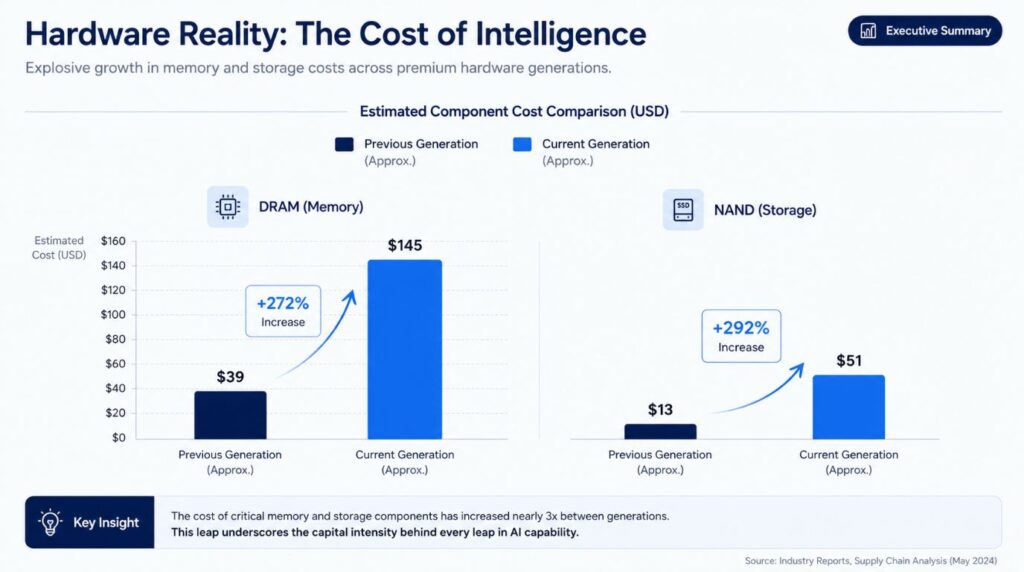
The graphic shows a dramatic jump in memory and storage costs between the iPhone 17 Pro and the upcoming iPhone 18 Pro.
Memory costs reportedly rise from around $39 to $145. Storage costs rise from around $13 to $51.
These aren’t marginal increases in the iPhone 18 Pro price. They’re substantial jumps in two critical components. For Apple, absorbing these costs would mean reducing margins. Historically, that’s not how Apple operates. Instead, it focuses on preserving premium positioning while passing part of the increase to consumers.
The Bigger Story Isn’t Apple
The real takeaway here isn’t simply a change in the iPhone 18 Pro price. It’s the fact that AI is now influencing industries far beyond software.
We’re already seeing AI drive investments in data centers, semiconductors, energy infrastructure, cooling systems, and cloud computing. Now it’s beginning to affect consumer electronics pricing as well.
The AI boom is creating winners and losers across the entire technology supply chain.
Chip manufacturers are winning. Data center providers are winning. Infrastructure companies are winning. Consumers may end up paying more.
What This Means for Marketers
As marketers, we often focus on user behavior and platform changes. But understanding infrastructure trends is becoming equally important.
The next decade won’t just be shaped by better AI tools. It will be shaped by who controls the hardware, chips, energy, and computing power that make those tools possible. The companies building the picks and shovels of the AI gold rush may ultimately benefit more than those simply using AI.
My Take on iPhone 19 Pro Price
For years, smartphone innovation was measured by better cameras, brighter screens, and faster processors. Now a new factor has entered the equation: AI-driven hardware demand.
If the final iPhone 18 Pro price launches with a noticeable increase, it won’t be because the device is radically redesigned from the previous year. It will simply be because the world is consuming more computing power than ever before.
The irony is fascinating.
Most people will blame Apple for the increased iPhone 18 Pro price. The real reason might be that millions of people are asking AI to generate text, images, code, and videos every single day. And someone has to pay for the chips that make all of that possible.
As the industry shifts, staying informed about the latest tech news is essential for anyone. Click through to read another thread!