

The Internet Is Getting Smaller. Should We Be Worried?
For years, the internet was celebrated as the ultimate platform for free expression, open access, and limitless information. But the data in this report paints a different picture. The conversation surrounding internet censorship in India has evolved drastically as website blocking directives have grown significantly over the last decade, while social media platforms continue to face increasing takedown requests.
Looking at the numbers, one thing is clear: content moderation is no longer an exception. It has become a core part of how the internet operates.
The Rise of Website Blocking
In 2014, there were just 471 directives to block websites. By 2024, that number had crossed 9,800. Even though 2025 data is only partial, thousands of directives have already been issued. This rapid escalation highlights how Internet Censorship in India operates quietly in the background, far beyond public view.
What stands out is that websites are being blocked far more frequently than apps. While app bans often make headlines because they affect millions of users overnight, website restrictions happen quietly in the background and rarely attract public attention.
Most internet users may never even realize that a website has disappeared from their digital world.
Social Media Platforms Under Pressure
The second chart reveals another interesting trend.
Facebook and X (formerly Twitter) have consistently received the largest share of takedown directives. In recent years, X has emerged as the platform facing the highest proportion of content removal requests.
This reflects a broader reality within the context of Internet Censorship in India: social media platforms have become the modern public square.
Political discussions, activism, breaking news, entertainment, and public opinion now live on these platforms. As a result, governments, regulators, and courts increasingly view them as spaces requiring oversight and intervention.
The challenge is finding the balance between preventing harm and preserving open conversation.
Government Directives vs Court Orders
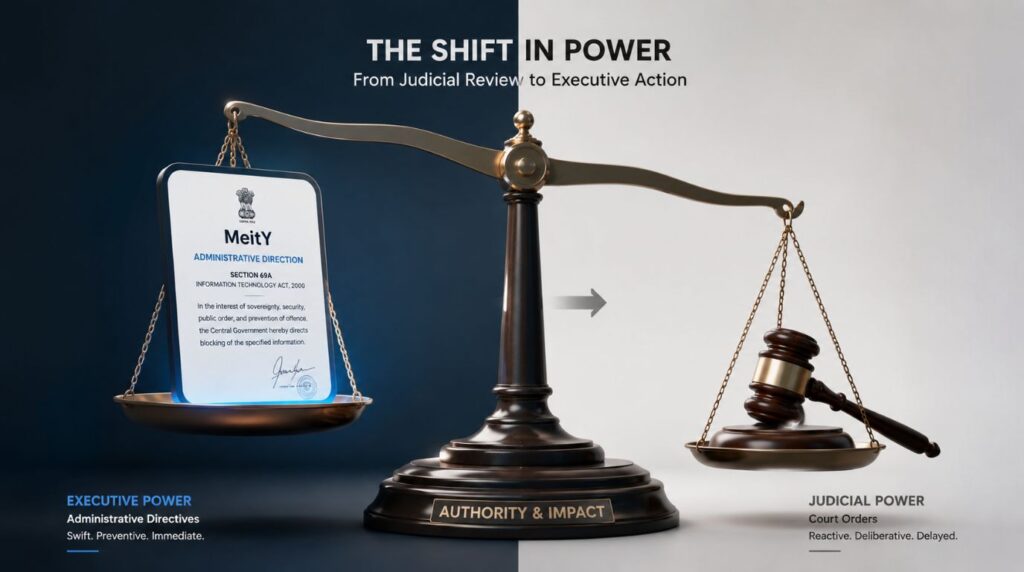
One of the most significant insights from the report is the growing role of administrative authorities in issuing blocking directives.
The Ministry of Electronics and Information Technology (MeitY) accounts for a substantial share of website blocking orders, often exceeding court-ordered actions.
This shift in administrative execution highlights how the framework of Internet Censorship in India is shifting from judicial oversight to executive decision-making.
Should decisions about online content primarily come from courts after legal review? Or should governments have the flexibility to act quickly when national security, misinformation, or public safety concerns arise?
There are valid arguments on both sides.
Speed is important during crises. But transparency and accountability are equally important when restricting access to information.
What This Means for Businesses

For brands and marketers, the rise of internet censorship in India is more than a policy discussion. Digital platforms are no longer guaranteed distribution channels.
Businesses that rely heavily on a single platform face increasing risks from regulatory changes, algorithm updates, content restrictions, and compliance requirements.
The lesson is simple: diversify.
Build owned assets such as websites, email databases, customer communities, and first-party data. Companies that depend entirely on third-party platforms are placing their future in someone else’s hands.
What This Means for Users
As internet users, we often assume the web is permanent. It isn’t.
Content can be removed. Websites can disappear. Accounts can be suspended. Platforms can change policies overnight. This doesn’t mean censorship is always wrong or moderation is always bad. Harmful content, scams, illegal activities, and misinformation do require action.
However, when discussing Internet Censorship in India, the real question is how these decisions are made and whether the process remains transparent, accountable, and open to scrutiny.
My Take on Internet Censorship in India
I believe we’re entering a new phase of the internet.
The first phase was about unlimited growth. The second phase was about social media dominance. The third phase appears to be about governance, regulation, and control, redefining how we think about Internet Censorship in India.
The internet isn’t becoming smaller because people are using it less. It’s becoming smaller because access, visibility, and content distribution are increasingly being shaped by platforms, regulators, and policies.
For businesses, the answer is resilience. For users, the answer is awareness. And for policymakers, the challenge is ensuring that safety doesn’t come at the cost of openness. Because once information disappears, most people never notice it was there in the first place.
As the industry shifts, staying informed about digital trends is essential for anyone. Click through to read another thread!