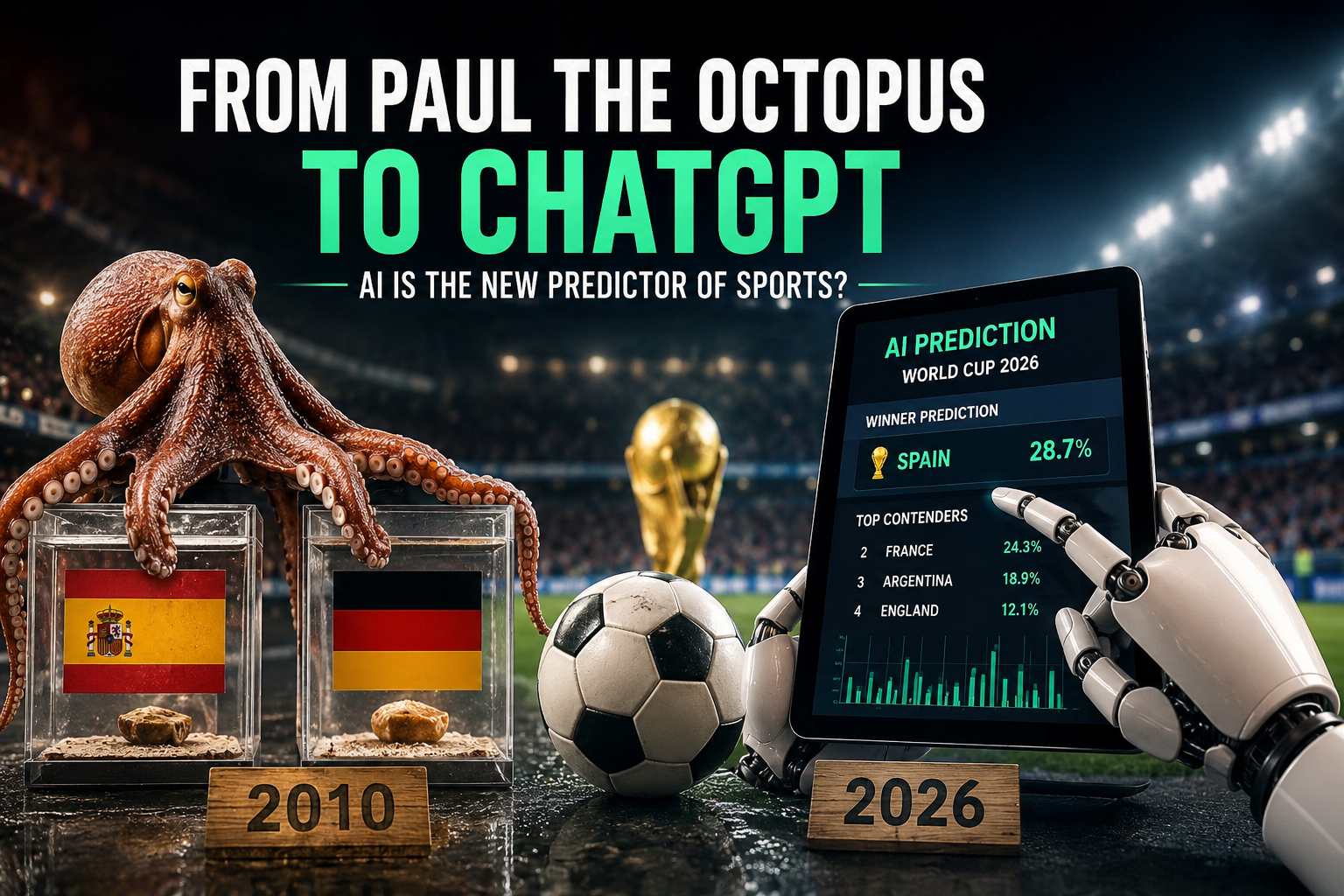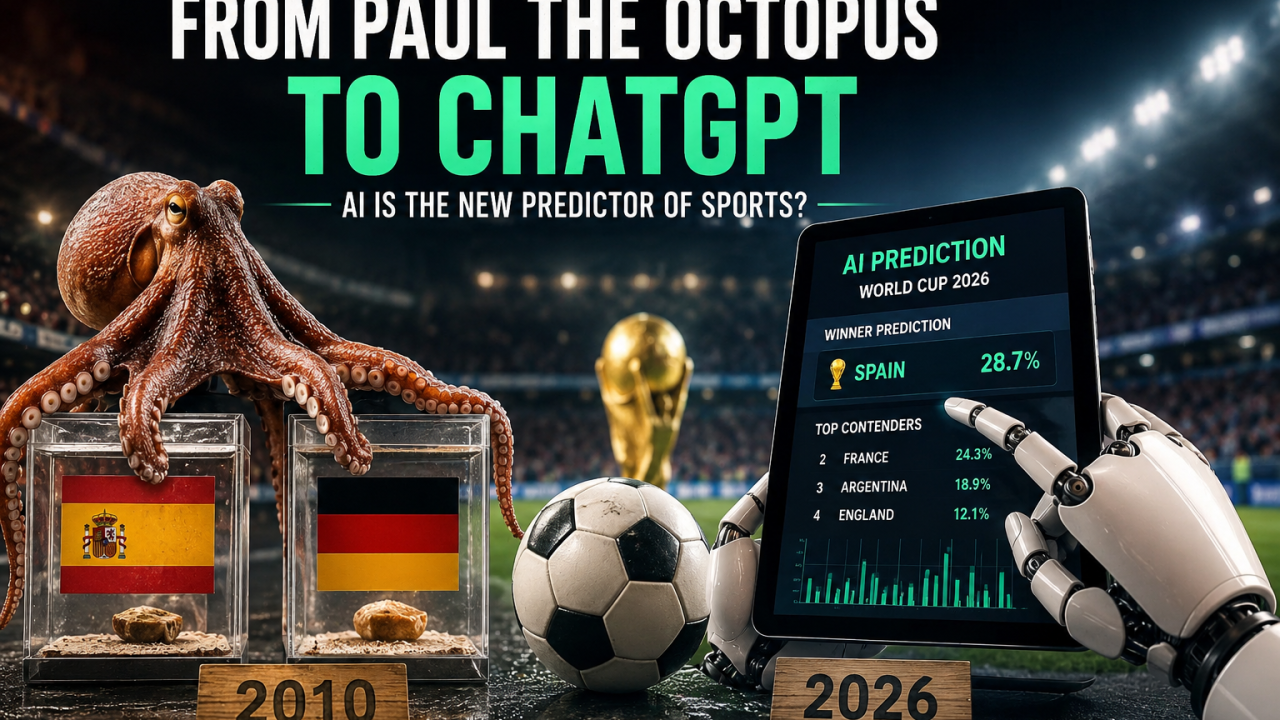

From Paul the Octopus to ChatGPT: Has AI Become the New Fortune Teller of Sports?
There was a time when the world’s most famous sports predictor wasn’t a statistician, analyst, or betting expert.
It was an octopus.
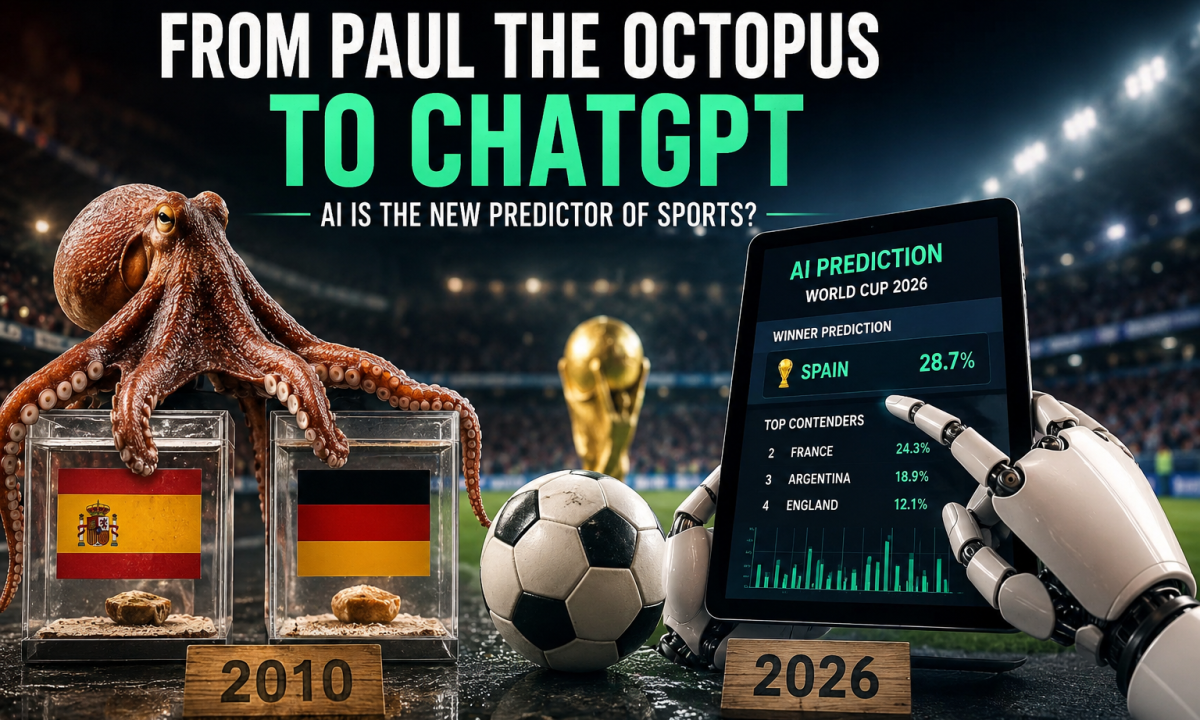
Yes, Paul the Octopus, who rose to global fame during the 2010 FIFA World Cup by correctly “predicting” match outcomes after choosing between food containers marked with competing nations’ flags.
Fast forward to 2026, and we’ve upgraded from marine life to machine intelligence.
Today, football fans are asking ChatGPT, Claude, Le Chat, DeepSeek, and other AI systems to predict World Cup winners, match scores, and tournament outcomes.
The question is:
Have we replaced Paul the Octopus with AI?
Why Fans Love Predictions
Sports fans have always been obsessed with predictions.
Before every major tournament, people want answers:
- Who will win?
- Who will be the top scorer?
- Which team is the dark horse?
- Who will choke under pressure?
Predictions are part of the entertainment.
They’re less about certainty and more about participation.
Everyone wants to feel like they saw the future before it happened.
AI Is the New Crystal Ball
Unlike Paul the Octopus, AI doesn’t pick teams based on seafood preferences.
Modern AI models can analyze:
- Historical performance
- Team rankings
- Player statistics
- Injury reports
- Recent form
- Tactical matchups
- Tournament history
In theory, this should make predictions smarter.
And often it does.
But there’s a catch.
Football Doesn’t Care About Data
If sports were entirely predictable, bookmakers wouldn’t exist.
Football remains one of the most unpredictable games in the world.
A red card.
A missed penalty.
An injury.
A moment of individual brilliance.
Any of these can destroy even the most sophisticated prediction model.
That’s why AI predictions should be viewed as educated probabilities rather than guarantees.
AI can tell you what is likely.
Sports exist to remind us that unlikely things happen all the time.
The Real Value of AI Isn’t Prediction
Personally, I think we’re asking the wrong question.
The most interesting thing about AI isn’t whether it can correctly predict the winner.
The real value lies in helping fans understand the game better.
Imagine asking AI:
- Why is Spain favored?
- What tactical advantage does France have?
- Which player matchup could decide the final?
- How does Argentina compare historically?
These insights are often more valuable than a simple prediction.
AI Has Become Part of Fan Culture
What’s fascinating is how quickly AI has become part of everyday conversations.
A few years ago, fans debated predictions with friends.
Today they debate predictions from AI models.
One chatbot picks Spain.
Another picks France.
A third chooses Argentina.
And suddenly AI-generated opinions become part of the pre-match banter.
That’s a remarkable cultural shift.
The Human Element Still Wins
No matter how advanced AI becomes, sport remains beautifully human.
AI can analyze millions of data points.
It cannot fully measure:
- Pressure
- Passion
- Momentum
- Crowd energy
- Leadership
- Belief
Those factors continue to produce sporting miracles that no algorithm can perfectly predict.
And that’s exactly why we keep watching.
Final Thoughts
The journey from Paul the Octopus to ChatGPT says a lot about how technology has evolved.
We’ve gone from animal instincts to advanced algorithms.
Yet the goal remains exactly the same:
Trying to predict something that may never be fully predictable.
AI may be smarter than an octopus.
It may process more information than any human analyst.
But when the referee blows the whistle, football still has a habit of surprising everyone.
And thankfully, not even artificial intelligence can change that.
One thing is certain: whether the prediction comes from an octopus, a pundit, or an AI chatbot, football fans will continue arguing about it long after the match is over. ⚽🤖🐙