


Experts are calling today the dark patterns in e-commerce responsible for the hidden tricks behind your online shopping cart. Let’s dive into it!
Ever Felt Like an App Was Nudging You to Buy Faster?
You’re browsing a travel website.
A message pops up: “Only 2 seats left!”
A timer starts counting down. A premium option is already selected for you. And suddenly, you’re rushing to complete a purchase you hadn’t even planned on making.
If this sounds familiar, you’re not imagining things.
A recent report by Datum Intelligence suggests that many digital platforms continue to rely on what are known as dark patterns in e-commerce—design techniques that subtly influence users into making decisions that benefit the platform more than the customer.
What Exactly Are Dark Patterns in E-Commerce?
Dark patterns in e-commerce are user interface tricks designed to manipulate behavior. They don’t force you to do something. Instead, they make certain choices easier, more urgent, or more attractive than others.
Think of them as the digital equivalent of a salesperson standing behind you saying: “Are you sure you want to miss this deal?”
every few seconds.
The Surprising Data on Dark Patterns in E-Commerce
According to the report:
- 73% of platforms still deploy forced-action designs.
- 69% continue using drip-pricing tactics.
- Several major e-commerce and travel platforms continue to face trust-related concerns.
You see a product priced at ₹999. By checkout, it becomes ₹1,399 after fees, handling charges, convenience charges, platform fees, and assorted mysterious additions.
The final price was never really ₹999.
Artificial Scarcity
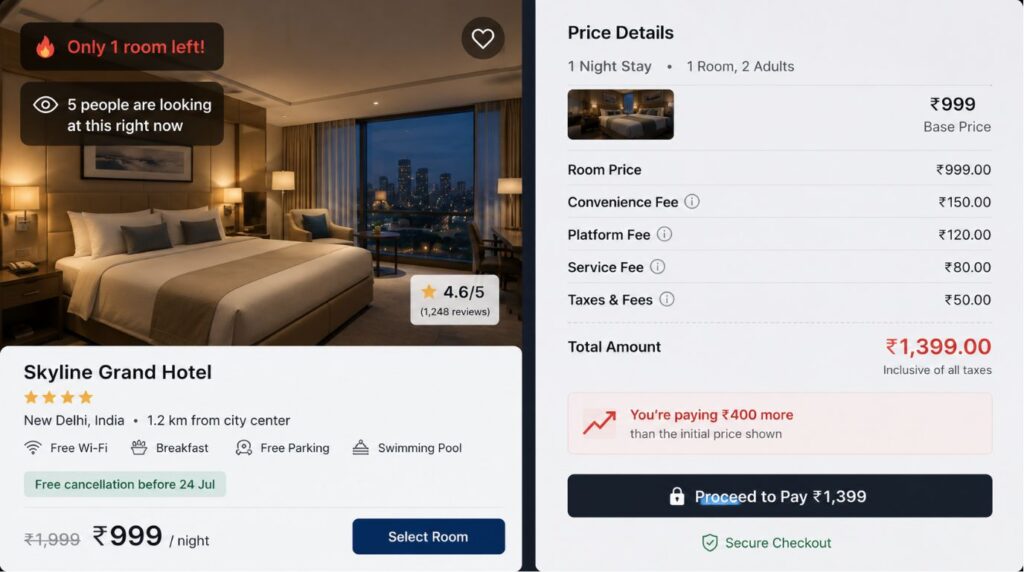
“Only 1 room left.”
“Only 3 people viewing this.”
“Sale ends in 5 minutes.”
Sometimes these messages are genuine. Sometimes they’re simply designed to create urgency.
Forced Actions
Want to read an article? Create an account first.
Want to cancel a subscription? Click through six different screens.
Want to continue? The bright green button is impossible to miss.
Why This Matters for Marketers
As someone who works in marketing, I find this fascinating. For years, marketers have been obsessed with conversion rates. However, deploying dark patterns in e-commerce is a short-term hack that destroys long-term customer lifetime value.
The problem is that not every conversion tactic builds trust. A user may purchase once because of pressure. They return because of trust.
And trust compounds far longer than manipulation.
The Real Competitive Advantage Is Trust
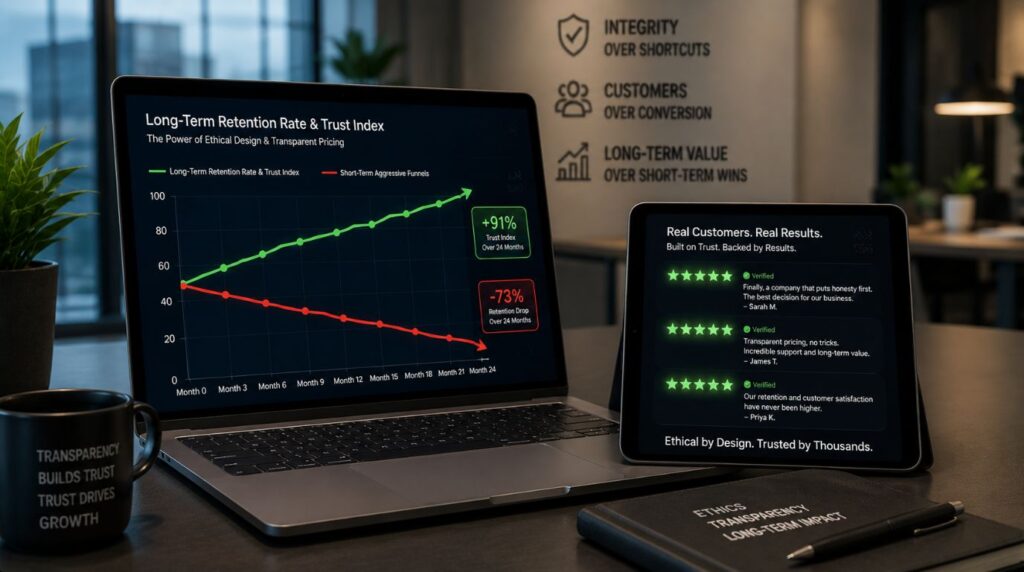
One insight from the report stood out to me. Consumers are increasingly becoming aware of these tactics. That changes everything.
The internet of 2015 rewarded clever growth hacks. The internet of 2026 rewards transparency.
Customers today can compare prices instantly, read reviews within seconds, and publicly expose bad practices. In a world where information travels at lightning speed, trust has become one of the most valuable business assets.
What Businesses Should Learn
The lesson isn’t that urgency is bad. The lesson is that fake urgency is bad. The lesson isn’t that persuasion is wrong. The lesson is that manipulation eventually backfires.
The brands that win over the next decade won’t necessarily be the ones with the most aggressive funnels. They’ll be the ones customers genuinely trust.
Final Thoughts on Dark Patterns in E-Commerce
Every click, notification, countdown timer, and checkout screen influences consumer behavior.
The question businesses should ask isn’t: “Can we increase conversions?”
The better question is: “Can we increase conversions without reducing trust?”
Because the easiest sale is often the one you force. The most valuable sale is the one customers are happy to repeat. And in the long run, trust always scales better than tricks.
As the industry shifts, staying informed about digital trends is essential for anyone. Click through to read another thread!