
India’s Startup Funding Has Slowed. The Real Question Is: Is That a Bad Thing?
A lot of analysts look at recent market snapshots and immediately conclude that India’s startup ecosystem is in trouble. However, when you analyze Indian startup funding trends with a long-term lens, a very different picture emerges.
The latest funding snapshot (July 16–31, 2026) shows that Indian startups raised $246 million across 30 rounds. That’s a 65.17% decline compared to the previous fortnight and 53.08% lower than the same period last year.
At first glance, these numbers appear worrying. But startup ecosystems shouldn’t be judged every two weeks.
Summary: Smart Capital Builds Stronger Companies
Every market correction feels like a crisis while you are living through it. Years later, history usually views these corrections as the exact moments that separated temporary trends from generational companies.
India maintains world-class founders, expanding digital infrastructure, massive consumer demand, and active global investor interest.
The era of easy money has slowed, but smart money continues to flow. Over the long run, analyzing Indian startup funding trends proves one thing: smart capital builds far stronger companies than easy money ever could.
The Shift in Indian Startup Funding Trends: From Growth to Profitability
The era of “growth at any cost” is officially over. When observing Indian startup funding trends, the real story isn’t about capital scarcity; it is about capital discipline.
Investors today aren’t asking, “How fast can you grow?”
They’re asking:
- Can you become profitable?
- Can customers stay without discounts?
- Does your product solve a genuine problem?
- Can your business survive without constant fundraising?
This structural evolution in Indian startup funding trends creates a far healthier foundation for long-term entrepreneurship.
The funding mix tells an interesting story
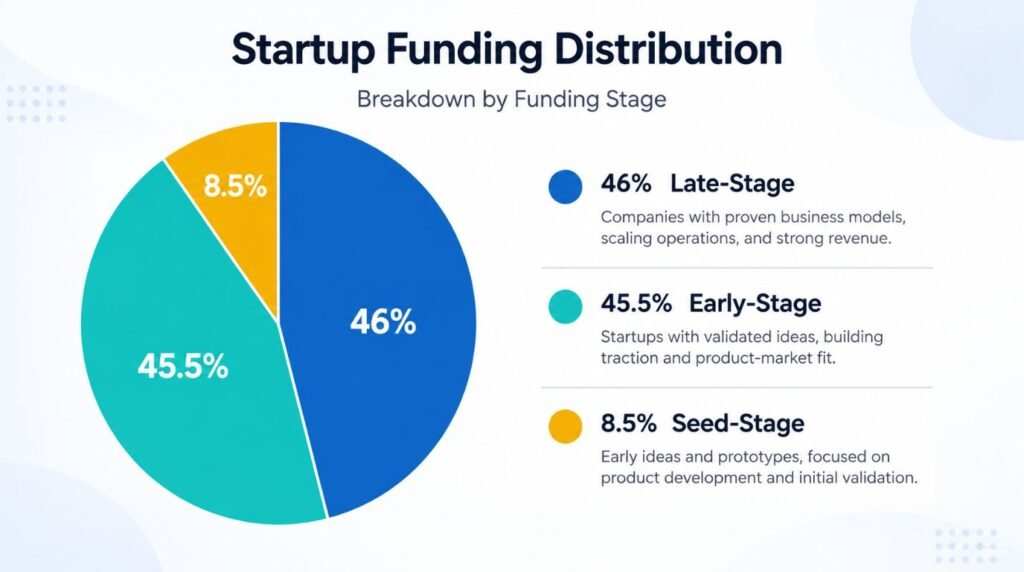
The distribution of capital across stages tells a compelling story about current Indian startup funding trends: Nearly 46% of funding went into late-stage startups, while 45.5% was invested in early-stage companies. Seed funding accounted for only 8.5%.
This suggests that investors are backing companies with stronger validation while continuing to support promising early ventures.
Capital hasn’t vanished. It’s simply become more disciplined.
Look at who’s getting funded.
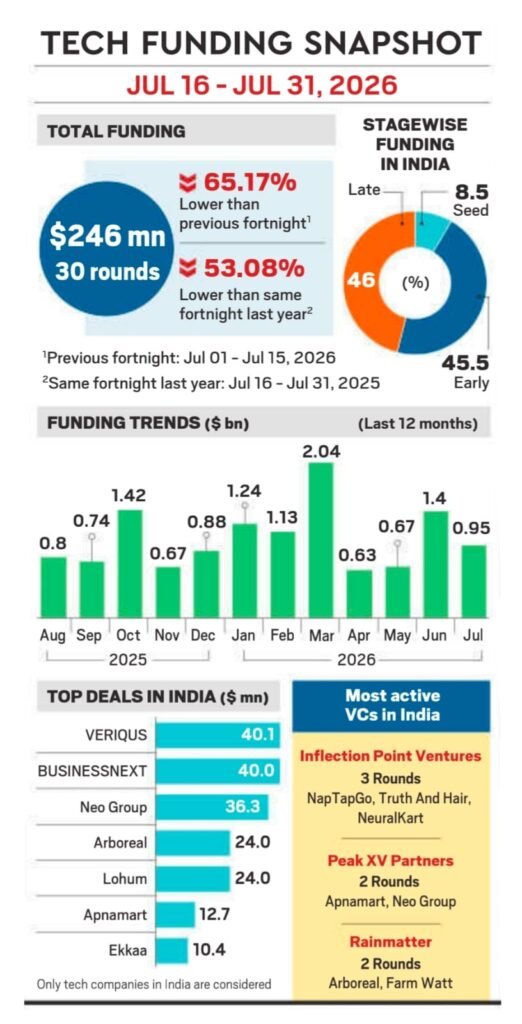
Companies like Veriqus, BusinessNext, Neo Group, Arboreal, Lohum and Apnamart continue attracting capital because they’re solving real problems across enterprise software, sustainability, financial services and manufacturing.
Notice something?
The biggest funding rounds aren’t necessarily going to the loudest startups. They’re going to businesses with measurable value.
Venture capital is evolving too.
Firms like Inflection Point Ventures, Peak XV Partners and Rainmatter remain among the most active investors.
This indicates that quality capital is still available. The difference is that founders now need stronger business fundamentals before receiving it.
What Current Indian Startup Funding Trends Mean for Founders
If you’re building a startup today, don’t optimise for headlines.
Optimise for:
- Customer retention
- Revenue quality
- Unit economics
- Operational efficiency
- Sustainable growth
Fundraising should be the outcome of building a great business—not the business model itself.
What this means for marketers
Marketing teams will also need to adapt. Easy funding once allowed startups to spend aggressively on customer acquisition.
Today, every marketing rupee is under scrutiny. The focus is shifting toward:
- Organic growth
- Performance marketing with measurable ROI
- Retention over acquisition
- Community building
- Brand trust instead of vanity metrics
Marketing is becoming accountable again. And honestly, that’s good for the industry.
My Take
Every correction feels like a crisis while you’re living through it. Years later, it often looks like the moment that separated sustainable companies from temporary ones.
India still has world-class founders, a massive digital economy, growing consumer demand, and strong investor interest.
The easy money may have slowed. But smart money is still flowing. And in the long run, smart money builds stronger companies than easy money ever could.
Source: Tracxn Tech Funding Snapshot
As the industry shifts, staying informed about digital trends is essential for anyone. Click through to read another thread!