

AI Spending Is Bigger Than the Number on the Balance Sheet
Theme: The hidden cost of the AI infrastructure race
I have been following the AI spending story for some time now, and one thing keeps becoming clearer: the amount companies say they are spending on AI may be only the visible part of the bill.
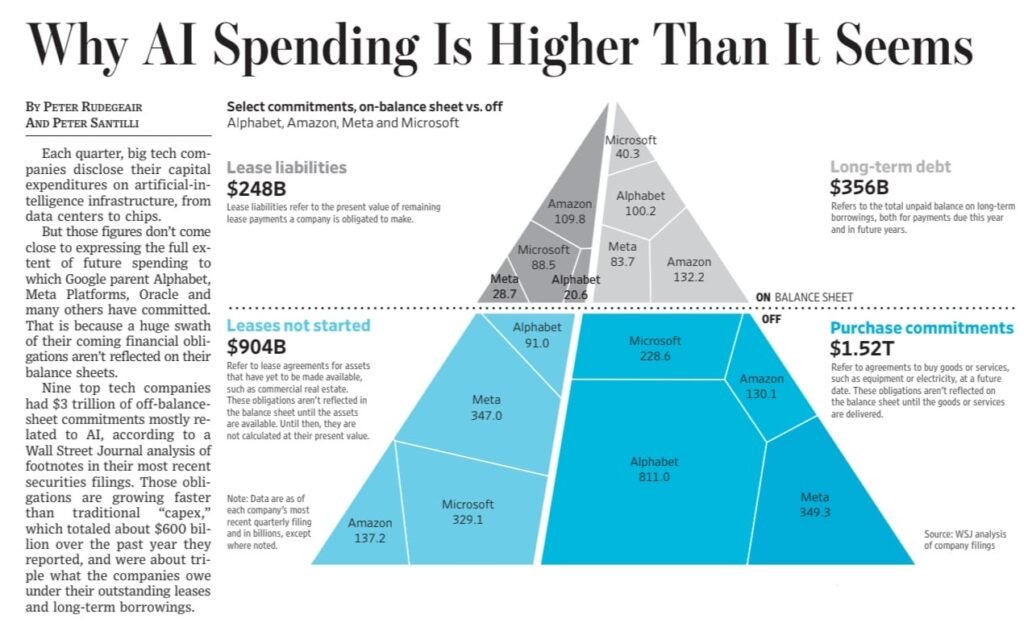
The graphic shared above, based on a Wall Street Journal analysis of company filings, makes this particularly interesting. Alphabet, Amazon, Meta and Microsoft are not only spending billions on data centres, chips and other AI infrastructure; they are also making enormous commitments that may not immediately appear as conventional capital expenditure on their balance sheets.
And that changes how I look at the AI boom.
The AI bill doesn’t end with CapEx
When we talk about AI spending, the conversation usually revolves around capital expenditure.
How much is Microsoft spending?
How much is Meta investing?
How many data centres is Amazon building?
How many GPUs are companies buying?
But the analysis highlights another layer: off-balance-sheet commitments.
According to the graphic, the selected companies have:
- $248 billion in lease liabilities
- $904 billion in leases not yet started
- $1.52 trillion in purchase commitments
- $356 billion in long-term debt
The striking number for me is the $1.52 trillion in purchase commitments.
These aren’t necessarily expenses that have already hit the books. They represent agreements to buy goods or services, equipment or electricity at a future date.
Similarly, leases that haven’t started yet aren’t sitting there as conventional current expenditure.
But the obligations are real.
And that’s where the AI spending story gets much more interesting.
The companies are essentially building the future before it arrives
AI infrastructure requires enormous physical infrastructure.
Data centres.
Servers.
Chips.
Networking equipment.
Power.
Real estate.
Cooling.
Electricity.
And all of this needs to be secured years before the final AI product reaches the consumer.
That means companies aren’t simply spending money on today’s AI products. They are making financial commitments based on what they believe tomorrow’s AI economy will look like.
Alphabet, Amazon, Meta and Microsoft are effectively betting that the demand for AI will be large enough to justify this infrastructure.
That is an enormous bet.
And it is also why I think looking only at quarterly advertising revenue, cloud revenue or AI-related product launches doesn’t tell us the complete story.
This is where the AI race becomes a business strategy story
For marketers, this may initially sound like a finance discussion.
I don’t think it is.
The infrastructure race will eventually influence almost everything we do in digital marketing.
More AI infrastructure means more computing capacity.
More computing capacity means more AI products.
More AI products mean more automation.
More automation means changes in search, advertising, content creation, analytics, customer service and commerce.
We are already seeing pieces of this transformation.
AI is moving from being a tool that marketers use to becoming infrastructure that platforms build their businesses around.
That distinction is important.
But there is another side to the story
Whenever I see numbers running into hundreds of billions or trillions of dollars, my first question is simple:
What happens if the expected demand doesn’t arrive quickly enough?
This is the uncomfortable part of the AI story.
Companies are committing huge amounts of money based on expectations of future demand. If AI adoption accelerates, these investments could look incredibly smart.
But if adoption, monetisation or enterprise spending grows more slowly than expected, companies could find themselves carrying enormous infrastructure commitments.
In other words, AI doesn’t just represent technological risk. It represents capital-allocation risk.
The companies aren’t merely asking, “Can we build this?”
They are also asking, “Will customers eventually pay enough for this to make the investment worthwhile?”
What does this mean for marketers?
I see three important implications.
1. AI is becoming infrastructure, not just software
We should stop thinking about AI purely as another productivity tool.
The biggest technology companies are investing in an entire ecosystem around it.
That means AI will increasingly become embedded into advertising platforms, search engines, productivity software, cloud services and consumer products.
For marketers, learning how these ecosystems work will become just as important as learning individual AI tools.
2. The cost of AI will eventually influence monetisation
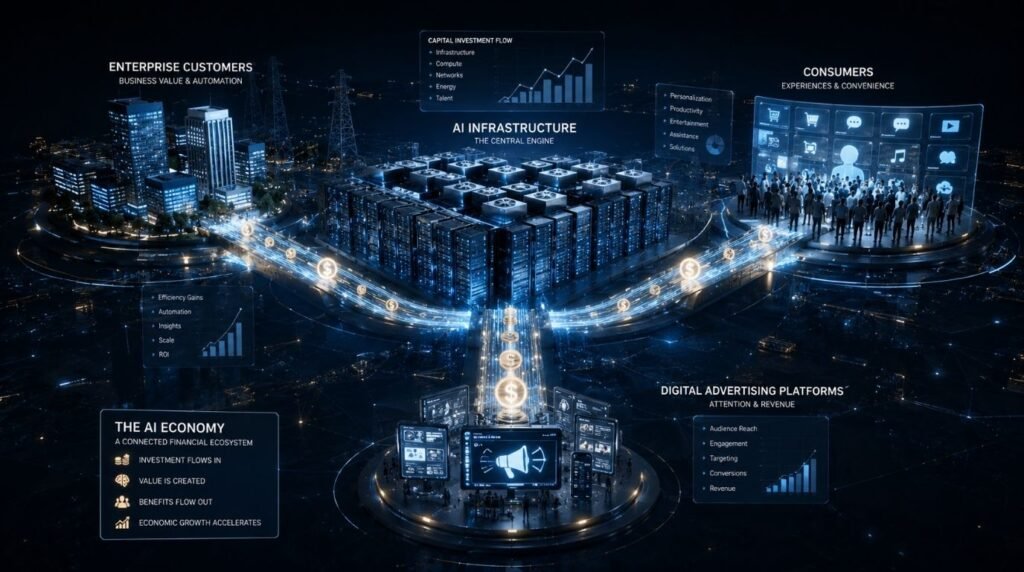
Someone has to pay for all this infrastructure.
That could be enterprises through cloud subscriptions.
Consumers through premium products.
Advertisers through advertising platforms.
Or some combination of all three.
This is why I expect the AI business model conversation to become much more important over the next few years.
Free AI is great.
But trillion-dollar infrastructure cannot be supported by enthusiasm alone.
3. Don’t confuse AI adoption with AI economics
This is perhaps my biggest takeaway.
People using AI does not automatically mean AI companies are making money.
Businesses experimenting with AI does not automatically mean those investments will generate sufficient returns.
And a company committing billions to AI does not necessarily mean that the spending will translate into proportional revenue.
Usage, revenue and profitability are three different things.
I think marketers need to keep that distinction in mind as AI becomes increasingly integrated into our work.
My takeaway
The AI race is no longer just about who has the smartest model.
It is about who can afford to build, operate and monetise the infrastructure required to run those models at enormous scale.
The graphic makes one thing very clear to me: the visible AI spending number is only part of the story.
Behind the data centres, GPUs and AI products are leases, purchase commitments, power agreements and long-term financial obligations.
And that makes the current AI boom both exciting and slightly uncomfortable.
Because the biggest question isn’t whether companies are willing to spend billions on AI.
They clearly are.
The real question is whether the AI economy that eventually emerges will be big enough to justify the bill.
And as a marketer, that’s the part of the AI story I will be watching most closely.
Source: The Wall Street Journal analysis of company filings, as referenced in the supplied graphic.
As the industry shifts, staying informed about AI trends is essential for anyone. Click through to read another thread!