

WHEN AI STARTS SHOPPING FOR US, WHAT HAPPENS TO COMMERCE?
WHEN AI STARTS SHOPPING FOR US, WHAT HAPPENS TO COMMERCE? Theme: Agentic Commerce and the Rise of AI-Powered Shopping There was a time when online shopping meant opening an app, searching for a product, comparing prices, reading reviews and finally clicking “Buy Now.”
Then came recommendations. Then personalised feeds.
And now we are entering something much more interesting: a world where the AI may do the shopping for us. A recent development involving Mastercard and fintech startup Alchemy caught my attention because it takes the idea of AI-powered commerce one step further. Instead of an AI simply recommending what I should buy, an AI agent could potentially make the purchase on my behalf within rules and spending limits that I have set.
For me, this development in Agentic Commerce is much bigger than another payment innovation. It could fundamentally change the relationship between consumers, brands, marketplaces and advertising platforms.
FROM SEARCHING TO DELEGATING Today, I still have to tell Amazon, Flipkart, Myntra or any other marketplace what I want. I search, compare, filter and read reviews.
Agentic Commerce Potentially Changes that Behaviour Completely.
Instead of saying: “Find me running shoes under ₹8,000.” I could eventually say: “I need running shoes suitable for daily running. Keep the budget below ₹8,000, buy from a trusted retailer and choose the best option.”
The AI then searches, evaluates available options and potentially completes the transaction. The distinction is important. This isn’t simply AI-assisted shopping.
It is moving towards AI-directed shopping driven by Agentic Commerce. And that creates a completely new layer between the consumer and the merchant. THE SHOPPER MAY NO LONGER BE THE PERSON CLICKING “BUY”
This is where things get particularly interesting for marketers. For decades, digital marketing has been designed around human behaviour. We optimise:
- Search keywords
- Product pages
- Meta ads
- Google Ads
- Recommendations
- Email campaigns
- Retargeting
- Checkout experiences
- Calls to action
Essentially, we are trying to influence a human being to make a decision.
But What Happens when the Decision-Maker is Increasingly An AI Agent?
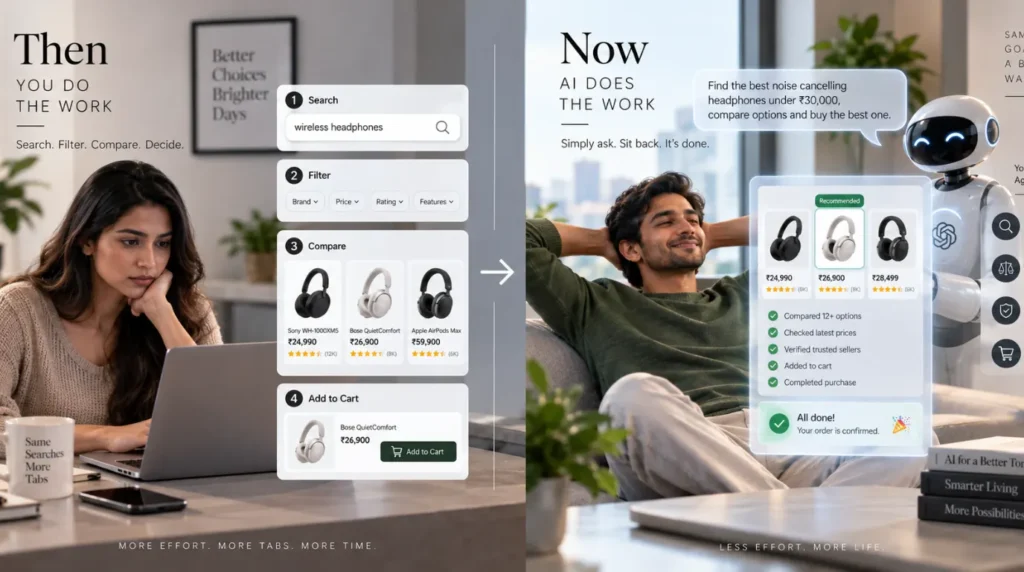
As Agentic Commerce grows, the AI doesn’t necessarily care about a beautifully designed banner.
It may care about:
Price.
Availability.
Reviews.
Delivery time.
Product specifications.
Brand reliability.
Return policies.
Consumer preferences.
Purchase history.
That could completely change what “good marketing” means in the era of Agentic Commerce.
SEO MAY HAVE A NEW COMPETITOR: AEO FOR AGENTS We have already spent years talking about SEO. Then came voice search.
Then AI search. Now I think marketers need to start thinking about another question: Can an AI agent understand and recommend my product? A human may look at a product page and think: “This looks premium.” An AI agent operating in Agentic Commerce may instead evaluate: “Does this product meet the user’s requirements?” That means product data suddenly becomes extremely important.
- Clean product feeds.
- Accurate specifications.
- Structured information.
- Transparent pricing.
- Availability.
- Reviews.
- Shipping information.
- Return policies.
- Compatibility information.
All of these could become part of the machine-readable reputation of a brand. The product page may no longer be designed only for humans.
It may increasingly need to be designed for machines making decisions on behalf of humans under the Agentic Commerce framework.
THEN THERE IS THE BIG QUESTION: WHO PAYS?

The Mastercard-Alchemy example is particularly interesting because the AI agent can potentially be given a virtual card with restrictions. For example, a consumer could establish rules around: How much the agent can spend. What categories it can purchase. Which merchants it can use. What types of transactions require approval.
That introduces an important concept: Permission-based commerce. Instead of giving an AI unrestricted access to your money, consumers could give it a defined shopping mandate. This could make Agentic Commerce more practical because the consumer doesn’t have to approve every individual action.
The consumer establishes the rules. The agent executes within those rules.
WHAT HAPPENS TO IMPULSE PURCHASES?
This is where I think marketers should pay particular attention. A huge part of modern digital commerce is built around impulse.
“Only 2 left.” “Sale ends tonight.”
“People are viewing this right now.” “Recommended for you.” “Buy it before it’s gone.”
These techniques work because humans are emotional, distracted and sometimes irrational shoppers. An AI agent driving Agentic Commerce may behave very differently. If I tell my agent: “Buy the best option under ₹5,000.” The agent may not care that a brand has spent ₹50 lakh creating a beautiful campaign. It may simply compare the available options against my criteria. That doesn’t mean branding becomes irrelevant.
In fact, brand trust could become even more important.
Because when an AI has hundreds of options to evaluate, the reputation and reliability of a brand may become one of the signals influencing its decision. THE NEW CUSTOMER JOURNEY COULD LOOK VERY DIFFERENT
Today:
Ad → Click → Website → Browse → Compare → Cart → Checkout
Tomorrow, it could look more like: Need → AI Agent → Evaluation → Decision → Transaction
That removes several traditional marketing touchpoints. And that should make every marketer uncomfortable—in a productive way. If the AI agent makes the decision before the consumer ever visits my website, then my traditional conversion funnel has changed.
The consumer may never see my homepage. They may never see my Instagram post. They may never watch my YouTube advertisement. They may never read my carefully crafted product description. The AI might simply decide whether my product qualifies for Agentic Commerce.
SO WHAT SHOULD MARKETERS START DOING?
I don’t think the answer is to abandon traditional marketing. But I do think we need to start preparing for a world where humans and AI agents coexist as buyers.
I would focus on five areas.
- Make product information exceptionally clear
If machines are evaluating products, ambiguity becomes expensive.
Specifications, pricing, availability and policies should be accurate and structured.
- Build genuine brand trust
AI agents may increasingly evaluate signals beyond advertising.
Reviews, reliability, fulfilment and customer experience could matter enormously.
- Think beyond keywords
The future may not simply be about ranking for what humans search.
It may also be about being understood by AI systems.
- Invest in first-party data
Understanding what customers actually buy, prefer and repeat could become increasingly valuable in Agentic Commerce.
- Rethink the funnel
The traditional journey from impression to click to conversion may not remain the only model. The future could involve an AI making a decision without the consumer ever visiting the brand’s digital property. THE BIGGEST CHANGE MAY NOT BE TECHNOLOGY For me, the most fascinating part of Agentic Commerce isn’t the virtual credit card.
It isn’t the AI bot. It isn’t even the ability to purchase something automatically. It is the fundamental shift in who is making the buying decision. For the last 20 years, digital commerce has been about making shopping easier for humans.
The next phase could be about making shopping easier for the AI that represents the human. And that changes the marketer’s job.
We may move from asking: “How do I convince the customer to buy?”
to: “How do I make sure the customer’s AI chooses me?”
That is a very different marketing problem. And honestly, I think we are only beginning to understand what it means. The next great e-commerce interface may not be a website or an app. It may be a conversation between an AI agent and another AI system—while the human simply waits for the package to arrive.
Mastercard’s vision for agentic commerce
Mastercard’s vision for agentic commerce
As the industry shifts, staying informed about digital trends is essential for anyone. Click through to read another thread!