
For many graduates, the first job is where education turns into experience. They learn to handle clients, analyse information, write reports, and solve problems under supervision there.
Artificial intelligence has started doing some of these tasks, raising a difficult question for employers. If AI takes over tasks that junior employees usually do, how will new workers gain experience? How will they build skills and advance in their careers?
The International Monetary Fund (IMF) warned this could become a serious challenge.
It may affect young workers entering an already competitive labour market. The growing AI impact on graduates is not just about job losses. It is also about whether businesses can create new ways for young professionals to learn and develop.

Quick answer
The IMF warns that AI could reduce hiring opportunities for young people in some entry-level roles. Routine tasks are particularly vulnerable to automation. The risk is not that every graduate will lose their job. The risk is that fewer traditional entry-level roles could make it harder for new workers. It may also be harder to gain the experience employers expect.
What Happened During the IMF Annual Meet?
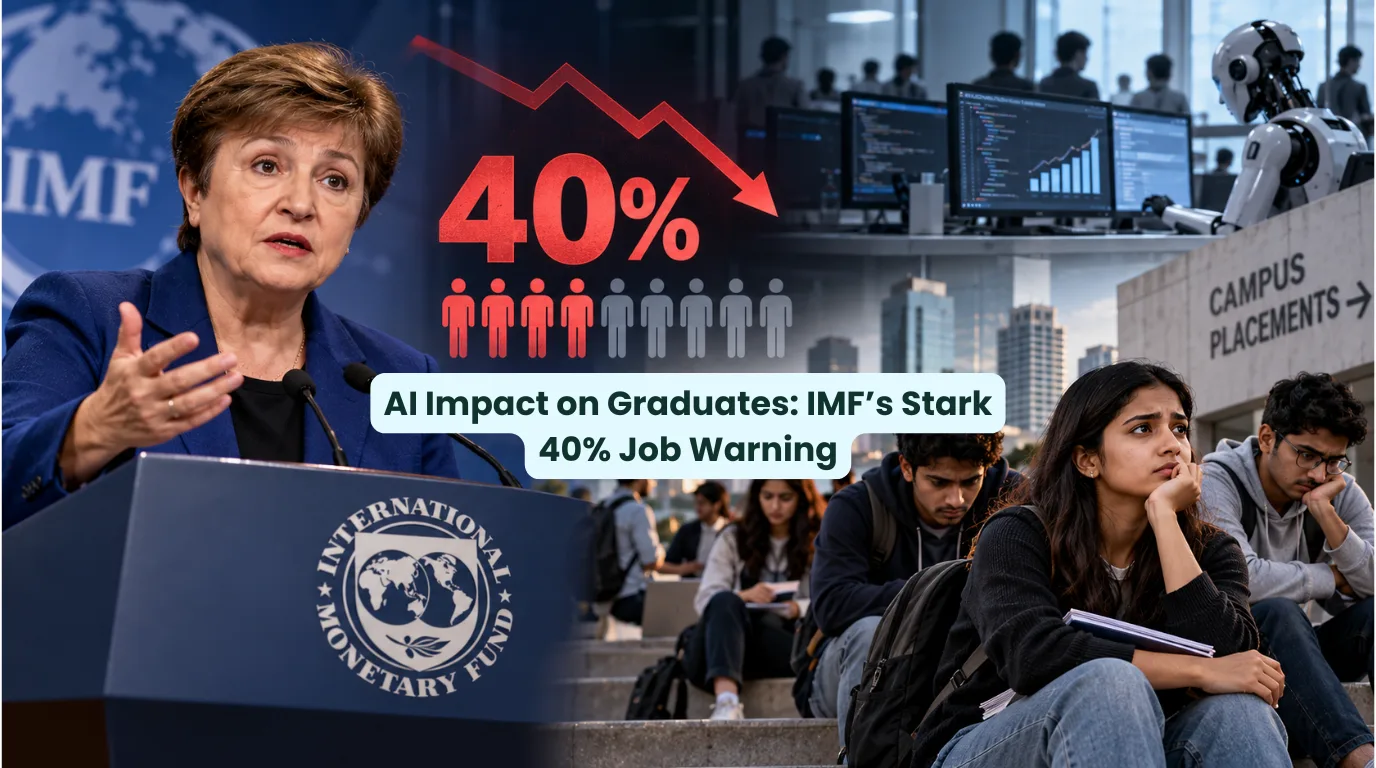
During the IMF-World Bank Annual Meetings in October 2026, IMF Managing Director Kristalina Georgieva warned about AI risks. She said more companies adopting the technology may affect young workers. Her concern is that automation could remove some entry-level jobs. These jobs often help people start their careers.
This warning reflects a broader debate about the AI impact on graduates and changing employment opportunities. The IMF’s January 2026 research on skills and employment found that AI skills are changing labour demand. Young workers face greater exposure in jobs where AI can perform tasks with limited human involvement. It shows that using generative AI has reduced entry-level hiring in some areas. Automation can now handle these tasks.
The distinction is important. The IMF is not saying that AI will eliminate all graduate jobs. The technology can also improve productivity and create demand for new skills. The outcome will depend on how businesses deploy AI and how quickly education and training systems respond.
Why it Matters for Young Graduates?
Entry-level jobs do more than provide salaries. They give new employees opportunities to make mistakes, receive feedback and learn how an organisation works.
A junior analyst might begin by gathering data before learning to interpret it. A new marketer may start with research, reporting and content drafts before taking responsibility for strategy. A junior developer may build experience through debugging, testing and reviewing code with senior colleagues.
AI can accelerate parts of this work. However, if employers automate these tasks and remove the learning they provide, graduates may face a paradox. Companies want experienced candidates, but fewer people get chances to gain that experience.
India has a particular reason to pay attention. A large number of graduate students can help the economy grow. However, changes in entry-level hiring can affect many young workers. The challenge is to turn AI-driven productivity into new opportunities rather than simply fewer starting positions.
What Businesses and Marketers Need to Know
1. Productivity does not have to mean fewer junior hires.
Businesses can use AI to help junior staff complete tasks faster while retaining human review and mentoring. Employees can then take on more complex responsibilities as their skills develop.
2. Graduate roles may need redesigning.
If AI takes over basic drafting, research, or reporting, employers should identify higher-level work graduates can learn. This could include checking AI outputs, interpreting results and applying business context to recommendations.
3. Skills need to go beyond prompting.
Graduates benefit from knowing how to use AI tools, but technical familiarity alone is not enough. Subject knowledge, critical thinking and strong communication skills remain essential. Employees must also be able to check AI-made answers. They must spot when the technology gives wrong or unsuitable results.
4. Employers should measure the effect on training.
Productivity gains and cost savings are useful metrics. But businesses should also track junior hiring and employee retention. They should also track mentoring and the time it takes new employees to work independently. These steps can help companies see if AI strengthens their workforce or harms the paths that develop new talent.
5. Education and hiring need to move closer together.
Universities, training providers and employers should work together to give students practical experience with real tasks. This includes AI-assisted workflows, problem-solving exercises and an understanding of human accountability when using automated systems.
The Number That Matters
1.2 billion people.
The IMF estimates that around 1.2 billion people will enter labour markets in developing economies over the next decade.
At the same time, AI is reshaping the global job market. The IMF estimates that AI could affect around 40% of jobs worldwide, with exposure rising to 60% in advanced economies compared with approximately 23% in low-income countries. Lower exposure does not necessarily mean greater protection; it may also reflect slower technology adoption.
These figures do not mean that all these jobs will disappear. AI may transform some roles, enhance others, and replace certain tasks. The real challenge is preparing a growing workforce for a job market where the skills employers need are changing rapidly.
The question is no longer just how many jobs AI will change, but whether graduates will have the skills to succeed in the jobs that emerge.
What Happens Next?

The next development to watch is how businesses use AI. Will they cut entry-level hiring, or redesign junior roles for AI help and faster learning?
Governments and educational institutions also face decisions about practical training, reskilling and how closely curricula reflect employers’ changing needs. The IMF has emphasised the importance of more responsive education and training as demand for new skills grows.
The broader question of AI job displacement will require evidence from different industries, occupations and countries. It is too early to assume that findings from specific US occupations will translate directly to India. Hiring patterns, industry structures and the availability of training opportunities can all influence the outcome.
DMT Take on IMF warning and The AI Impact on Graduates
The biggest risk may not be that AI takes every junior job. Companies remove repetitive work that once taught junior staff, but they do not create a better path to expertise.
Employers should not preserve inefficient tasks simply for the sake of tradition. However, they still need to consider how people develop judgment, context and professional experience. AI can now do more work that once helped people build these skills. This makes training and mentoring even more important.
The AI impact on graduates will depend partly on how organisations respond to this change. For graduates, learning to use AI effectively is becoming increasingly important. For employers, learning how to develop people alongside AI is just as important.
Sources
- IMF: New Skills and AI Are Reshaping the Future of Work — Official IMF analysis of changing skill requirements and entry-level hiring risks.
- IMF: Bridging Skill Gaps for the Future: New Jobs Creation in the AI Age — Research on AI skills, employment, wages and young workers.
- IMF Finance & Development: Graduating into Uncertainty — Reporting on graduates, AI-related labour market pressures and the need for relevant skills.
- Business Insider: IMF Director Warns AI Could Leave Young Workers Without a Way Up the Career Ladder — Coverage of Georgieva’s October 2026 warning.

Daksh Juneja is a performance marketing expert, trainer, and content creator featured in HT Tech. He helps businesses drive up to 4X ROI through Google and Meta Ads.