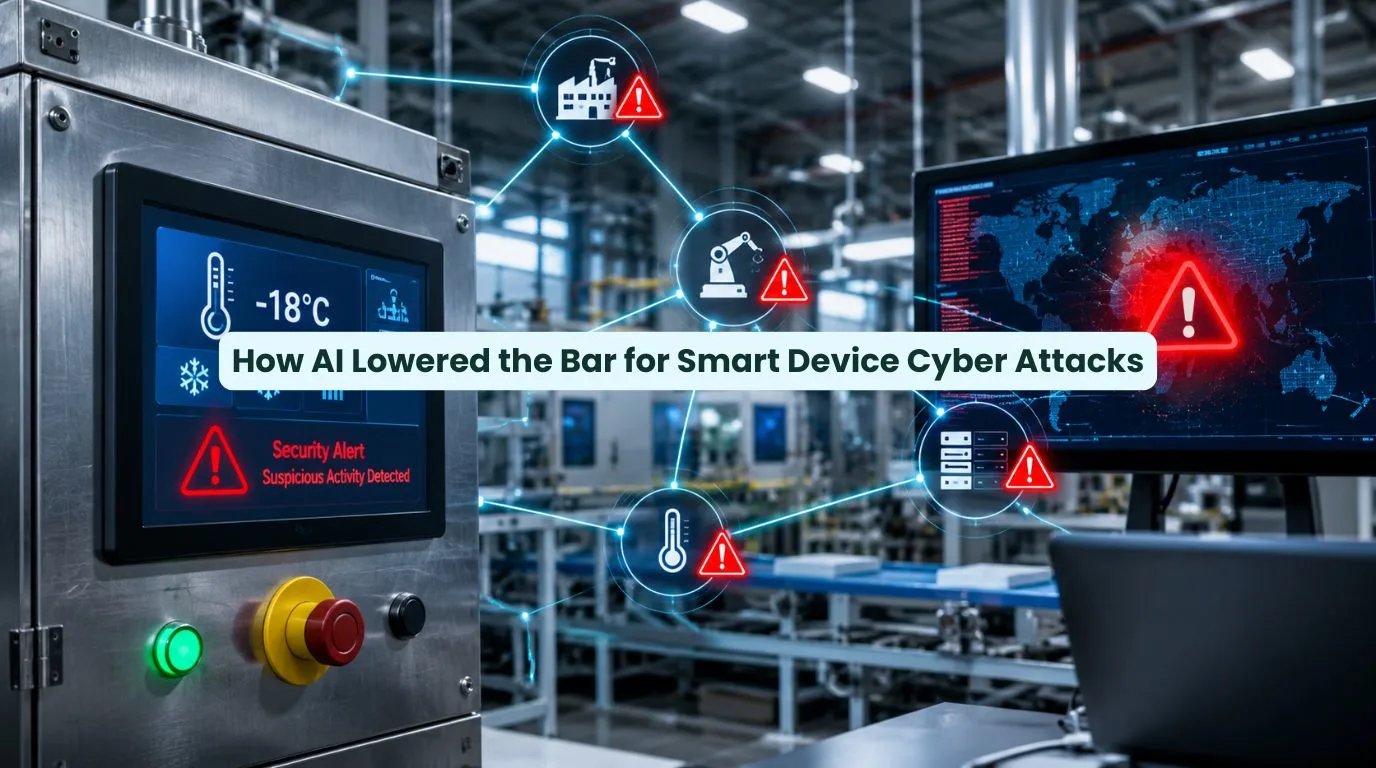


Every year, millions of new smart gadgets connect to the internet. People discuss smart home apps, artificial intelligence tools, industrial automation, and corporate convenience. But there is another side to this tech revolution that often gets less attention: its effect on cybersecurity and the impending smart device cyber attacks.
Think about it. When physical equipment connects to the web, hackers can attack it from far away.
This includes supermarket freezers. It also includes medical devices. It also includes power plants. In the past, breaking into these physical systems was extremely difficult. It required months of research, expensive equipment, and elite coding skills.
Artificial intelligence has completely changed that dynamic. The security impact of smart devices goes beyond stolen passwords. It can affect daily business operations, critical supply chains, and public safety.
Quick Answer
Artificial intelligence is making smart device cyber attacks easier to carry out.
It does this by automatically finding security flaws. Instead of needing advanced technical skills, bad actors can now use AI tools. They can quickly find exposed hardware online. Industry experts warn that AI eliminates traditional skill barriers, turning physical machinery into accessible targets for automated cyberattacks.
What Happened?
Cyberattacks on physical equipment across Europe recently sent a serious warning across the tech world. Supermarket refrigeration controllers and blood bank equipment were targeted, leading to operational disruptions.
These intrusions showed how hyper-connected physical systems are becoming attractive targets. Modern machines almost always come with web apps or remote portals. Everything from household ovens and lights to commercial refrigeration and pacemakers can now be adjusted over the internet.
While this remote control brings huge convenience and cost savings to businesses, it creates serious backdoors. AI makes this vulnerability much bigger. Attackers can now use automated tools to find open web connections fast.
Why It Matters

- The technical skill barrier has collapsed
In the past, launching smart device cyber attacks on real hardware needed custom exploit code and strong technical skills. A hacker had to spend months testing physical devices in a lab.
AI removes those obstacles. As Gianni Cuozzo, CEO of cybersecurity firm Exein, said, attacks on physical equipment used to need special skills. They also took time and money. AI strips away those barriers, meaning far more connected devices are turning into viable targets.
Instead of manually checking code for errors, threat actors now use AI-driven software to perform automated vulnerability hunting. The tools continuously scan the internet for unpatched systems, allowing even low-skilled bad actors to launch successful attacks.
- Physical infrastructure faces real-world risks
When a standard corporate database is breached, confidential files might be leaked. But when smart device cyber attacks hit physical machinery, the consequences happen in the real world.
- Food Supply Chains: Hacking commercial freezers can spoil tons of food in a single night.
- Healthcare Facilities: Disruption to hospital storage systems or blood banks risks critical medical supplies.
- Industrial Operations: Taking control of sensors or machinery can force factories to stop production lines.
Every piece of connected hardware represents an entry point if it is not properly secured.
- Attackers want disruption, not just cash
Historically, cybercriminals focused heavily on ransomware attacks to extract quick cash payments from businesses. However, with automated smart device cyber attacks, the primary goal is often shifting from extortion to operational disruption.
In recent European incidents where supermarket refrigeration units were compromised, observers noted that the attackers’ goal was to disrupt operations rather than demand money.
When AI lowers the cost and effort to find targets, state actors and criminal groups can launch large attacks. They may do this to cause panic and test supply chain resilience.
- Smart features bring hidden security costs
Companies add web portals and remote connectivity to physical equipment to save money and improve efficiency. Remote operation allows businesses to run equipment smoothly and predict maintenance before machines break down.
However, constant remote access brings dangerous risks. The same web feature built for convenient maintenance can become the door a hacker uses to get inside.
Businesses often spend a lot to secure office computers.
They may forget that smart building controls or industrial temperature sensors are exposed to the internet.
What Businesses and Developers Need to Know
For software engineers, hardware manufacturers, and business leaders, cybersecurity can no longer be an afterthought.
- Focus on embedded security: Devices need security built into their chips and firmware. Do not rely only on network firewalls.
- Adopt Zero-Trust policies: Every piece of connected hardware must continuously verify its identity before accepting remote instructions.
- Use defensive AI: Because offensive AI tools scan for flaws in seconds, human security teams cannot react fast enough. Organizations must deploy AI-driven security tools capable of detecting and isolating compromised devices in real time.
Understanding how AI accelerates vulnerability hunting helps companies build stronger defenses before bad actors locate their exposed equipment.
The Concept That Matters
Automated Reconnaissance.
This concept helps explain how AI changes physical security. The biggest danger of modern smart device cyber attacks is not just the attack code. It is the speed at which AI scouts for open doors.
AI tools automate the boring, time-consuming parts of hacking. By scanning the web for weak hardware links, AI lets bad actors find thousands of vulnerable targets in minutes.
What Happens Next?
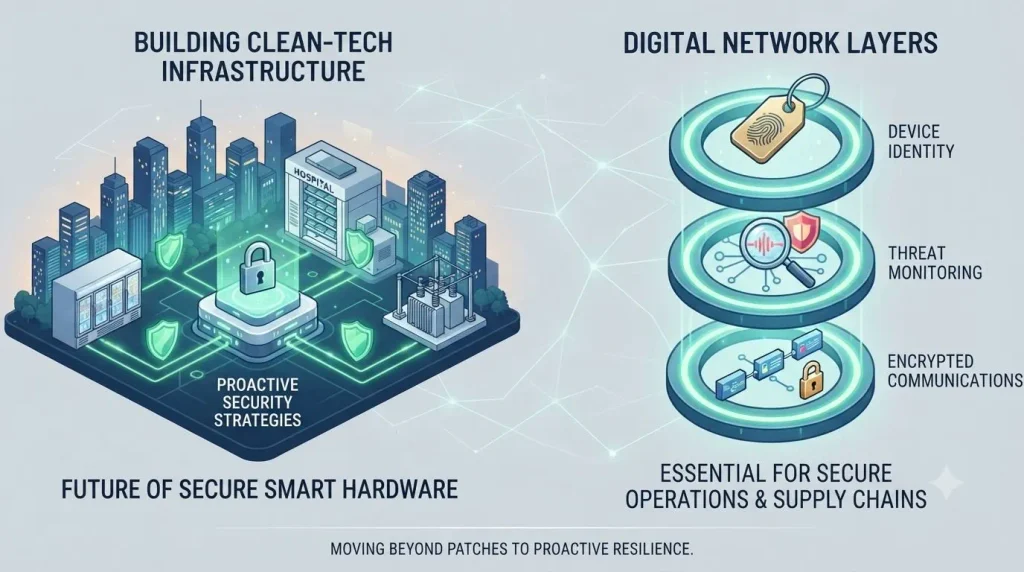
The tech industry needs to do more than push out software patches after a breach occurs. It needs long-term, proactive security strategies for smart hardware.
Securing physical machinery requires building strong clean-tech infrastructure. Just as cities need safe roads and clean water, digital networks need device identity, threat monitoring, and encrypted communications.
As more everyday devices connect to the internet, physical equipment needs better security. This will help keep operations safe. It will also protect critical supply chains.
DMT Take on Smart Device Cyber Attacks
The digital world and the physical world are merging fast. Smart appliances, automated factories, and web-controlled utilities are creating incredible new possibilities. But technical progress should not be measured only by how many features a smart device offers or how convenient an app is.
The reality of smart device cyber attacks shows that convenience comes with serious security costs if left unchecked.
Building security directly into physical infrastructure must be treated as an essential part of technology development.
The real question is not just how many physical devices we can connect to the internet. It is whether we can secure those devices well enough to keep our daily lives and businesses running safely.
Sources:
The Wall Street Journal / Resilience Media – Supermarket freezer hacks expose growing threat to Europe’s connected infrastructure (Reporting on recent cyberattacks targeting commercial refrigeration systems and physical IoT hardware). Available at Resilience Media.
SpotMedia – Hackers probed Europe’s fridge systems weeks before cyberattacks (Analysis of automated reconnaissance and vulnerability scanning targeting critical European cold chain facilities). Read the report on SpotMedia.
Exein Official Research & Documentation – Industry analysis and commentary by CEO Gianni Cuozzo on physical AI threats, embedded runtime security, and automated vulnerability hunting for connected hardware. Learn more at Exein About Us.
See Also: Gen Z Entrepreneurship: Will India Pick Startups Over Jobs?

Daksh Juneja is a performance marketing expert, trainer, and content creator featured in HT Tech. He helps businesses drive up to 4X ROI through Google and Meta Ads.