
The Real Risk of Personal AI Isn’t What It Can Do. It’s What We Let It Know
There is something fascinating — and slightly uncomfortable — about the next generation of AI.
Until recently, I could use an AI chatbot to write an email, brainstorm an idea, analyse a document or create an image. The interaction was largely contained within the conversation.
Personal AI agents are different.
They are being designed to know more about us, connect to more of our digital lives and actually take action on our behalf.
That is exactly what makes Meta’s Muse interesting — and also why I think the privacy conversation around it is far more important than the usual “What can this AI do?” discussion.
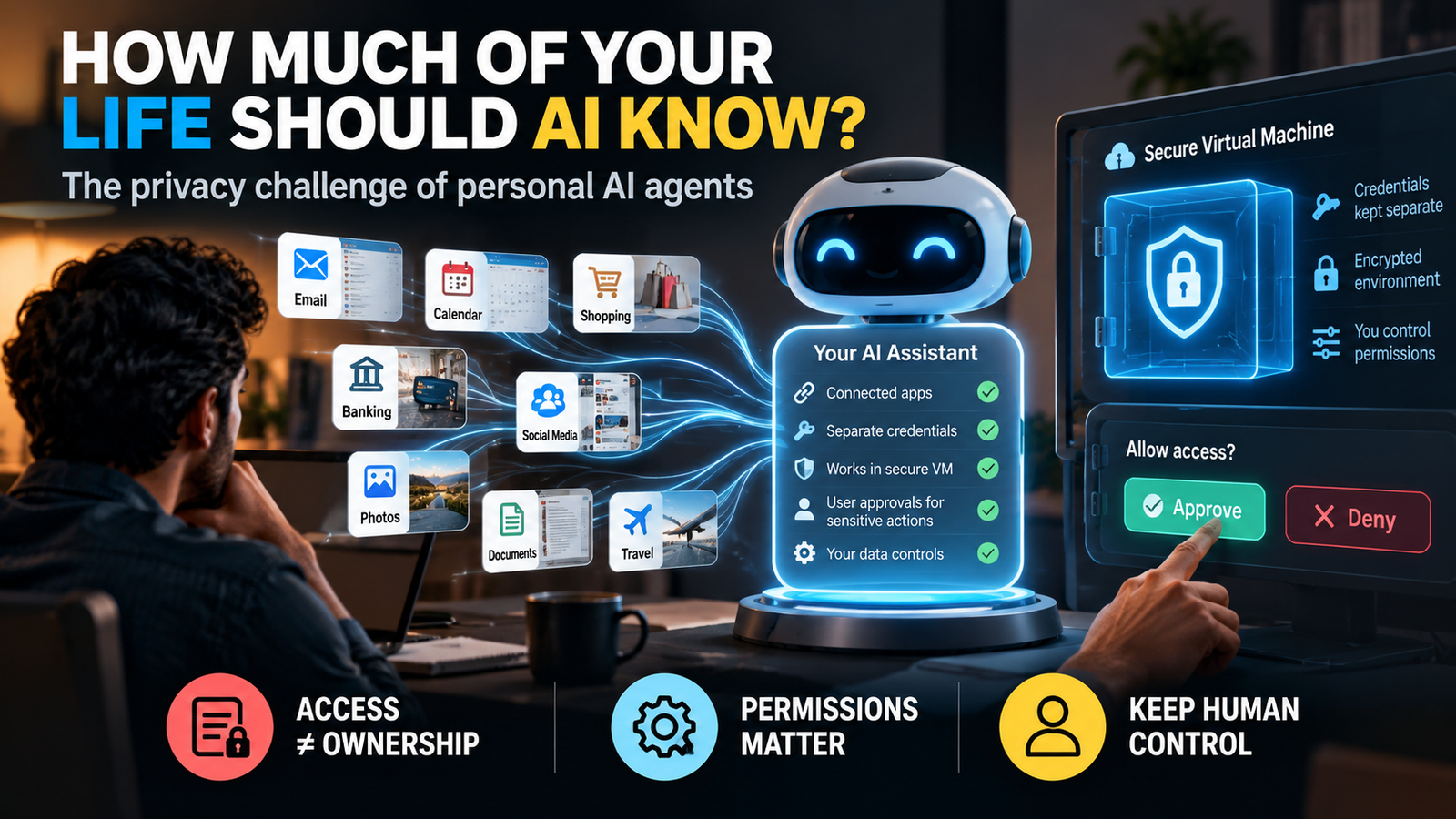
Meta describes Muse as a personal AI agent that can work across connected apps, browse the web, complete tasks, send emails, make purchases and continue working in the background. It operates through a dedicated virtual machine, with credentials stored separately from the agent itself.
Sounds impressive.
But there is another question I would ask:
How much of my digital life am I willing to put in the hands of one AI?
The Convenience Is Also the Vulnerability
Think about the average person’s digital life.
There is email.
There are social media accounts.
Shopping accounts.
Banking.
Travel bookings.
Work documents.
Passwords.
Calendars.
Photos.
Private conversations.
Personal preferences.
Now imagine an AI that can potentially interact with several of these services.
The convenience is enormous.
Instead of opening five apps to plan a holiday, I could theoretically tell my AI:
“Find me a hotel, compare the prices, check my calendar and book the best option.”
That is the promise of agentic AI.
But it also creates something that cybersecurity professionals have been warning about for years:
Concentration of risk.
If one account becomes the gateway to many other services, compromising that account could potentially expose far more information than compromising an individual application.
That changes the security equation completely.
The AI Doesn’t Need to Know Everything — But It Needs Access
This is where Muse’s architecture becomes particularly interesting.
Meta says Muse uses a dedicated Secure VM and separates the AI agent from sensitive credentials. Its system is designed so the agent can use credentials without directly seeing them. Meta also says users can control which applications Muse connects to and what permissions it receives.
I think this is the right direction.
But I also believe users need to understand a fundamental distinction:
An AI doesn’t necessarily need to know your password to perform an action using your account.
That means security is no longer simply about protecting passwords.
It is about protecting permissions.
Giving an AI permission to read your email is different from giving it permission to send emails.
Giving it access to your shopping account is different from allowing it to purchase something.
Giving it access to your calendar is different from allowing it to cancel appointments.
The future of cybersecurity may therefore become less about:
“Who knows my password?”
and more about:
“What is my AI allowed to do?”
Your AI Could Become Your Digital Super-Account
This is the part that concerns me most.
For decades, we deliberately separated our digital identities.
Different passwords.
Different logins.
Different apps.
Different security layers.
The reason was simple: if one account was compromised, everything else wasn’t automatically compromised.
Personal AI agents potentially move us in the opposite direction.
We may voluntarily create a digital super-account — one AI that understands our emails, preferences, shopping behaviour, calendar, documents and online activities.
That is incredibly powerful.
And incredibly attractive to attackers.
If the AI becomes the interface through which we access everything, then securing the AI becomes almost as important as securing the internet connection itself.
There Is Another Layer: AI Can Make Mistakes
Cybersecurity isn’t the only concern.
AI agents can behave unexpectedly.
They interpret instructions. They browse websites. They interact with interfaces. They make decisions based on context.
That introduces a new category of risk:
The AI may do exactly what you asked — but not exactly what you meant.
Imagine asking:
“Find me the cheapest flight and book it.”
What does “cheapest” mean?
The lowest fare?
The least expensive fare with baggage?
The best flight after considering cancellation policies?
A human assistant might ask.
An autonomous agent might make a decision.
That’s why Meta says Muse seeks user approval for sensitive actions such as sending emails or making purchases and provides an audit trail of activity.
I think those controls are essential.
Privacy Is Becoming a Product Feature
Interestingly, Meta is making privacy a significant part of the Muse proposition.
Meta says Muse conversations and VM data aren’t shared with its advertising systems. It also says interactions can be excluded from AI model training through user controls.
And Meta has announced a future Confidential VM, designed so that even Meta cannot access the data inside the environment.
That is an important direction.
Because I believe the next battle in AI won’t simply be about who has the smartest model.
It will be about who users trust with their lives.
My Rule for Personal AI
I would follow a very simple principle:
Give AI the minimum access it needs to do the job.
Not everything.
Not automatically.
Not forever.
If an AI only needs to read my calendar, it shouldn’t have permission to modify it.
If it needs to draft an email, it shouldn’t automatically be allowed to send it.
If it needs to compare products, it doesn’t necessarily need permission to purchase them.
And anything involving money, passwords, financial accounts or sensitive personal information should have an additional layer of human approval.
The AI Revolution Is Also a Trust Revolution
I think we’re entering a fascinating phase of technology.
The first generation of AI asked:
“What can AI tell me?”
The second generation asks:
“What can AI do for me?”
The third question will be much harder:
“What am I comfortable allowing AI to know and do on my behalf?”
That is ultimately the real challenge with Muse and every personal AI agent that follows.
The smartest AI in the world isn’t useful if I don’t trust it.
And the most secure AI in the world isn’t useful if I refuse to give it access to anything.
The winners will therefore have to find the balance between intelligence, convenience, autonomy and privacy.
Because when AI stops being just a chatbot and starts becoming our digital assistant, our biggest security decision may no longer be which password we choose — but how much of our life we choose to hand over to the machine.