
WORLD NEWS DAY: WHY TRUSTED NEWS MATTERS MORE THAN EVER
28 September | World News Day Today is World News Day, and I find the occasion particularly meaningful at a time when we have more access to information than at any point in history — and, ironically, perhaps more difficulty deciding what to trust.
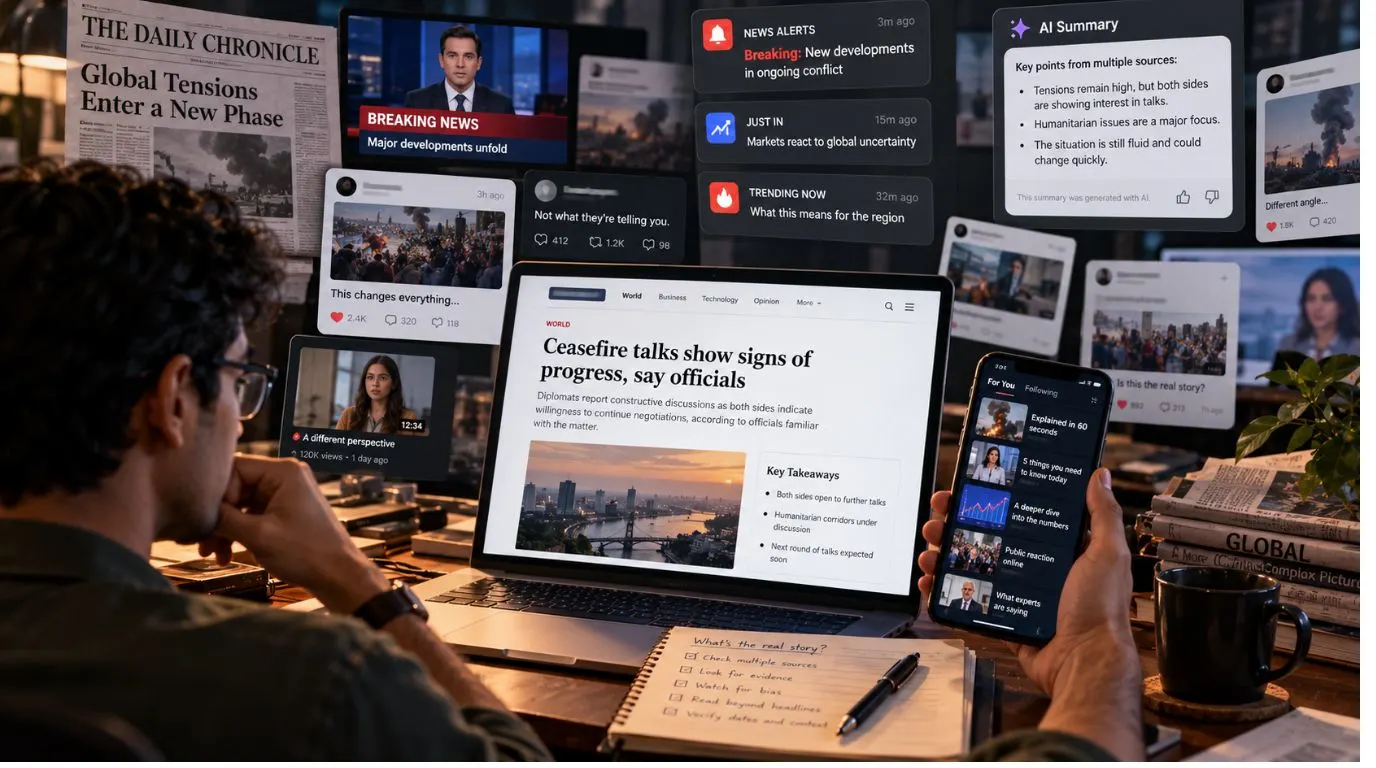
Every morning, we wake up to hundreds of headlines. WhatsApp forwards. Telegram updates, X posts , Instagram reels, YouTube explainers, News apps.
AI-generated summaries. Notifications from multiple publications. Information is no longer scarce. Attention and trust are . and that is what makes World News Day worth thinking about.
WE HAVE NEVER HAD SO MUCH NEWS
I often think about how dramatically the experience of consuming news has changed. A few decades ago, news came to us at specific times. The morning newspaper. The evening television bulletin. Perhaps a radio update. Today, news follows us everywhere.
Something happens anywhere in the world and we can know about it within minutes. That accessibility is incredibly powerful but it has created another problem:
When everyone can publish, who do we trust? A journalist spends days investigating a story.
A social media account can summarise it in 30 seconds. Someone else can turn it into a meme. Another person can add an opinion. An AI tool can rewrite it.
And within hours, the original information can become almost impossible to distinguish from commentary, speculation or misinformation.
THE TRUST PROBLEM
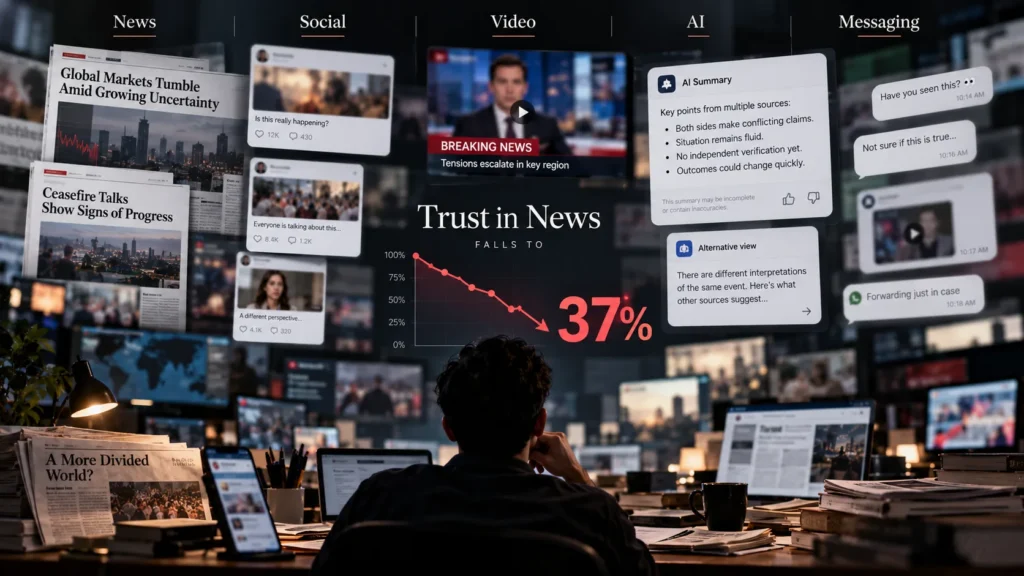
The graphic accompanying this post highlights a worrying trend: the share of people saying they trust the news has declined from almost 48% in 2025 to 37% in 2026, according to the data presented in the source.
That’s a significant decline and regardless of where someone gets their news, declining trust should concern all of us.
Because journalism plays an important role that goes beyond simply telling us what happened. Good journalism investigates.
It verifies. It asks questions. It provides context. It challenges claims. It gives us information that allows us to form our own understanding of events. When trust in that process declines, people don’t necessarily stop consuming information.
They may simply become more vulnerable to accepting information based on who shared it, how emotional it feels or whether it confirms what they already believe.
THE MOST DANGEROUS NEWS ISN’T ALWAYS FALSE NEWS
This is something I have increasingly thought about. We often worry about fake news but there is another problem: half-true news.
A headline can be technically accurate but completely misleading without context. A statistic can be real but presented selectively. A photograph can be genuine but unrelated to the event being discussed. A video can be authentic but edited in a way that changes its meaning.
And an opinion can be presented with the visual language of a fact. That’s why simply asking:
“Is this true?” is sometimes not enough.
- We also need to ask:
- Where did this come from?
- Who reported it?
- What is the evidence?
- What is missing from the story?
- Is this fact, analysis or opinion?
Those are increasingly important digital skills.
WHY JOURNALISM STILL MATTERS
The message associated with World News Day is essentially that trusted journalism matters. I agree with the underlying principle but I don’t think “trust” should mean blindly believing everything a news organisation publishes.
Quite the opposite. For me, trustworthy journalism should encourage scrutiny.
It should tell us what is known. It should distinguish that from what is alleged or uncertain. It should correct mistakes.
It should provide sources where appropriate and it should give audiences enough context to make up their own minds. In other words:
Trust shouldn’t mean “believe me.”
It should mean:
“Here is how we arrived at this information. You can examine it.”
NEWS CONSUMPTION HAS ALSO BECOME A SOCIAL ACTIVITY
The personal note accompanying the image says that these news posts have been receiving around 10,000 impressions a day through WhatsApp, Telegram and X. That is an interesting reminder of how news now travels.
A news organisation may publish a story. But its distribution doesn’t stop there. Someone shares it with a friend. That friend forwards it to a WhatsApp group. Someone posts it on X. Another person discusses it on Telegram and suddenly, one piece of journalism has travelled through an entire network of people.
We are no longer just consumers of news. We are also distributors of it and that gives each of us a small responsibility.
Before forwarding something, perhaps we should spend an additional 30 seconds checking where it came from. That 30 seconds can make a surprisingly large difference.
THE NEW ROLE OF THE READER
I believe the responsibility for trustworthy information doesn’t sit entirely with journalists. It also sits with us. Every time we forward a headline, we are effectively endorsing its distribution.
Every time we share an unverified claim, we contribute to the information environment around us. Every time we pause and verify something before sharing it, we improve that environment — even if only slightly.
This doesn’t mean we need to become investigative journalists. It simply means becoming more conscious consumers of information.
AND THEN THERE IS AI
There is another reason this conversation has become even more important in 2026. Artificial intelligence has made creating content dramatically easier.
A person can now generate:
- A convincing article
- A realistic photograph
- A video
- An audio clip
- A social media post
- A fake screenshot
- A synthetic voice
in minutes. That makes media literacy even more important. The future isn’t going to be about asking:
“Is this online?”
Almost everything will be online. the question will increasingly be:
“Can I verify this?”
WORLD NEWS DAY IS ALSO ABOUT RESPONSIBILITY
For me, World News Day isn’t just an occasion to celebrate journalists.
World News Day is also an opportunity to think about our own behaviour as readers. If we want better journalism, we need to value it. If we want credible information, we need to seek it.
If we want responsible news consumption, we need to practise it and if we want fewer misleading stories circulating in our communities, we need to stop treating the forward button as a reflex. Sometimes the most responsible thing we can do with a piece of information is simply not share it until we know more.
NEWS THAT YOU CAN USE
This is why I like the idea behind the personal message accompanying the World News Day post:
“News that you can use.”
For me, that is ultimately what good journalism should provide. Not just information for the sake of information but information that helps us understand the world around us.
Information that helps us ask better questions. Information that helps us make better-informed decisions and sometimes, information that simply makes us stop and think.
I also appreciate the idea of being a small part of someone’s life through the sharing of news because that is what modern news distribution has become.
A journalist creates the story. A reader discovers it. Someone shares it. Another person learns something and the information continues travelling.
THIS WORLD NEWS DAY, I HAVE ONE SIMPLE REQUEST
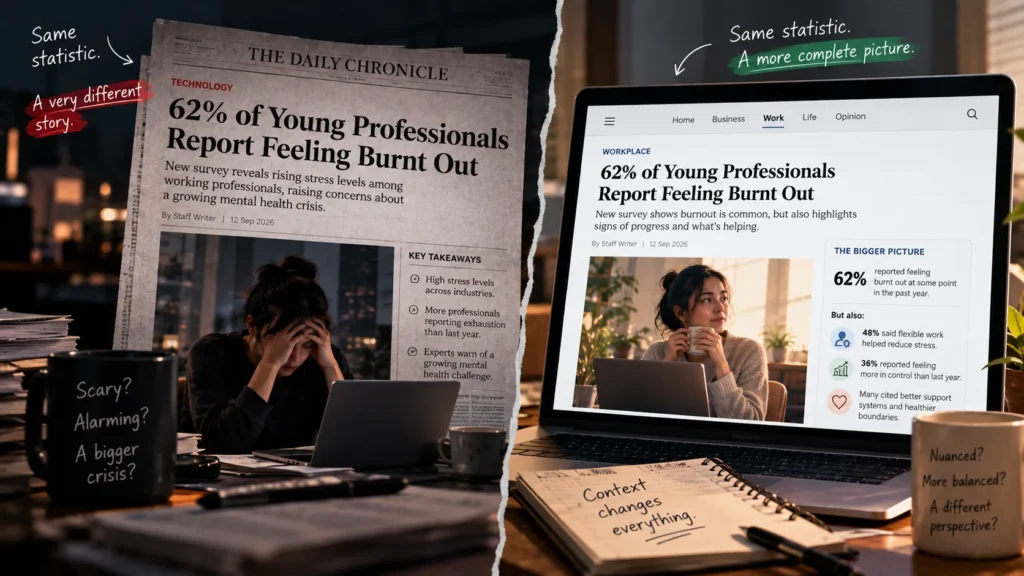
Before we share the next breaking-news headline, sensational statistic or “forwarded as received” message, let’s pause for a moment.
Who reported World News Day?
Where did the information come from?
Is World News Day evidence?
Is this fact or opinion?
Is the headline telling me something — or trying to make me feel something? That tiny pause is becoming one of the most important habits of the digital age because we don’t need less news.
We need better information, better journalism and better-informed readers and perhaps that is the real message of World News Day. Trusted journalism matters. But so does the trust we place in it — and the responsibility we take when we pass it on.
Happy World News Day and thank you to everyone who continues to read, question, verify, share and stay curious.
News is powerful. Let’s make sure we’re using that power responsibly.
Reuters Institute Digital News Report 2026
As the industry shifts, staying informed about digital trends is essential for anyone. Click through to read another thread!