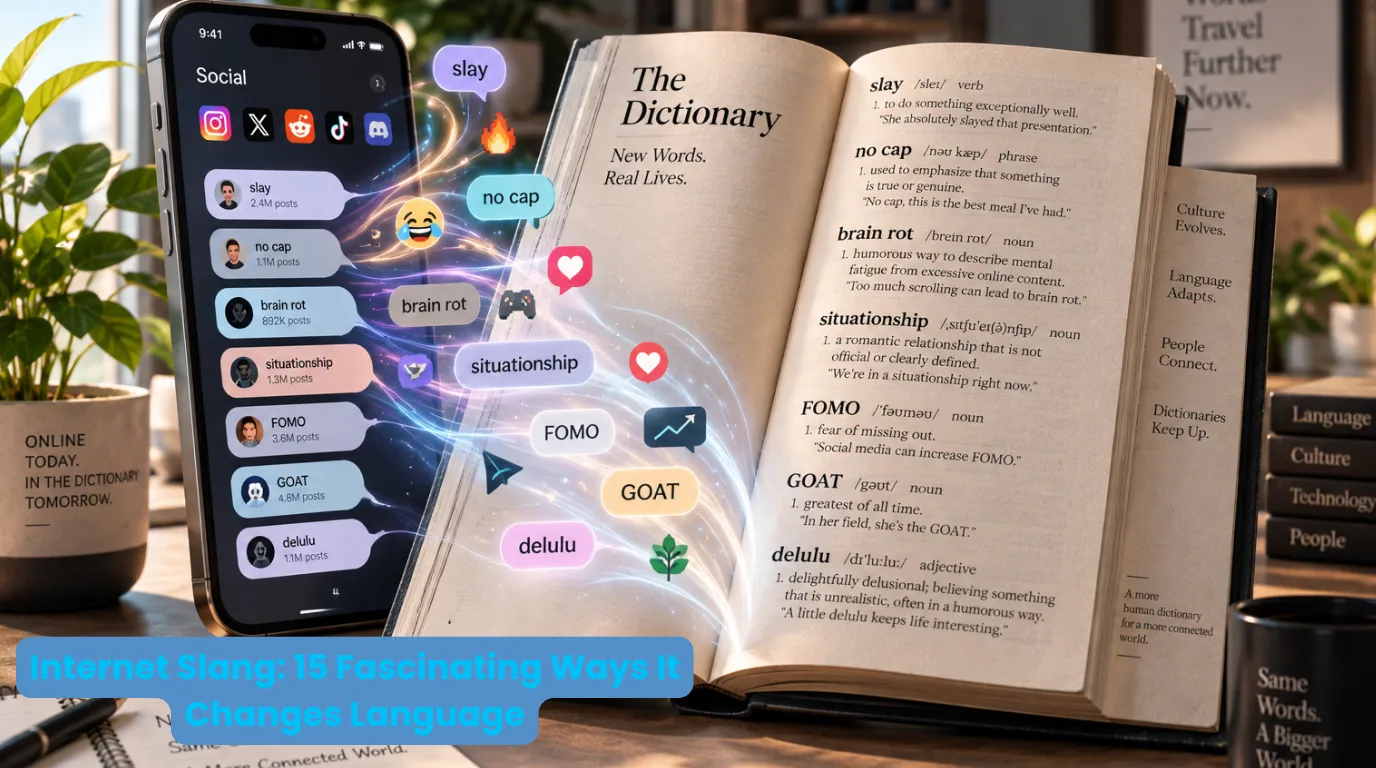

THE INTERNET IS NOW REWRITING THE DICTIONARY
Theme: How Internet Culture Is Turning Memes, Slang and Digital Behaviour Into Everyday Language
There was a time when dictionaries told us what words meant.
Now, I sometimes feel the internet is telling dictionaries what words should mean.
The latest additions and definitions highlighted by Merriam-Webster are a fascinating snapshot of how dramatically our language is changing. Words that would have sounded ridiculous, niche or completely incomprehensible a few years ago are now describing real behaviours, emotions, cultural phenomena and even entire lifestyles.
And as someone who spends a lot of time around digital marketing, social media and younger audiences, I find this evolution of internet slang particularly interesting.
Because language is often the earliest signal of cultural change.
If people invent a word for something, it usually means that something has become common enough to need a name.
So let’s decode some of the internet’s newest vocabulary.
XENNIAL: An Icon of Nostalgic Internet Slang

A Xennial describes people on the cusp between Generation X and Millennials.
They essentially grew up during the transition from an analogue childhood to a digital adulthood.
Think:
Landline phones → mobile phones
Cassette tapes → Spotify
Encyclopedias → Google
TV schedules → streaming
No internet → always online
I find the Xennial identity particularly interesting because these people experienced both worlds. They remember life before smartphones but have also adapted to living with them. Yacht rock refers to a style of smooth, polished soft rock associated particularly with the late 1970s and early 1980s.
The interesting part isn’t just the music. It’s the revival. The internet has a remarkable ability to take something from decades ago, give it a new label, create a community around it and suddenly make it a recognized piece of internet slang again.
The Internet doesn’t just Create Trends. It Resurrects Them.
California sober describes an approach to sobriety where someone avoids certain substances, particularly alcohol or harder drugs, while still allowing some substances that traditional sobriety might prohibit. It is a term that shows how language evolves around changing attitudes and personal approaches to behaviour.
The larger lesson is that people increasingly want internet slang that describes their specific version of an experience, rather than fitting neatly into an existing category.
Limerence describes an intense state of infatuation or romantic obsession, particularly the overwhelming desire for another person’s affection or reciprocation. This is fascinating because the feeling isn’t new. The word is. And social media has arguably made the phenomenon much easier to document, discuss and turn into creative internet slang content.
One person posts: “Why can’t I stop checking whether they have seen my story?”The internet responds with a vocabulary lesson.
MANDELA EFFECT
The Mandela Effect describes a situation where a large group of people collectively remembers something differently from how it actually happened.
This is one of my favourite internet-era terms because it perfectly captures something that feels increasingly common online. People don’t simply disagree about facts. Sometimes thousands of people confidently remember the same incorrect version of something.
The web then turns this collective memory lapse into functional internet slang. The Sunday scaries are the anxiety or dread people experience as the weekend comes to an end and the working week approaches.
I suspect this one needed very little explanation. Sunday evening: Weekend → 100%
Motivation for Monday → buffering…
What interests me is that an everyday emotional experience has become a recognisable cultural phrase.
And once something becomes popular internet slang, people can share it, meme it and build an entire conversation around it. Looksmaxxing refers to the pursuit of maximising one’s physical attractiveness.
This can include grooming, fitness, skincare, clothing, hairstyle and other appearance-related practices.
It is a perfect example of how internet communities take an existing behaviour and turn it into a new cultural vocabulary. People have always wanted to look better.
The internet simply gave the behaviour a name — and an ecosystem. A parasocial relationship is a one-sided relationship in which a person develops a sense of connection with a public figure or media personality who does not personally know them.
Social media has taken this phenomenon to another level. Earlier, you might have watched a celebrity on television. Today, you see their breakfast, holiday, relationship, home, opinions, stories and daily updates.
The Boundary Between Adience and Acquaintance becomes much Blurrier.

And suddenly, parasocial becomes an important piece of internet slang for understanding digital culture. The uncanny valley describes the unsettling feeling produced when something looks almost, but not quite, human.
This has become particularly relevant in the age of AI-generated images, avatars and digital humans. Too artificial? Fine. Completely human? Fine. Almost human but somehow wrong? Very uncomfortable. AI has made the uncanny valley considerably more relevant to everyday internet slang terms.
Copium is a humorous internet term for the hopeful or unrealistic thinking people use to cope with disappointment. You lose the match: “Next time we’ll definitely win.” Your startup doesn’t get funding:
“Actually, this is probably good for us.” Your favourite stock falls 40%: “I’m just buying the dip.” That is essentially copium. The online world has successfully turned deep denial into everyday internet slang.
A meme coin is a cryptocurrency inspired largely by an internet meme, joke or online cultural phenomenon.
Unlike traditional financial terminology, the name itself tells you how deeply internet culture has entered finance.
Memes aren’t just entertainment anymore.
They can become communities, brands, marketing vehicles and even financial assets.
Cuffing season refers to the period, particularly during colder months, when people become more interested in finding a romantic partner or companionship.
Winter is Coming.
And apparently, so is the relationship. Again, the behaviour probably existed forever.
The internet simply packaged it into two words of viral internet slang. Rizz refers to romantic charm or the ability to attract or charm someone. Someone has good rizz? They can apparently talk their way into your heart. Someone has zero rizz?
Well… Maybe they should stick to LinkedIn or learn new internet slang formulas.
Skibidi is one of those internet terms that demonstrates just how strange modern language can become. Popularised through viral internet content, it can be used in a deliberately nonsensical or humorous way. And that is precisely the point. Not every new word exists because we need a precise definition.
Some exist because the internet collectively decided that a sound, joke or piece of content was funny enough to become language.
- 6-7
Then there is “6-7.” This is perhaps the ultimate example of internet language becoming intentionally absurd.
It emerged as a viral expression associated with online meme culture and has been used in deliberately nonsensical ways. And that is actually an important lesson.
Language doesn’t always evolve because people need to communicate more efficiently. Sometimes it evolves because people want to belong to the joke.
If you understand it, you’re part of the group. If you don’t… Well, you’re probably Googling it to see what this new internet slang represents.
WHAT ALL OF THIS TELLS ME Looking at these terms together, I don’t think the biggest story is really about dictionaries.
It is about culture. Words such as parasocial, looksmaxxing, limerence, Sunday scaries and uncanny valley describe behaviours and experiences that have become increasingly visible in modern life.
Others such as rizz, skibidi, copium and 6-7 demonstrate how quickly internet communities can create shared language. And terms like meme coin, California sober and cuffing season show how internet vocabulary can cross into finance, lifestyle and everyday conversations.
For marketers, this matters enormously.
Language tells us how People are Thinking.
If an audience has invented a word for something, there is probably a cultural conversation happening around it. And brands that understand that conversation can communicate much more naturally.
But there is a warning here too. Using slang doesn’t automatically make a brand relevant. Nothing is more painful than a 45-year-old brand meeting deciding that its new campaign needs “rizz.”
The better approach is to understand why the word exists, who uses it, what cultural behaviour sits behind it and whether the brand has any legitimate reason to participate. THE INTERNET DIDN’T JUST CHANGE HOW WE TALK
It changed what we have words for. We now have language for being obsessed with someone. For remembering something incorrectly. For feeling anxious on Sunday evening.
For trying to become more attractive. For being emotionally attached to someone who doesn’t know we exist. For coping with disappointment.
For feeling uncomfortable around almost-human technology. For dating during winter. And apparently, for saying “6-7.” That, to me, is the fascinating part.
The dictionary is no longer just recording language. It is documenting the culture that created it. And if the last decade has taught me anything, it is this:
The internet doesn’t wait for language to catch up. It creates the language first — and eventually, the dictionary comes along.
Merriam-Webster’s dictionary and language resources
As the industry shifts, staying informed about digital trends is essential for anyone. Click through to read another thread!