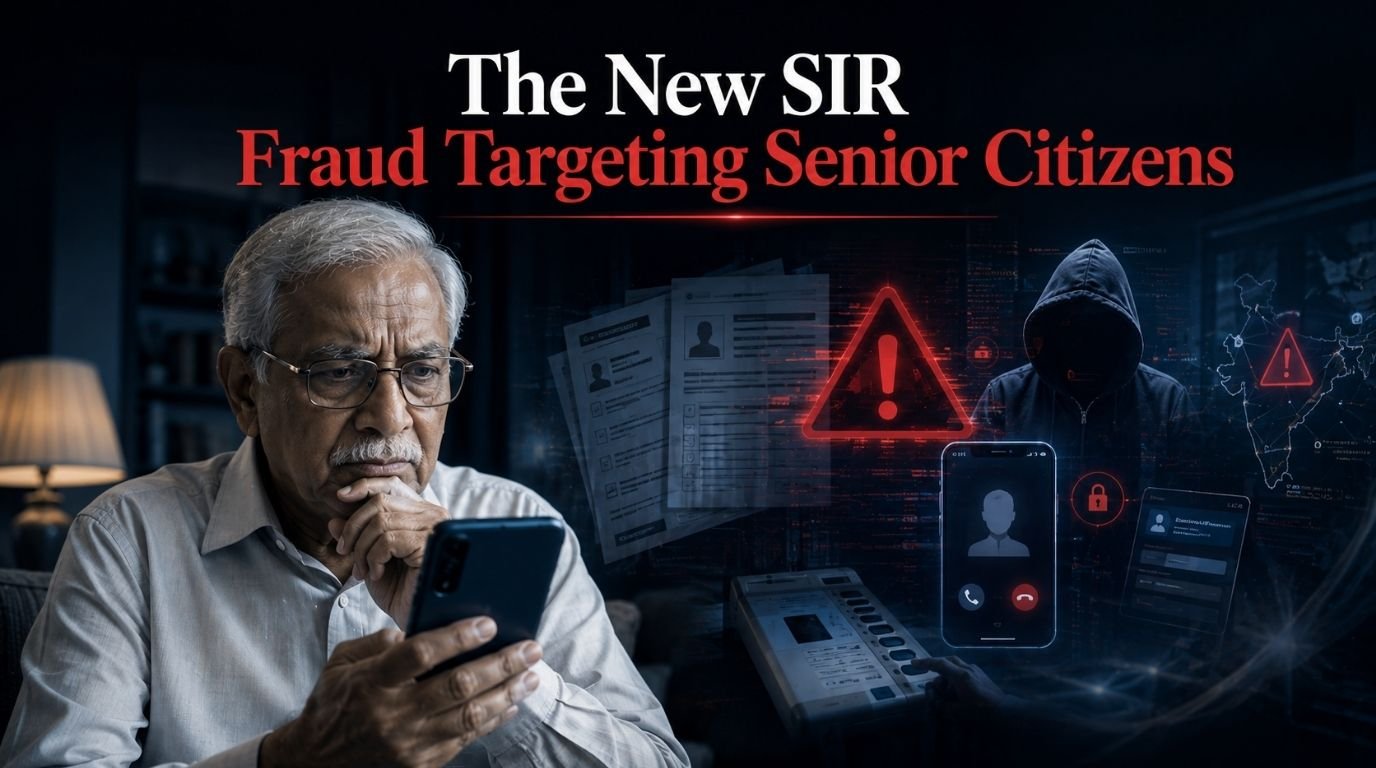

When Fear Becomes the Scam: The New SIR Fraud Targeting Senior Citizens
Theme: How cybercriminals are weaponising urgency, technology and public anxiety
There is a new kind of cyber scam that I find particularly disturbing—not because the technology is sophisticated, but because the psychology behind it is.
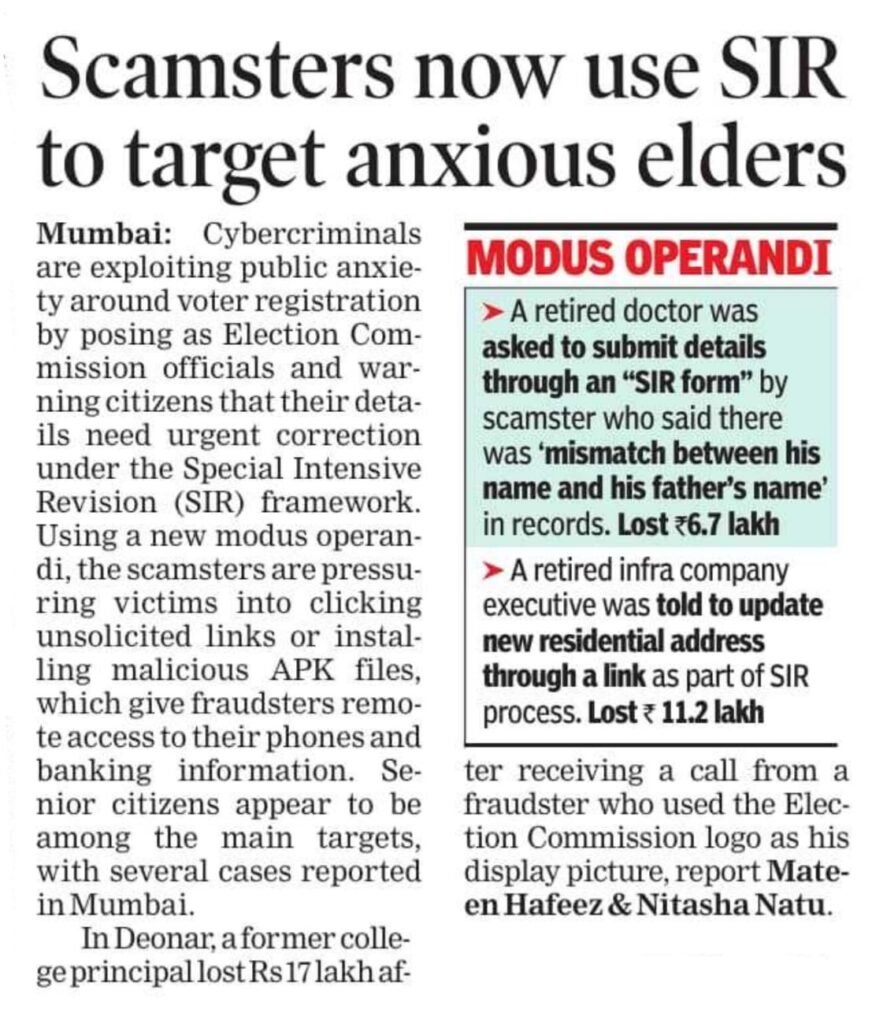
The latest cases emerging from Mumbai show cybercriminals posing as Election Commission officials and using the ongoing Special Intensive Revision (SIR) of electoral rolls as a pretext to target senior citizens.
The pattern is frighteningly simple: create fear, create urgency and then offer a fake solution.
Recent reports say victims have been told that there is a mismatch in their voter records, that their names could be affected, or that they need to urgently complete an SIR-related verification. They are then directed towards suspicious links or asked to install APK files. In one reported Mumbai case, a retired college principal allegedly lost ₹17 lakh after downloading a malicious APK presented as part of the SIR process.
Another 77-year-old retired doctor reportedly lost ₹6.71 lakh after being contacted about an alleged discrepancy in his SIR form and being directed to a fake verification website.
And this is where I think the real lesson lies.
The scam isn’t really about SIR. It’s about anxiety.
Cybercriminals have understood something marketers have known for years:
Emotion drives action.
Fear drives clicks.
Urgency reduces scrutiny.
Authority increases trust.
Put all three together and you have a remarkably effective social-engineering formula.
Imagine receiving a call from someone claiming to be from the Election Commission.
They tell you:
“There is a discrepancy in your voter record.”
“You need to correct it immediately.”
“If you don’t, you may face problems with your voting status.”
Then they send you a link.
For someone who is unfamiliar with digital fraud, particularly an elderly person, this can sound completely legitimate.
The scammer doesn’t need to convince the victim that the technology is genuine.
They only need to convince them that something is wrong and they must fix it immediately.
Technology makes the scam more dangerous
The use of malicious APK files is particularly concerning.
Unlike simply sending a fake website, convincing someone to install an application can potentially give criminals much deeper access to the device.
In the Mumbai case involving the retired principal, the victim was allegedly asked to install an APK and make a nominal ₹5 payment. Subsequent unauthorised transactions resulted in a reported loss of ₹17 lakh.
That ₹5 is almost irrelevant.
The scam isn’t about collecting ₹5.
It is about getting access.
And that is an important lesson for everyone using smartphones.
The smallest payment request can sometimes be the biggest warning sign.
The senior citizen angle worries me the most
I think this is where families need to become more proactive.
Senior citizens are not necessarily less intelligent or less aware.
But they may be more trusting of institutional authority.
And when someone invokes something as important as voting, government records or an official verification process, the psychological pressure can be significant.
The latest Mumbai reporting specifically identifies senior citizens as major targets of this SIR-related fraud.
This means cyber safety can no longer be treated as an individual’s responsibility alone.
Families need to discuss it.
Children need to talk to their parents.
Grandchildren need to help grandparents understand what legitimate digital communication looks like.
And perhaps most importantly, we need to remove the embarrassment associated with asking for help.
The golden rule I would follow
If somebody calls me and says:
“You need to do this immediately.”
I stop.
I don’t click.
I don’t install.
I don’t share an OTP.
I don’t provide banking details.
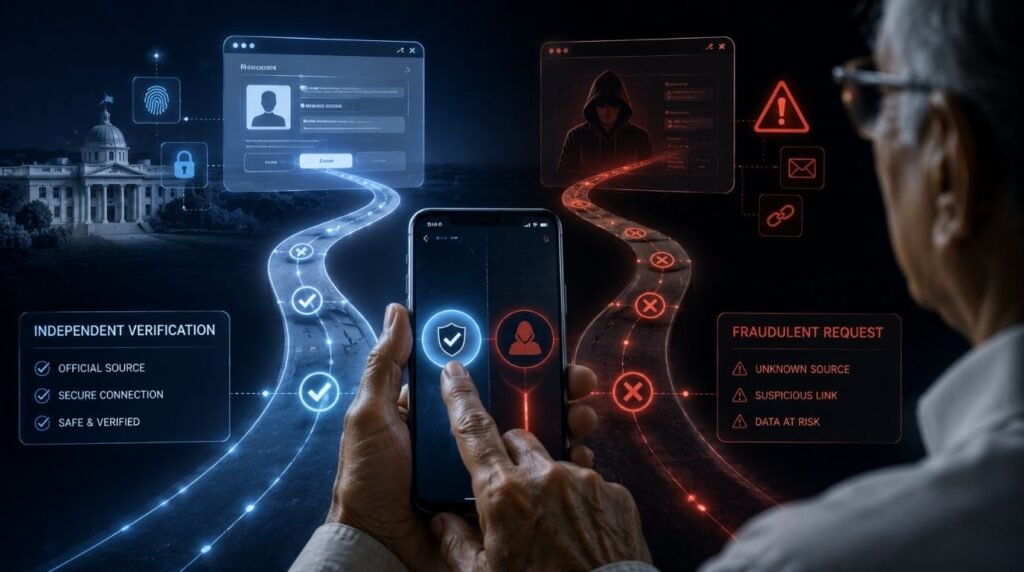
I independently verify the request.
That five-minute pause can potentially save years of financial savings.
The official Election Commission’s voter services portal provides SIR-related services, including filling the enumeration form, checking voter information and tracking applications.
The Election Commission also provides 1950 as its voter helpline, while the Chief Electoral Officer, Maharashtra, lists 1950 specifically for SIR-related queries.
So instead of responding to the number or link supplied by a stranger, I would independently go to the official voter services platform or contact the official helpline.
That distinction matters.
Never install an APK because someone told you to
This should probably become a household rule.
No unknown APK files.
Not because someone says they’re from the Election Commission.
Not because someone says they’re from your bank.
Not because someone claims your Aadhaar needs updating.
Not because someone says your electricity connection will be disconnected.
Not because someone says your parcel is stuck.
And definitely not because someone says you have five minutes to comply.
If an application is legitimate, verify it independently and obtain it through the appropriate official channel.
The Mumbai cases show why this matters.
There is also a marketing lesson here
This story reminds me of something I teach in digital marketing.
The most effective communication isn’t necessarily the one with the most information.
It is often the one that understands what the audience is feeling.
Scammers understand this extremely well.
They identify a relevant issue.
They identify a vulnerable audience.
They introduce uncertainty.
They create urgency.
And then they provide a solution.
It is essentially a dark version of a conversion funnel.
Problem → Fear → Urgency → Action → Exploitation.
The frightening part is that the funnel works.
And that is why digital literacy needs to evolve beyond knowing how to use a smartphone.
People need to understand how digital manipulation works.
My takeaway
For me, the biggest lesson from the SIR scam isn’t simply “don’t click suspicious links.”
It is much broader.
Don’t allow urgency to make your decisions for you.
If somebody is genuinely calling from an official organisation, you can verify their identity.
If something genuinely needs to be corrected, you can find the official process.
If there is genuinely a deadline, the information should be independently available through official channels.
And if someone threatens you with immediate consequences unless you click a link, download an application or transfer money, that is precisely when you should slow down.
Because the scammer’s biggest weapon isn’t the APK.
It isn’t the fake website.
It isn’t even the stolen data.
It is panic.
And the simplest defence against panic is a pause.
Stop. Verify. Then act.
That’s perhaps the most important digital safety lesson we can teach our parents, grandparents—and frankly, ourselves.
Sources: Election Commission of India voter services portal and Chief Electoral Officer, Maharashtra, for official SIR services and helpline information; recent Mumbai reports from The Times of India and Free Press Journal for the reported cases.
As the industry shifts, staying informed about digital trends is essential for anyone. Click through to read another thread!