I remember when a strong portfolio was all you needed. You’d pour weeks into it — agonising over case studies, obsessing over presentation. Today, an AI can generate a hundred versions of that same portfolio before your morning chai goes cold. And honestly? That should scare us a little.
There’s a new applicant in the room
If you work in design, you’ve felt it. That quiet unease when a colleague casually mentions they mocked up an entire brand identity over the weekend using Midjourney. Or when a client sends back your proposal asking why they can’t just “use AI for this.” The shift isn’t coming — it’s already here, sitting in the chair next to you.
What used to take a junior designer three solid days now takes a well-written prompt and twenty minutes of refinement. That’s not an exaggeration. And while there’s something genuinely exciting about that kind of speed, there’s also something worth grieving — because a lot of what got compressed was the learning, the struggling, the figuring-it-out that shaped good designers in the first place.
The jobs quietly going missing
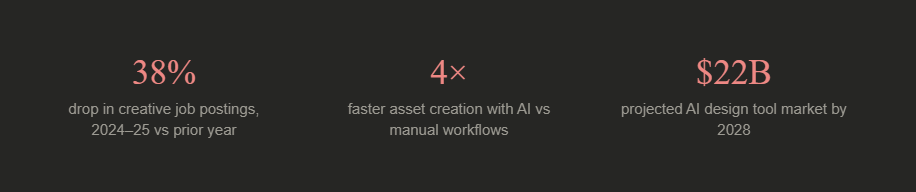
Here’s the thing nobody wants to say at a design conference: entry-level roles are disappearing. Not dramatically, not all at once — just quietly, one headcount at a time. The tasks that used to fill a junior designer’s first year — resizing ads, building social templates, generating product mockups — are now largely automatable. Companies that once hired three juniors now hire one, and that one person is expected to manage AI pipelines, review outputs, and somehow also do the actual thinking.
Freelancers have felt this even more painfully. On platforms like Fiverr and Upwork, the going rate for logo design has collapsed. Clients who once happily paid for craft are now wondering aloud why they can’t just do it themselves in Canva AI. It’s not that designers got worse. It’s that the bar for “good enough” got permanently lowered — and most clients, frankly, don’t know the difference.

Now AI is doing the hiring too
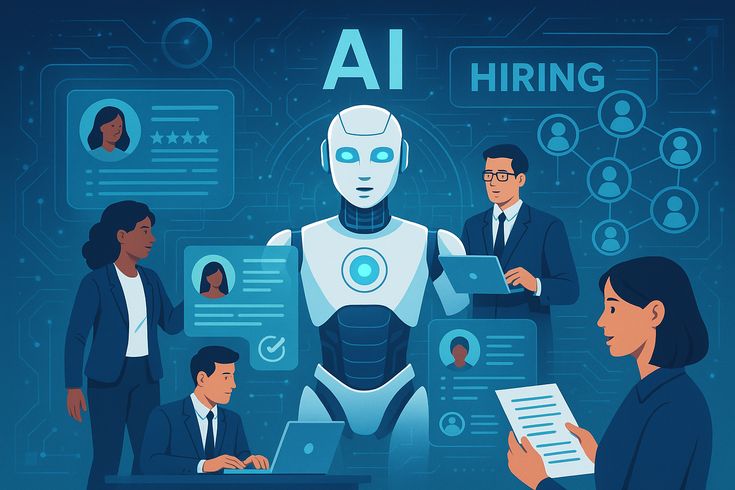
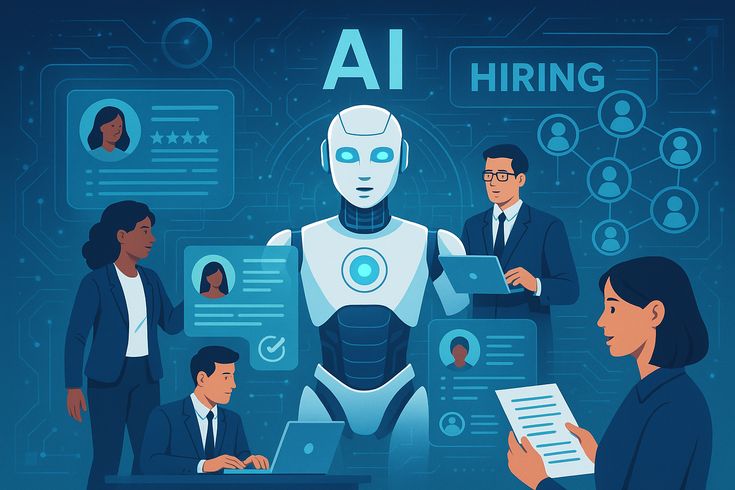
This is where it gets a bit surreal. It’s not just the work being automated — it’s the hiring process itself. Companies are using AI to screen portfolios, rank candidates, and score “design sense” through algorithmic assessments. Your portfolio gets scanned for tool keywords before a human ever lays eyes on it. Automated design challenges are graded by machine before they reach a creative director’s desk.
And here’s the weird loop we’ve created: designers are using AI to build their portfolios — Midjourney for visuals, Firefly for refinement, ChatGPT to write the case study — and then AI on the other side is evaluating those same portfolios. Human judgment, the thing design has always lived and died by, is being squeezed out of both ends of the pipeline. It feels a little like being asked to shout into a room where no one is listening.
What companies are actually doing
I’ve spoken to designers inside big tech teams, and the conversations are remarkably similar. “Right-sizing creative.” “Efficiency-first resourcing.” The language is always careful, always corporate. But what it means is: we used to have 15 designers, now we have 8, and we expect the tools to cover the gap. Those 8 are now part strategist, part creative director, part AI wrangler.
Some studios have quietly stopped hiring juniors altogether — citing “AI scaffolding” as a substitute. But here’s what worries me most about that: you can’t have experienced senior designers in 2030 if nobody is hiring and training juniors in 2025. We’re eating the seed corn. The pipeline that fed the industry for decades is drying up, and we’re not talking about it loudly enough.
- Visual identity & logo design — heavily disrupted by generative AI
- Social media content design — largely automatable with template AI
- UI mockups & wireframing — Figma AI and similar tools accelerating pace
- Stock illustration & iconography — commoditised by image generators
- Junior generalist roles — the first category facing role elimination
What still matters — at least for now
Okay, breathe. This isn’t a eulogy. The designers who are thriving right now aren’t the ones who refused to touch AI out of principle, nor the ones who handed all creative thinking over to it. They’re the ones who figured out that AI is like a very fast, very tireless studio intern — useful, impressive even, but completely lost without someone to give it direction and catch its mistakes.
Strategy. Client empathy. Cultural understanding. Knowing when something is technically correct but emotionally wrong. Knowing when a design solves the brief but misses the point. These are things no model can reliably replicate yet. And the designers who lean into those skills — who make themselves indispensable for their judgment, not just their output — are finding themselves more valued, not less.
The real question nobody’s asking
Some roles that exist in design today will genuinely not exist in 2030. I think most of us know that, even if we don’t say it. What’s less discussed is what we do about it — as individuals, and as an industry. Do we keep letting AI quietly absorb the entry-level work that used to build careers? Do we let hiring algorithms decide who’s worth talking to? Or do we push back — loudly, clearly, in places where it gets heard?
Design has always evolved. Every wave of new tools brought panic and then adaptation. But this one feels different in scale and speed. The response has to be just as intentional. Invest in the craft that can’t be prompted. Build relationships that value your thinking, not just your files. And if AI-generated work is being passed off as considered design, say something.
The algorithm may be hiring. But it still doesn’t know what it actually wants — until a human tells it. Hold onto that.
This piece reflects industry observations and publicly available data on hiring trends, AI tool adoption, and freelance market shifts as of early 2026.