
When Social Media Platforms Finally Agree: Teen Safety Cannot Be a Solo Act
What happens when parents restrict Instagram, but the teenager simply moves to TikTok or YouTube?
That is the uncomfortable reality behind Meta’s latest open letter to TikTok and YouTube.
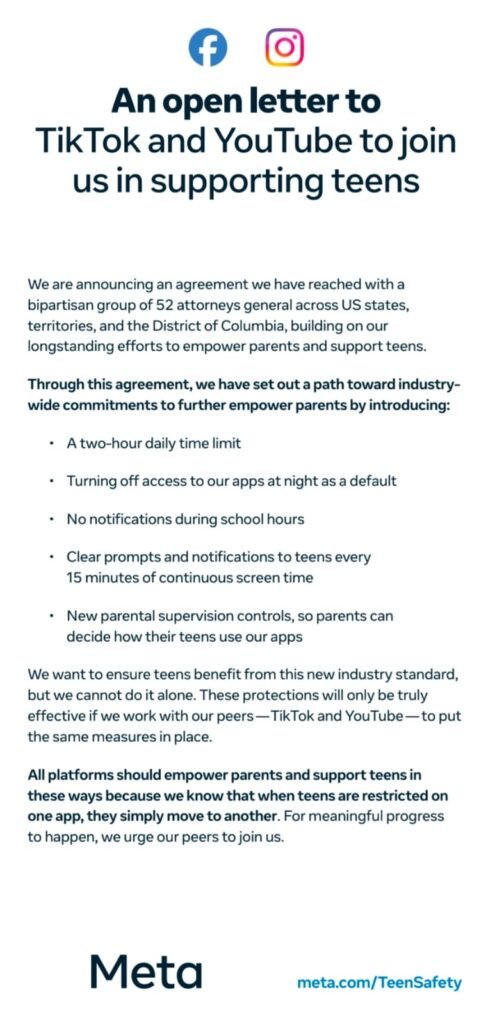
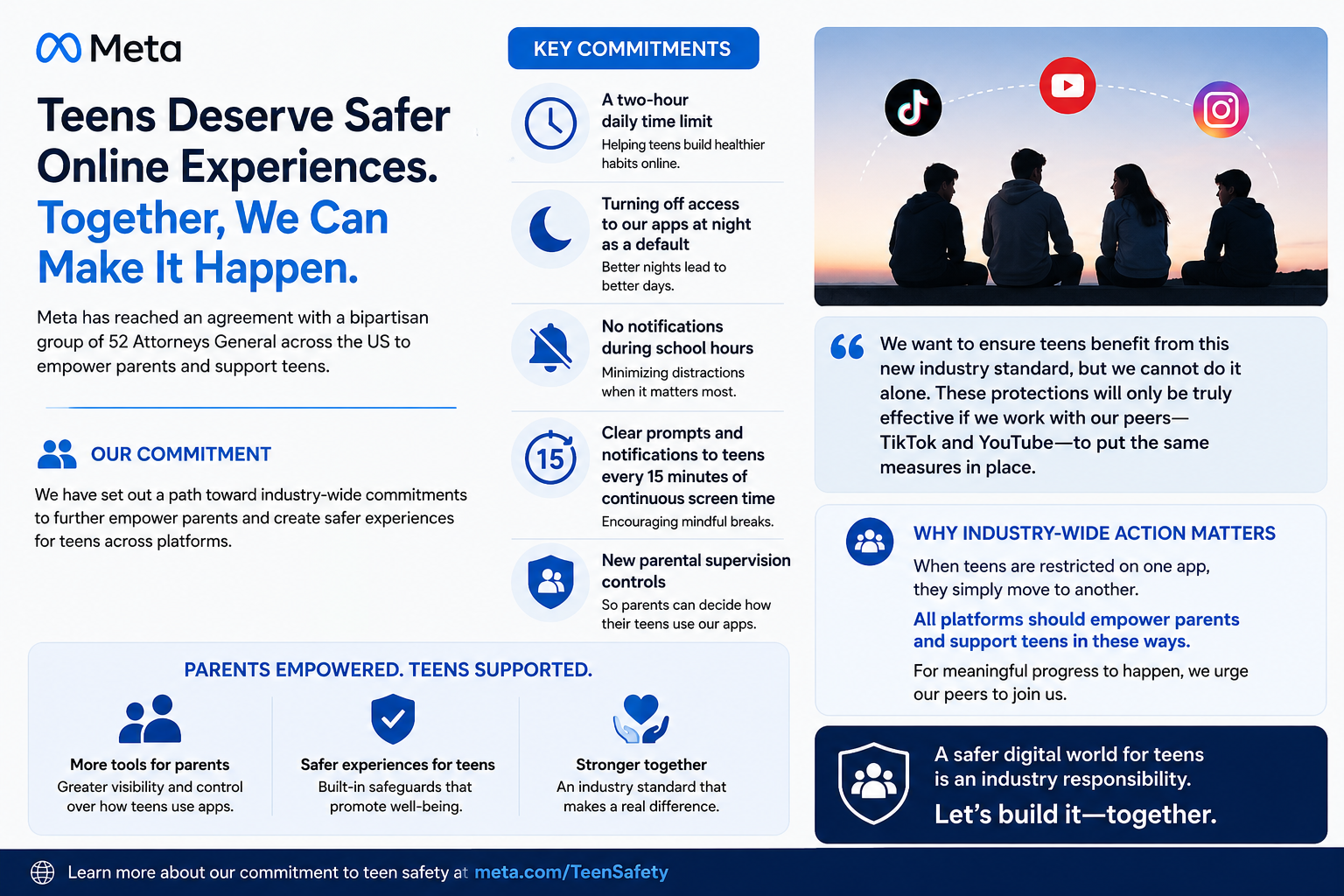
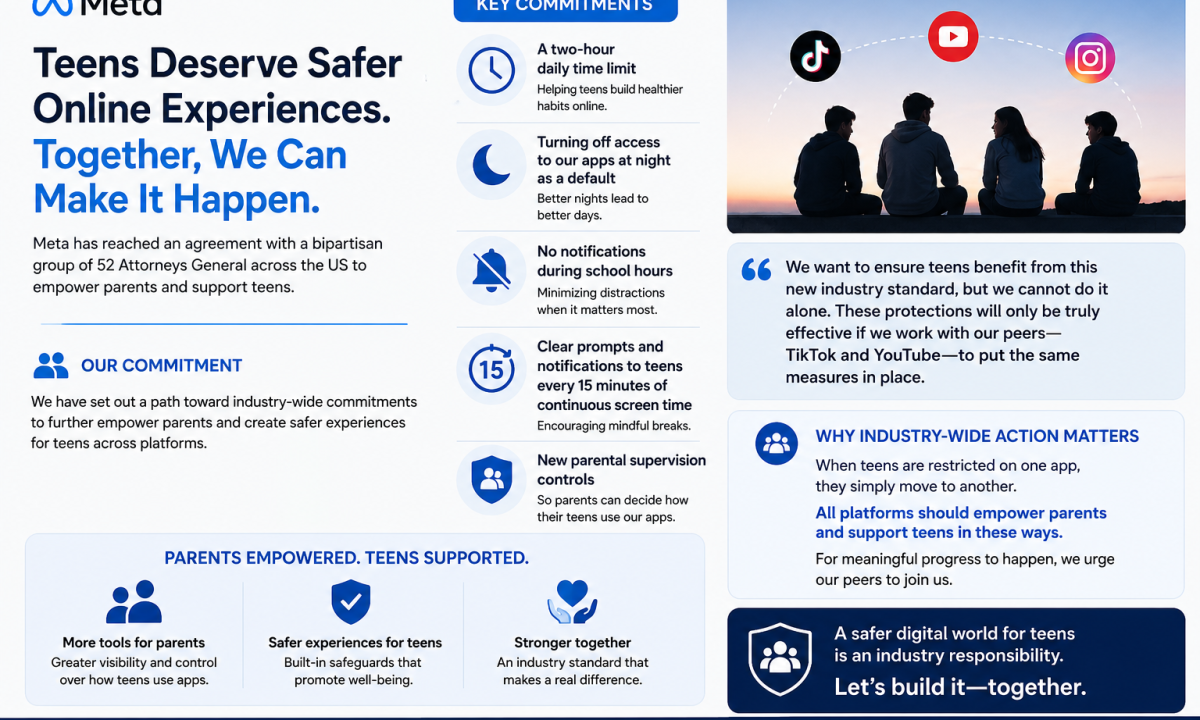
Meta says it has reached an agreement with a bipartisan group of 52 US attorneys general, building on efforts to give parents more control and support teens online.
The proposed industry-wide commitments include:
- A two-hour daily time limit
- Default nighttime restrictions
- No notifications during school hours
- Prompts every 15 minutes of continuous screen time
- Stronger parental supervision controls
On the surface, these sound like sensible safeguards.
But the most interesting part of the announcement isn’t any individual feature.
It is this statement:
“When teens are restricted on one app, they simply move to another.”
And that changes the conversation completely.
The problem isn’t Instagram. It’s the ecosystem.
For years, the debate around teen social-media safety has focused on individual platforms.
Should Instagram change its algorithm?
Should TikTok restrict screen time?
Should YouTube introduce stronger parental controls?
But teenagers don’t experience social media as separate products.
They experience it as one connected digital ecosystem.
If one platform becomes restrictive while another remains frictionless, behaviour simply shifts.
Which means platform-by-platform solutions can only go so far.
The real battle is for attention
There is also a larger question here for marketers.
The entire digital advertising industry has been built around one incredibly valuable commodity:
Attention.
More time spent → more engagement → more data → more advertising opportunities.
But when the user is a teenager, should more engagement always be considered a success metric?
Perhaps this is where the industry needs to rethink what “engagement” actually means.
A teenager spending three hours on an app isn’t necessarily a more successful user experience than one who spends 45 minutes.
Sometimes, the best product decision may actually be getting the user to put the phone down.
From engagement to responsibility
This could be an important shift in how platforms think about product design.
Notifications aren’t neutral.
Infinite scroll isn’t neutral.
Recommendation algorithms aren’t neutral.
The timing and frequency of prompts aren’t neutral.
Every one of these design choices influences behaviour.
And when the audience is young, those choices carry an additional responsibility.
But regulation alone won’t solve this
Technology companies can build controls.
Governments can establish standards.
Parents can set boundaries.
But none of these work particularly well in isolation.
The most interesting idea in Meta’s letter is therefore not a specific screen-time limit.
It is the call for industry-wide participation.
Because if every platform follows the same basic principles, parents aren’t forced to play whack-a-mole across five different apps.
And teens don’t simply migrate from one platform to another.
The bigger question for the industry
We’ve spent the last decade asking:
“How do we keep people engaged?”
Perhaps the next decade needs to ask:
“How do we make engagement healthier?”
That is a much harder question.
And it will require platforms to balance growth with responsibility, parents with technology, and business objectives with the wellbeing of their youngest users.
Because ultimately, teen safety shouldn’t depend on which app a teenager happens to open next.
It needs to become an industry standard.
And that conversation is only just beginning.
#SocialMedia #DigitalMarketing #TeenSafety #Meta #TikTok #YouTube #Technology #Marketing #ResponsibleTech #FutureOfSocialMedia