
Maybe Job-Hopping Isn’t a Red Flag Anymore
Date: 28 August 2026
Theme: Job Hopping, Adaptability & The Future of Careers
For years, I have heard the same advice given to professionals:
“Don’t change jobs too often. It will look bad on your CV.”
Recruiters often looked at someone who had changed companies every year or two and immediately started asking questions.
Is this person unreliable?
Will they leave us too?
Are they incapable of committing?
I understand where that thinking came from.
But I think we may have been looking at job-hopping from the wrong perspective.
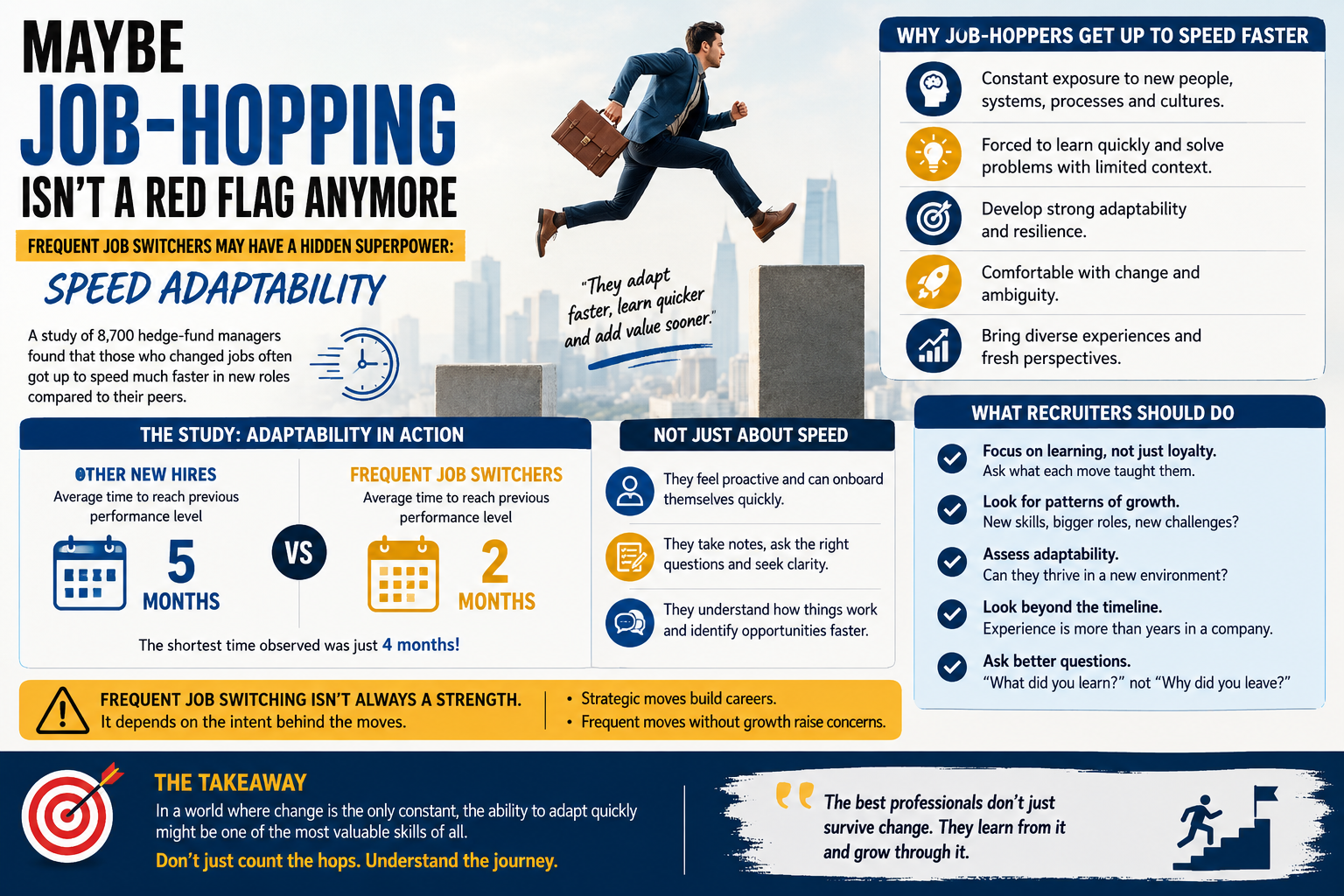
A study highlighted in the accompanying article, involving 8,700 hedge-fund managers, suggests something quite interesting: people who had switched jobs more frequently were able to get up to speed much faster in their new roles.
While other new hires took an average of five months to reach their previous performance levels, frequent job switchers took around two months.
That’s not a small difference.
That’s a potential competitive advantage.
What if changing jobs teaches you how to learn?
This is the part I find most interesting.
When you change organisations repeatedly, you are constantly forced to learn.
New people.
New systems.
New processes.
New cultures.
New customers.
New expectations.
New technologies.
And, most importantly, you have to figure things out without having the luxury of spending years becoming comfortable.
Over time, perhaps you develop a skill that doesn’t appear anywhere on your CV:
The ability to adapt quickly.
And I think that skill is becoming increasingly valuable.
The workplace today isn’t what it was 20 years ago.
Technology changes faster.
Roles change faster.
Companies restructure faster.
Skills become obsolete faster.
AI is already changing the nature of several jobs.
In such an environment, perhaps the ability to adapt is sometimes more valuable than the ability to stay in the same position for ten years.
Experience isn’t always measured in years
This is something I strongly believe.
We have traditionally measured experience using a very simple formula:
10 years in a company = experienced.
But I’m not sure it is that simple.
Someone could spend ten years doing essentially the same job, with the same systems, same customers and same responsibilities.
Another person could spend ten years working across five different companies, industries, teams and business models.
Who has more experience?
There isn’t an obvious answer.
The second person may have experienced five different organisational cultures, multiple leadership styles, different technologies, different customer behaviours and different ways of solving problems.
That experience can create a completely different kind of professional maturity.
Breadth can sometimes be as valuable as depth.
The hidden skill recruiters may be missing
The article uses an interesting phrase:
“Speed adaptability.”
I like that.
Because adaptability is usually treated as a soft skill.
Something we put at the bottom of a CV alongside communication, teamwork and leadership.
But perhaps it deserves much more importance.
Imagine hiring two people.
Candidate A has spent eight years in one organisation.
Candidate B has changed roles several times.
Candidate A knows their previous organisation extremely well.
Candidate B may be much better at walking into an unfamiliar environment and figuring things out.
Now imagine that your company is undergoing a major transformation.
New technology.
New management.
New business model.
New processes.
Which candidate might have the advantage?
It isn’t necessarily the person with the longer tenure.
It may be the person who has repeatedly experienced change.
But let’s not romanticise job-hopping
There is an important caveat here.
I don’t think every job-hopper is automatically an exceptional employee.
There is a difference between strategic career movement and simply moving because the grass looks greener every six months.
Frequent movement can happen for many reasons.
Money.
Poor management.
Career growth.
Toxic culture.
Better opportunities.
Learning new skills.
Personal circumstances.
Or simply because someone doesn’t know what they want.
So I wouldn’t recommend changing jobs just to make your CV look more dynamic.
The lesson isn’t:
“Change jobs frequently.”
The lesson is:
“Don’t automatically assume that frequent job changes mean poor performance or low commitment.”
That’s a very different argument.
What recruiters should start asking
Perhaps the interview question shouldn’t be:
“Why have you changed jobs so many times?”
Maybe it should be:
“What did each move teach you?”
That’s a much better question.
If someone has changed five companies and can clearly explain how every move helped them develop new capabilities, that’s valuable information.
Did they learn a new technology?
Did they manage a larger team?
Did they enter a new industry?
Did they work with international clients?
Did they move from execution to strategy?
Did they learn how different organisations operate?
If the answer is yes, then the CV isn’t necessarily showing instability.
It could be showing intentional learning.
The AI era makes this even more relevant
This is where the story becomes particularly interesting for me as someone working in digital marketing and training.
I have watched marketing roles change dramatically over the years.
SEO changed.
Social media emerged.
Performance marketing exploded.
Marketing automation became mainstream.
Data became central.
Then generative AI arrived.
And now marketers are expected to understand AI tools, automation, analytics, content, creativity and strategy simultaneously.
The ability to learn one skill and keep doing exactly the same thing for 15 years is becoming increasingly risky.
The professionals who will probably thrive are those who can repeatedly say:
“I don’t know this yet, but I can learn it.”
That mindset is more important than ever.
Job-hopping can also create a dangerous illusion
There is another side to this.
Someone who changes jobs frequently may become very good at starting.
But starting isn’t the same as building.
Every new organisation gives you the excitement of a clean slate.
New title.
New office.
New colleagues.
New challenges.
But some of the most valuable professional experiences come after the honeymoon period.
When you have to fix something that isn’t working.
When you have to manage a difficult stakeholder.
When you have to stay through a difficult business cycle.
When you have to build something that takes three years rather than three months.
So I wouldn’t say that staying is bad either.
Sometimes resilience is the skill.
The smartest professionals, in my opinion, learn both:
How to adapt quickly and how to stay long enough to create meaningful impact.
The future of careers may be less linear
I think the traditional career ladder is already disappearing.
The old model was something like:
Junior → Manager → Senior Manager → Director → VP → CXO
The new model may look more like:
Learn → Build → Switch → Relearn → Experiment → Lead → Reinvent
And that’s not necessarily a bad thing.
Careers are becoming portfolios of experiences rather than a single uninterrupted story.
Someone might work in an agency.
Then move to a startup.
Then join a large corporation.
Then become a consultant.
Then build their own business.
Then return to a corporate role.
From a traditional HR perspective, that might look messy.
From a learning perspective, it might be incredibly valuable.
My takeaway
I think we need to stop asking whether someone is a job-hopper and start asking whether they are a learning-hopper.
There is a big difference.
If someone keeps changing jobs but keeps learning, expanding their capabilities and taking on bigger challenges, I wouldn’t automatically see that as a weakness.
I might actually see it as evidence of adaptability.
But if someone changes jobs repeatedly without building anything meaningful, then the pattern tells a different story.
Ultimately, the number of companies on your CV isn’t the most important thing.
The capabilities you accumulated while moving between them are.
And perhaps recruiters need to rethink one of their oldest assumptions.
The person who has stayed in one place for ten years may have demonstrated loyalty.
But the person who has successfully navigated five different environments may have developed something equally valuable:
the ability to land somewhere new and become useful very quickly.
In a world where change is no longer an exception but the default, that might just be the hidden superpower we have been overlooking.
Source: Based on the article/image provided, citing research involving 8,700 hedge-fund managers and researchers from Rutgers and Cornell universities.