

A person searching for a product or business may no longer start and end their search with Google. They may ask an AI assistant for tips, compare answers across platforms, then visit a website to decide. This shift is changing how businesses approach search visibility.
This is where AI-Powered SEO in India is becoming an important part of the conversation for businesses and marketing teams.
For Indian marketers, SEO is becoming less about rankings alone and more about being found wherever people seek answers.
Quick Answer
AI-Powered SEO in India is growing in two linked areas. Marketers use AI to improve SEO workflows. Consumers are also using AI assistants more for information.
Google is also introducing AI-powered search experiences. However, traditional SEO fundamentals still matter. Businesses need useful content, strong technical foundations, and clear expertise to remain discoverable.
What Happened?
AI is changing how SEO professionals research, create, optimise, and measure content. The growing adoption of AI-Powered SEO in India reflects how marketing teams are using artificial intelligence to improve everyday search optimisation tasks.
Indian marketing teams are already experimenting with these capabilities. Digital Uncovered’s India B2B AI Marketing Benchmark Report 2026 surveyed 30 B2B marketing practitioners. The survey ran from March 26 to April 7.
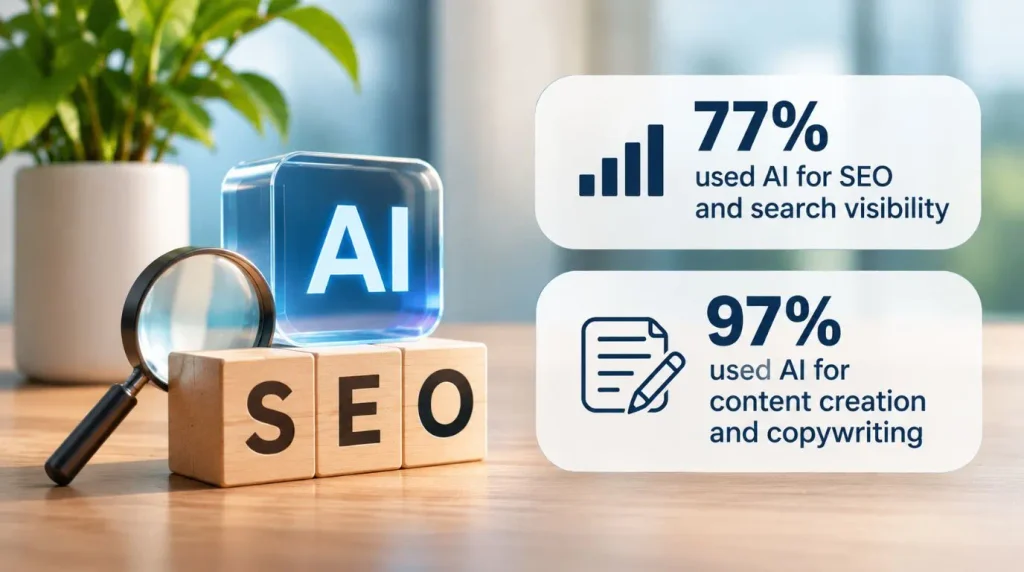
It found that 77% used AI for SEO and search visibility. The report also found that 97% used AI for content creation and copywriting. This suggests AI is becoming part of everyday marketing work. However, we should not treat the survey’s small, B2B-focused sample as representative of all Indian SEO professionals.
For now, AI-Powered SEO in India appears to be gaining traction among B2B marketing practitioners, although wider industry adoption still needs to be studied.
Search behaviour is changing too.
YouGov based its India Web Search and AI Report 2026, published on July 8, on a survey of more than 1,000 Indian adults. It examined how people move between search engines, AI assistants, maps, and marketplaces to find information.
Its central finding is important: online discovery is no longer confined to one platform. People use different services depending on what they want to find.
Google is also changing its search experience through AI Overviews and AI Mode. These features use AI to help users understand more complicated questions and explore information through supporting links.
Google’s official guidance makes one point clear: existing SEO best practices remain relevant. Websites do not need separate technical requirements or special AI-only markup to appear in these experiences.
Together, these developments show that AI influences both how marketers perform SEO and how people discover information.
Why It Matters
For years, SEO strategies have focused heavily on improving visibility in conventional search results. That objective still matters. However, AI-Powered SEO in India now needs to account for how users discover information through AI assistants and search summaries.
But when users receive AI-generated summaries or recommendations, the journey towards a website can become different.
A user looking for the best CRM software might ask an AI assistant to compare several platforms. They may do this before visiting the platforms’ websites. A traditional search may still be part of that journey, but it is no longer necessarily the only starting point.
This creates a new challenge for businesses. They need to know where their audiences search. They should know what information people expect. They must understand how their brand appears in different discovery experiences.
A growing distinction is also emerging between traffic and visibility. An AI-generated answer might reference a website without a user directly visiting it. Conversely, a business may receive website traffic even if an AI response does not mention it.
Do not treat these outcomes as interchangeable.
For Indian businesses, the opportunity is significant. DataReportal’s Digital 2026 report estimated that India had 1.03 billion internet users at the end of October 2025. That represents a large and diverse audience with different search habits, languages, and information needs.
SEO strategies must account for this diversity rather than assume that every customer follows the same search journey.
What Businesses And Marketers Need To Know
- AI is becoming an SEO assistant, not an SEO strategy
AI tools help marketers find keyword ideas and analyse search intent. They can also generate content outlines, identify content gaps, and organise research. They can also reduce time spent on repetitive tasks.
However, AI-generated recommendations still need human evaluation. A keyword with high estimated search volume may not attract the right audience. A generated article may cover a topic without offering anything original.
The objective should be to use AI to improve research and execution, not outsource strategic decisions. This is an important distinction for businesses investing in AI-Powered SEO in India because better tools do not automatically produce better search results.
- Content needs to offer more than a summary
AI systems can summarise information that already exists across the web. This makes original insights more valuable. A strong AI-Powered SEO in India strategy should therefore prioritise useful information, first-hand experience and content that answers specific customer questions.
Businesses should publish content that includes expert explanations, real examples, original research, product knowledge and practical experience.
Google’s guidance for AI search specifically encourages unique, useful content rather than material that simply repeats information available elsewhere.
For Indian businesses, this creates a chance to answer local questions and meet regional needs. It also helps with pricing and market-specific problems that generic content may miss.
- Technical SEO remains important
AI-powered search does not remove the need for a technically accessible website.
Search engines still need to discover, crawl, and index relevant pages. Businesses should continue monitoring indexing, internal links, website performance, mobile usability, and structured data.
Google also says websites do not need special AI files to show up in its AI search features. They also do not need extra schema markup or artificial content-chunking techniques.
This is important because businesses can waste time implementing supposed AI SEO hacks instead of fixing actual website problems. In practice, AI-Powered SEO in India still depends on websites being accessible, technically sound, and easy for search engines to understand.
- Measure more than traditional rankings
Rank tracking remains useful, but it cannot explain every change in search visibility. Businesses should track organic clicks, impressions, conversions, and engagement. Use tools like Google Search Console and Google Analytics 4.
They can also track whether their brand appears in relevant AI-generated answers using third-party monitoring platforms. However, these platforms use different methods. So, treat their results as guidance, not official Google ranking data.
The important question is whether visibility is reaching the right audience and contributing to business objectives.
- India’s regional search opportunity deserves attention
India’s search market is linguistically diverse. Businesses cannot assume that English-language content addresses every customer’s needs.
AI tools can help with translation, localisation and regional content research. But direct translation is not the same as understanding local search intent.
Businesses should consider the language, terminology, cultural context and purchasing behaviour of their target audiences.
This is especially relevant for local businesses, ecommerce brands and companies serving customers across multiple Indian states.
The Number That Matters
77%
Digital Uncovered’s India B2B AI Marketing Benchmark Report 2026 found that 77% of 30 surveyed B2B marketers used AI. They used it for SEO and search visibility.
The finding suggests that people already apply AI to more than content writing. Marketing teams are also exploring its role in search research and optimisation.
However, the sample is small and focused on B2B practitioners. Read it as an early industry indicator, not a nationwide AI SEO adoption rate.
What Happens Next?

The next phase of AI-powered SEO in India will likely bring more overlap. It will connect traditional search, AI assistants, and other discovery platforms. As adoption grows, AI-Powered SEO in India will increasingly involve understanding how content appears across traditional search results and AI-generated responses.
SEO teams must understand how their content performs across these experiences. They should not abandon the fundamentals that make websites discoverable.
AI-powered research and automation may become more common. At the same time, businesses will need stronger editorial standards. This will stop inaccurate, repeated, or generic content from reaching their websites.
The bigger question is how measurement will evolve. Marketers need clearer ways to understand when AI-generated search experiences influence discovery, brand consideration, and eventual conversions.
What remains unclear is how much website traffic will shift between traditional search and AI-assisted discovery. The answer may differ by industry, query type, and audience.
DMT Take on AI-Powered SEO in India
The most interesting part of AI-powered SEO is not that machines can now write articles or suggest keywords. The definition of search visibility is expanding.
This is the real shift behind AI-Powered SEO in India: businesses must think beyond rankings and understand how customers discover, evaluate, and choose brands.
A business may rank well in standard search yet still be missing from AI-generated answers customers read. Another business may receive AI mentions but struggle to turn that visibility into enquiries.
At DMT, we believe Indian businesses should not treat AI SEO as a separate discipline. They should also avoid chasing every new optimisation trend. Build technically sound websites. Understand what customers are asking. Publish original, useful information. Strengthen expertise and measure actual business outcomes.
AI can make SEO work faster, but it cannot compensate for a weak website or content that offers little value.
The businesses that adapt will understand both sides of this change. AI is transforming SEO workflows. People are also changing how they search.
Sources:
- Google Search Central – Guide to Optimising for Generative AI Features. Read the guide.
- Digital Uncovered – India B2B AI Marketing Benchmark Report 2026. Read the report.
- YouGov – India: Searching for Answers, July 8, 2026. Read the report overview.
- DataReportal – Digital 2026: India. Read the report
See Also: AI-Generated Content: Do Marketers Truly Trust It in 2026?

Daksh Juneja is a performance marketing expert, trainer, and content creator featured in HT Tech. He helps businesses drive up to 4X ROI through Google and Meta Ads.