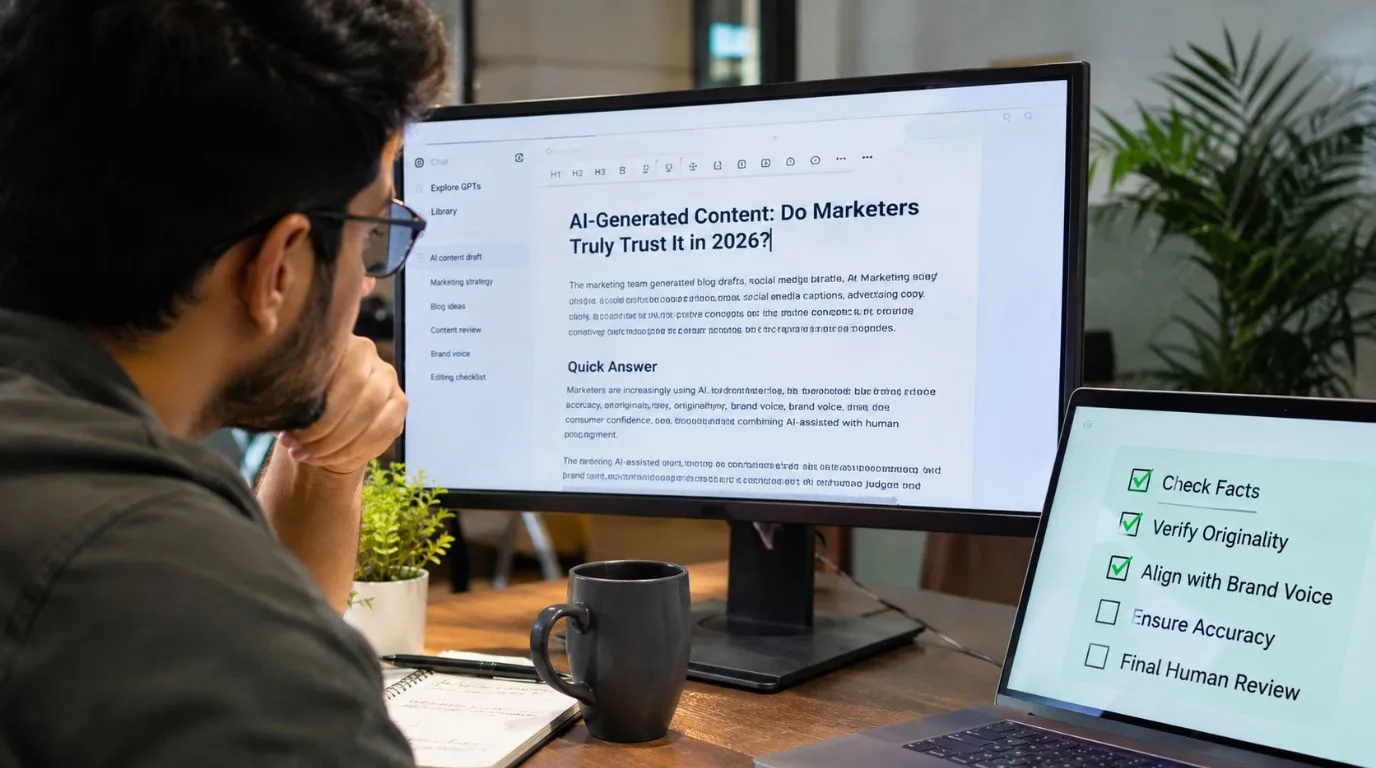

A marketing team can now generate blog drafts, social media captions, advertising copy, and creative concepts in minutes. AI has made content production faster and more accessible. But there is a difference between using AI to create something and trusting it enough to publish without checking. That difference matters more as AI takes a larger role in marketing.
Quick Answer
Marketers are increasingly using AI to create content, but their trust remains conditional. Research shows most professionals still review AI-generated material before publishing. However, the increasing adoption of AI-Generated Content does not mean marketers are ready to trust every output without human supervision.
Accuracy, originality, brand voice, and consumer confidence remain concerns. The emerging approach is not to choose humans or AI. To combine AI-assisted work with human judgment.
What Happened?
AI-generated content has moved from experimentation to regular use in marketing workflows. The shift towards AI-Generated Content reflects a wider change in how businesses produce and manage their marketing material.
Ahrefs’ 2026 State of AI in Content Marketing survey, published on September 30, gathered responses from 301 marketers. It found that 93% used AI to create or help create content, compared with 87% in its 2025 survey.
The research also found that 61% of respondents became more positive about AI-generated content over the past year. Yet this growing confidence does not mean marketers are ready to accept every AI output without review.
This suggests that marketers are becoming more accepting of AI-Generated Content, even though they still have concerns about its reliability.
Two-thirds of respondents said they trust AI-generated written content only when a human reviews it first. Just 2.7% said they trust it without any human review. Meanwhile, 89% of AI users manually check AI-generated content, up from 80% in 2025.
Consumer research presents another side of the picture.
A September 2026 Gartner survey of 1,006 US consumers found that 65% believed brands used too much AI content. Another 57% said this content had made them less trusting of brand messaging overall.
The industry is therefore facing two different realities. Marketers are becoming more comfortable using AI, while some consumers are becoming more cautious about the content brands publish.
Why It Matters

The growing use of AI does not automatically make marketing content better. AI can produce a polished paragraph, an advertising headline, or a social media caption. But a well-written sentence is not necessarily accurate, original, or useful to the intended audience.
Consider a brand publishing an AI-generated article about a technical product. The article may read well, but it may include wrong specifications, outdated details, or claims the company cannot support.
The same issue applies to advertising. An AI-generated image may look professional but fail to represent the actual product. A campaign message may sound persuasive but make promises the business cannot fulfil.
These problems can affect more than content quality. They can influence customer expectations and brand credibility.
Consumer trust matters because audiences do not always know how someone created a piece of content. They judge what they see based on its accuracy, usefulness, and authenticity.
Gartner’s findings suggest that simply increasing content production may not be enough. If audiences begin associating brands with repetitive or low-quality AI material, publishing more could become counterproductive.
What Businesses And Marketers Need To Know
- AI adoption is not the same as AI trust
A marketer may use AI every day without trusting it to make the final decisions. AI can help with research, outlines, first drafts, content variations, and idea generation. But factual claims, brand messaging, and important customer communications need closer attention.
Businesses should distinguish between tasks where AI can work independently and those where human approval is necessary.
- Human review must involve more than proofreading
Checking grammar and spelling is not enough. A reviewer should verify facts, statistics, product information, quotations, and references. They should also check whether the content reflects the brand’s positioning and addresses the audience’s actual needs.
An AI-generated article can be grammatically correct and still be misleading.
The reviewer must understand the subject well enough to identify what the AI may have misunderstood or invented. This is particularly important when AI-Generated Content includes technical information, industry statistics, or claims about a product.
- Originality is becoming more valuable
AI tools can generate large volumes of content, but producing more material does not guarantee a distinctive brand voice.
If many businesses use similar prompts and the same AI patterns, their content may start sounding alike.
Marketers should bring original research, customer experiences, expert opinions, campaign observations, and genuine business insights into their content. AI can help organise these inputs. It cannot replace the value of having something meaningful to say.
Without these inputs, AI-Generated Content can become another source of repetitive material rather than a way to create distinctive brand communication.
- Consumer trust needs to be considered
Marketers should not assume that customers are comfortable with every use of AI.
Gartner’s research indicates that some consumers are concerned about the growing volume of AI-generated marketing material. This makes transparency, accuracy, and relevance important considerations.
Businesses should also establish clear rules for AI-generated images, testimonials, product descriptions, and other customer-facing material.
The objective should be to use AI in ways that improve the customer experience rather than simply increase output. The long-term value of AI-Generated Content will depend partly on whether audiences find it relevant, transparent, and trustworthy.
- AI is moving beyond content creation
Meta’s October 2026 announcement at Advertising Week New York illustrates how this role is expanding. The company is testing new features in its AI Business Assistant. These features will help advertisers plan and create campaigns.
Advertisers can also generate images and write text. They can adjust targeting and change budgets using chat-style instructions. Meta says previews, approvals, and controls will allow advertisers to decide what to delegate.
This is an important development because AI is moving from generating marketing material towards helping execute marketing decisions.
However, we are testing the capabilities described. Do not confuse them with a fully autonomous advertising system that every advertiser can already use.
For marketers, this raises a bigger question.
How much control should businesses give AI when it shapes what they publish? How much control should it have when it affects their advertising budgets?
The Number That Matters
66%
Ahrefs’ 2026 survey found that 66% of marketers trust AI-written content only after a human reviews it. The figure captures the central tension in AI-assisted marketing.
Professionals are comfortable using AI, but they still want a person to take responsibility for the final output. Only 2.7% of respondents said they trust AI-generated content without any human review.
The survey included 301 respondents. So, its findings show the views of those surveyed. They do not measure every marketer worldwide.
What Happens Next?

The next stage of AI content marketing will likely focus less on creating content. The focus will be more on how reviewers review, personalise, and evaluate content.
Businesses will need clearer processes for checking AI-generated information, protecting brand voice and approving customer-facing content. Businesses will also need to decide which types of AI-Generated Content require expert review, editorial approval, or additional fact-checking.
AI tools will also become more closely connected to marketing platforms. Meta’s advertising assistant is one example of this shift, although its more advanced campaign-execution features remain in testing.
What remains unclear is how much work marketers will delegate to AI systems. Businesses also lack clarity on how they will measure decision quality.
The industry will also need to pay attention to consumer behaviour. If people grow more sceptical of generic AI-made content, brands must work harder to show expertise and originality.
DMT Take on AI-Generated Content
The key point in this discussion is that marketers do not seem to choose between AI and human creativity. They are trying to work out where each belongs.
AI is useful when it reduces repetitive work, speeds up research, and helps teams explore more ideas. But speed should not become the main measure of content quality.
At DMT, we believe the real advantage will come from marketers who know how to use AI without becoming dependent on it. A brand should not publish an article simply because AI can write one. It should publish because the article offers something accurate, useful, and worth reading.
AI can help create the first draft. It can suggest a better headline, organise research, and improve readability. But someone still needs to decide whether the content deserves to represent the brand.
How much content businesses can generate will not determine the future of AI marketing. How much of that content people can actually trust will determine it.
Sources:
- Ahrefs – 2026 State of AI in Content Marketing Survey, September 30, 2026. Primary research for marketer adoption, attitudes towards AI quality, human review, and publishing practices. Read the research.
- Gartner – Marketing Survey, September 22, 2026. Consumer attitudes towards AI-generated brand and influencer content, based on 1,006 US consumers. Read the findings.
- Meta – Advertising Week New York, October 6, 2026. Official announcement of AI assistant improvements and agentic advertising capabilities. Read Meta’s announcement
See Also: Technology Skills in Demand in India: 2026 Guide

Daksh Juneja is a performance marketing expert, trainer, and content creator featured in HT Tech. He helps businesses drive up to 4X ROI through Google and Meta Ads.