


India’s AI startup scene is attracting bigger cheques.
But the most interesting change involves more than just the amount we are raising. It is the growing importance of infrastructure, foundation models, and AI products built for real business needs. Investors are backing a wider range of companies, yet questions about computing costs, valuations, and revenue remain.
The Indian AI startup funding boom is testing whether India can turn AI ambition into durable businesses.
Quick Answer
Indian AI startup funding accelerated in 2026. Inc42 reported that AI startups raised $438 million in the third quarter alone, bringing first-nine-month funding to around $1.1 billion. The capital is flowing into infrastructure and AI applications, but strong funding figures do not guarantee commercial success.
What Happened?
Inc42’s Indian Tech Startup Funding Report for Q3 2026 found that Indian AI startups raised $438 million. They raised it across 35 deals from July to September. That was a 265% increase year on year, making AI the most-funded sector in the quarter. The report put cumulative AI funding for the first nine months of 2026 at approximately $1.1 billion.
The momentum follows a strong first half. Inc42 reported $676 million raised across 57 AI funding deals in H1 2026. That is more than four times the $162 million recorded in H1 2025.
The funding mix is just as important as the total. CRISIL’s June 2026 analysis said India’s AI sector attracted more capital in the first half of 2026. It drew more capital than in 2025.
Two funding rounds largely drove this rise. Neysa Networks raised $600 million. Sarvam AI closed a $234 million Series B.
CRISIL also found that nearly half of tracked AI capital went to infrastructure. This covers the period from January 2022 to June 2026. It included GPU cloud services and other computing capacity.
These figures come from different research providers. They may use different definitions for AI companies, funding events, and reporting periods. Do not combine them as though they form one uniform dataset.
The shared signal, however, is clear: investor attention towards the Indian AI startup funding ecosystem has strengthened.
Why It Matters
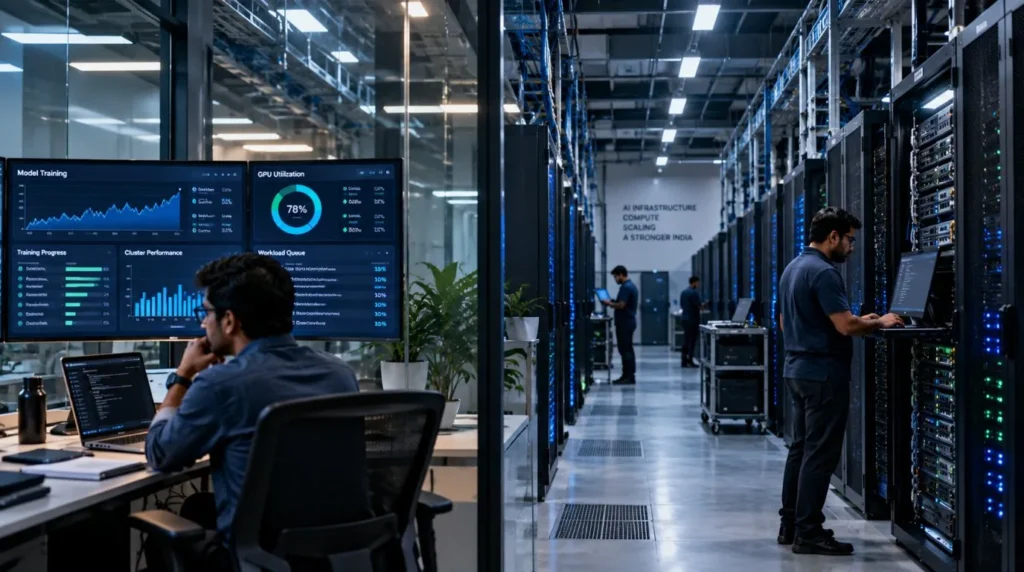
AI startups need more than software developers and a compelling product demo.
Building and running AI systems can be expensive. It may require costly computing infrastructure and specialised hardware. It also needs reliable data. You must be able to serve customers at scale.
That creates two connected investment opportunities. Infrastructure companies provide the computing capacity that AI developers need. Application-layer startups use AI to solve problems in sectors such as finance, healthcare, customer service, and enterprise software.
India has an opportunity in both areas. Its large digital market and software talent base can support products for local business needs, languages, and price points. But competing in foundation models or large-scale computing also needs money and technical skills. Many young startups cannot get these easily.
The Indian AI startup funding trend raises a strategic question: will India build firms with world-class technology?
Or will most value stay in infrastructure and apps built around models from elsewhere? The answer may differ by category.
What Businesses And Marketers Need To Know

1. Follow the use case, not just the funding round. A large investment shows investor confidence, not proof of product-market fit. Businesses picking AI vendors should look for paying customers, clear results, and a clear reason it beats alternatives.
2. Infrastructure is part of the AI business model. Computing costs affect pricing, margins, and the ability to scale. For AI startups, access to reliable compute can be a competitive advantage. For buyers, infrastructure choices can affect the long-term cost of using an AI service.
3. Applied AI needs a defensible advantage. A startup building on widely available models needs more than a polished interface. Proprietary workflows, domain expertise, distribution, customer data rights, or measurable performance can help differentiate its offering.
4. Valuation is not the same as business maturity. CRISIL has warned that valuations in parts of India’s AI ecosystem have run ahead of established commercial revenue. Investors and customers should distinguish money raised from recurring revenue, customer retention, and unit economics.
5. Founders should match capital to the problem. Infrastructure businesses may need substantial upfront investment, while some software applications can test demand with smaller budgets. The right funding strategy depends on the company’s costs, customer acquisition cycle, and path to revenue.
The Number That Matters
$1.1 billion – Approximate Indian AI startup funding raised in the first nine months of 2026.
Source: Inc42’s Q3 2026 funding report and accompanying analysis.
This figure captures the scale of investor interest, but it also needs context. A small number of large rounds concentrate a meaningful portion of the funding. The total does not mean every AI startup can access capital more easily. It also does not show how much revenue the sector generates.
What Happens Next?
People will judge the next phase by what startups deliver after raising money. Investors will want to see if companies can keep their customers.
They will also look for higher profit margins. They will want proof that companies can build products that remain useful as AI models become cheaper and more capable.
Three areas need attention:
- The first is the cost of AI infrastructure.
- The second is how companies adopt AI products built locally.
- The third is whether startups can build technology that is hard to replace.
Government support, such as the IndiaAI Mission, may affect access to computing resources.
It may also help grow India’s AI ecosystem. But public support and private investment will need to translate into commercially sustainable services.
DMT Take on Indian AI Startup Funding Trends
Indian AI startup funding story is becoming more substantial, but the amount raised is only the first chapter.
Infrastructure funding can help close real gaps in computing capacity. Applied AI can bring automation to everyday business problems. Foundation models can strengthen local capabilities. Yet none of these categories guarantees lasting companies simply because investors show interest.
The more useful question is not which startup raised the biggest round. It is which businesses can turn capital into a product customers keep paying for.
Our view at DMT:
People may remember 2026 less for the size of India’s AI funding boom. People may remember it more for whether that money builds a durable, commercial AI ecosystem. The next winners will need more than capital and a compelling AI story. They will need technology, distribution, cost discipline, and customers who see enough value to stay.
Sources:
- Inc42: Indian AI Startup Funding Surges 265% YoY in Q3 2026 — Q3 funding, deal count and nine-month funding estimates.
- Inc42: Indian Tech Startup Funding Report, Q3 2026 — Sector-level funding data and investor sentiment.
- Inc42: Indian AI Startup Funding Soars Over 4X YoY in H1 2026 — First-half funding trends and deal activity.
- CRISIL Intelligence: Indian AI’s Three Tests — Analysis of infrastructure, growth capital and commercial viability.
- Venture Intelligence: India AI & Deep Tech Investment Report 2025 — Additional context on AI and deep-tech investment trends.
Read Next DMT Original Blog Here – Most In-Demand AI Roles in 2026: Best Skills to Learn

Daksh Juneja is a performance marketing expert, trainer, and content creator featured in HT Tech. He helps businesses drive up to 4X ROI through Google and Meta Ads.