
A software developer who knows a programming language is valuable.
But can they use AI tools to build software? Can they understand cloud systems? Can they keep applications secure? Can they use data to solve business problems?
These are some of the technology skills in demand as Indian companies rethink what they expect from technical professionals.
That combination is becoming increasingly relevant as Indian companies adopt new technologies. The demand for technical talent isn’t disappearing; expectations for technology roles are changing.
Quick Answer
The technology skills in demand in India include artificial intelligence, data analytics, cybersecurity, cloud computing, and software engineering. Growing demand for automation, platform engineering, and technology literacy supports these capabilities.
The strongest candidates will combine practical technical ability with problem-solving, communication, and an understanding of how technology supports business operations.
What Happened?
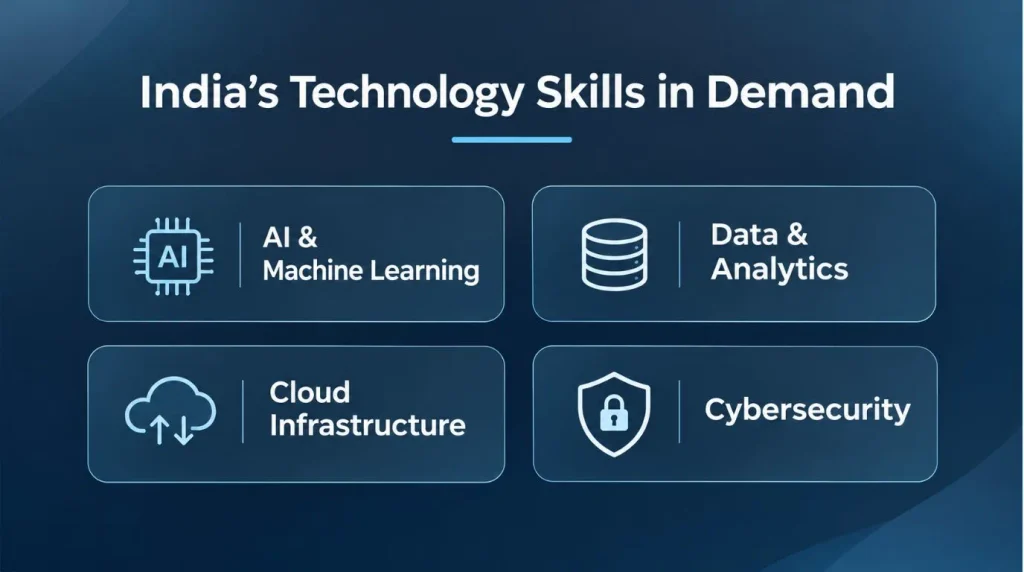
India’s technology workforce is facing a shift in the capabilities employers need. The shift in technology skills in demand reflects how businesses are adopting AI, data-driven systems, cloud infrastructure, and digital security.
NIIT released the India Skills Gap Report 2026 on 31 March 2026. It was published in partnership with YouGov. The report surveyed 3,500 respondents.
These included students, working professionals, recruiters, CXOs, and academic leaders. It found that digital and data skills ranked among the top three critical skills. This was true for the next three to five years across all surveyed groups. Cybersecurity also emerged as a major workforce priority.
The report reflects demand across several sectors, including IT and IT-enabled services, banking and financial services, manufacturing, healthcare, e-commerce, telecommunications and government.
This makes digital and data capabilities central to the technology skills in demand across India’s changing workforce.
The World Economic Forum’s Future of Jobs Report 2025 provides a wider perspective. It names AI and data, networks and cybersecurity, and tech literacy as fast-growing global skills through 2030. Its India-specific analysis also lists Big Data Specialists, AI and Machine Learning Specialists, and Security Management Specialists. These are among the country’s fastest-growing job roles.
Cybersecurity research adds another dimension. The Data Security Council of India’s Cyber Security Skilling Landscape 2025–2026 reports hiring challenges. Organisations struggle to find candidates with practical security skills. This is especially true as cloud infrastructure, AI, and connected systems grow more complex.
These findings point to a broader change. Companies need people who can build technology and manage it. They also need people who can analyse its data and protect related systems.
Why It Matters
Technology is no longer limited to the IT department. This wider adoption is one reason technology skills in demand are no longer relevant only to traditional IT roles.
Banks use data and AI to support risk analysis. Retailers rely on software platforms to manage inventory and customer experiences. Manufacturers use connected systems and automation. Marketing teams work with analytics, customer data, and AI tools.
As technology spreads across departments, the need for people who understand both technical systems and business requirements increases.
This also changes the meaning of employability. Knowing a tool or earning a certification may help someone get noticed. Employers still need people who can use that knowledge at work.
For professionals, the opportunity is to develop skills that remain useful across different tools and platforms. For companies, the challenge is to hire and train people who can put those skills into practice.
What Businesses and Professionals Need to Know
The following areas highlight the technology skills in demand across Indian businesses, from specialist engineering roles to technology-enabled business functions.
- Artificial intelligence and machine learning
AI is one of the clearest areas of growing technology demand. Companies are exploring generative AI, predictive analytics, intelligent automation, and AI-assisted workflows.
AI and machine learning are among the most visible technology skills in demand, particularly as companies explore automation and AI-assisted workflows.
Useful capabilities include:
- Python and machine learning fundamentals
- Working with large language models and APIs
- Retrieval-augmented generation (RAG)
- Model evaluation and monitoring
- AI workflow integration
- Responsible AI and governance
The important distinction is between knowing how to use an AI tool and knowing how to build, integrate, or manage AI systems.
A business may need employees who use AI to improve daily work. A technology company may need engineers who build production-ready AI applications. These are different skill requirements.
- Data analytics and Data engineering
AI systems and business decisions depend on data that is accessible, accurate, and organised.
Data analytics and data engineering remain important technology skills in demand because reliable data supports both AI systems and everyday business decisions.
Companies need professionals who can collect, clean, manage, and interpret data. This creates demand for skills such as SQL, Python, data visualisation, database management, and business intelligence.
Tools such as Power BI and Tableau help teams turn data into reports and dashboards. Data engineering skills are equally important because businesses need reliable pipelines and infrastructure before they can draw useful conclusions.
People without the job title of data analyst also have the opportunity. Product managers, marketers, finance professionals, and operations teams also benefit from understanding data.
- Cybersecurity and cloud security
As businesses move more operations online, security becomes part of everyday technology management.
Cybersecurity is another critical area among the technology skills in demand, as organisations face growing risks across applications, networks, and cloud environments.
Companies need professionals who can identify vulnerabilities, monitor threats, protect applications, and manage access to sensitive information.
Important areas include:
- Network and application security
- Cloud security
- Identity and access management
- Security operations and threat analysis
- Risk management and compliance
- AI security
The Data Security Council of India’s 2025–26 report found a skills gap.
It said 73% of surveyed enterprises had limited access to skilled cybersecurity candidates. It also said 68% of service providers had the same issue.
This is particularly relevant because security knowledge increasingly needs to cross traditional boundaries. A cloud engineer, for example, must understand how settings and access controls affect the security of their systems.
- Cloud computing and platform engineering
Businesses depend on cloud infrastructure to run applications, store information, and support digital services.
Cloud computing and platform engineering are increasingly relevant technology skills in demand as businesses build and maintain scalable digital infrastructure.
Skills in AWS, Microsoft Azure, and Google Cloud can help in cloud administration roles. They are also useful for architecture, app deployment, and infrastructure management.
Other useful capabilities include:
- Docker and Kubernetes
- Infrastructure as Code
- CI/CD pipelines
- Site reliability engineering
- Cloud cost management
- Monitoring and system performance
Platform engineering is also becoming important as organisations seek to make software development and deployment more reliable.
The value of these skills is practical. Companies need systems that stay available, secure, and cost-effective as usage grows.
- Software development and automation
AI-assisted coding is changing how developers work, but it does not remove the need to understand software fundamentals.
Companies still need professionals who can design applications, write maintainable code, integrate APIs, test systems, and resolve technical problems.
Programming languages and frameworks like Python, JavaScript, Java, and React remain useful, depending on the role.
Automation skills also matter. Businesses use scripts, workflow platforms, and robotic process automation to reduce repetitive work and connect systems.
The best developers know when to use automation, how to test the results, and how to maintain their work.
- Technical and business skills must work together
Technical knowledge alone does not guarantee that a solution will work in a business environment.
Professionals need to understand requirements, explain trade-offs, work with different teams and translate technical decisions into practical outcomes.
Analytical thinking, communication, adaptability and continuous learning therefore remain important. The World Economic Forum lists analytical thinking as a key skill employers want, along with creative thinking.
It also notes growing demand for resilience and lifelong learning.
For example, a data analyst who can explain a business metric may add more value. A person who only builds a dashboard may not. A developer who understands the user’s problem can make better product decisions.
The Number That Matters
73% of surveyed enterprises reported limited availability of skilled cybersecurity candidates.
The figure comes from the Data Security Council of India’s Indian Cyber Security Skilling Landscape 2025–2026. The report also found that 68% of surveyed cybersecurity service providers reported limited candidate availability.
Why does this matter?
It shows that technology adoption creates demand for specialised skills, but the talent pipeline does not always keep pace. Buying security software or moving systems to the cloud does not remove the need for skilled people.
They must know how to configure, monitor, and protect those environments.
The figure applies specifically to the organisations surveyed for the cybersecurity report. Do not interpret it as a shortage rate across every technology occupation in India.
What Happens Next?
The next phase of technology hiring in India will likely bring more overlap. Traditional technical roles will require new skills.
This overlap will shape technology skills in demand, with employers increasingly looking for professionals who understand connected systems rather than isolated tools.
AI engineers will need to understand data infrastructure and security. Cloud professionals will need to account for AI workloads and costs. Software developers will need to work effectively with AI-assisted tools while maintaining code quality and reliability.
Companies will also need to reconsider how they assess candidates. NIIT’s 2026 report found that 38% of respondents agreed. Employers increasingly value certifications and micro-credentials alongside traditional degrees. It also highlighted internal reskilling and upskilling as important ways to strengthen access to talent.
For professionals, this makes continuous learning important. A qualification can build basic knowledge. Practical projects, real-world problem-solving, and clear results make that knowledge more convincing.
For employers, hiring alone will not solve every skills gap. Training existing employees and giving them opportunities to work with real systems will also matter.
DMT Take on Technology Skills in Demand in India
The technology professionals Indian companies need most will not simply be the people who know the latest tools. They will be the people who know how to use technology to solve problems reliably.
The most valuable technology skills in demand will be those that help professionals connect AI, data, software, infrastructure, and security to real business needs.
AI may attract the most attention, but it depends on data, software, infrastructure, and security. A business adopting AI without these foundations may struggle to turn experimentation into useful products and services.
Our view at DMT is that professionals should avoid building their careers around a single tool or short-lived trend. Develop strong fundamentals, understand how systems connect, and build practical experience in a specialisation.
For Indian companies, the priority is clear. They should hire for skills. They should invest in reskilling. They should give employees chances to use what they learn.
The future of technology work will reward people who can connect technical depth with business understanding.
Sources:
- NIIT — India Skills Gap Report 2026 — India-specific research on employer expectations, digital skills, and workforce readiness.
- World Economic Forum — Future of Jobs Report 2025 — global and India-specific outlook for technology skills and job roles.
- — cybersecurity talent availability and practical skill gaps.
- ISC2 — India Cybersecurity Workforce: Skills, AI and Retention Challenges — India-specific cybersecurity workforce findings.
See Also: SaaS Industry in India 2026 – Top Trends

Daksh Juneja is a performance marketing expert, trainer, and content creator featured in HT Tech. He helps businesses drive up to 4X ROI through Google and Meta Ads.