

I’ve noticed something interesting. Every time we talk about AI, the conversation goes straight to:
- “Will it replace jobs?”
- “Will it take over industries?”
- “Is this the end of work as we know it?”
Meanwhile, in the background, people are quietly building AI agents that send emails, schedule meetings, track tasks, and basically run parts of their lives.
No drama. No headlines. Just… output.
And I think that’s where the real shift is happening.
First, let’s clear the Biggest Confusion
Most people still think:
ChatGPT = AI
But that’s like saying:
- Google Docs = the internet
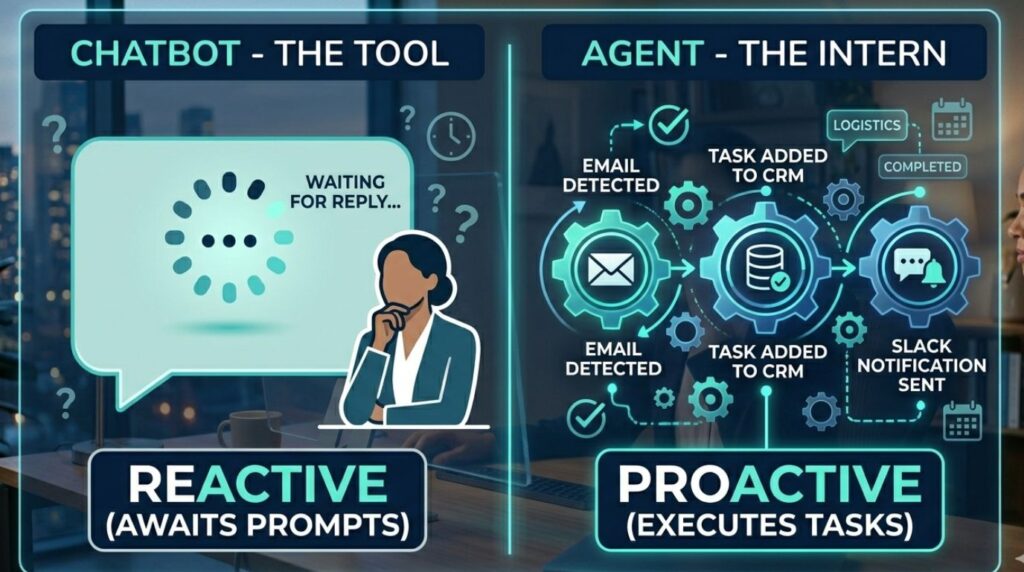
A chatbot responds. AI agents act.
And that one difference changes everything.
What AI Agents actually feel like (in real life)
Think of it like this.
Instead of:
- You’re checking emails
- You’re setting reminders
- You’re following up
An agent:
- Monitors your inbox
- Detects tasks
- Logs them somewhere
- Nudges you before deadlines
Without you asking.
It’s less like a tool. More like a slightly over-efficient assistant who never sleeps.
And no, you don’t need to be “technical.”
This is my favourite myth. “AI agents are for coders.”
They’re not. If anything, the core skill here is: Clarity.
- Can you define a task clearly?
- Can you explain the steps without confusion?
- Can you specify what “done” looks like?
Because that’s literally how you instruct an agent.
The Uncomfortable Truth About Work
Most of us don’t have a workload problem. We have a repetition problem.
- Following up on emails
- Moving data between tools
- Scheduling things manually
- Tracking tasks in 5 different places
None of this is “high-value work.” It just feels important because it’s constant.
This is where Agents quietly Win
AI agents thrive in:
- Clear triggers
- Predictable workflows
- Repeatable outcomes
Which, let’s be honest…Is 60–70% of most jobs.
The Funny Part (and lightly painful)
We’ve spent years:
- Hiring people
- Training teams
- Building processes
And now we’re realising: Half of that could’ve been automated with better systems.
Not fewer people. Better design.
The Real Use Case (that nobody is talking about enough)
AI agents are not about replacing jobs. They’re about:
Reducing mental load.
Because the highest cost in modern work isn’t time. It’s:
- Context switching
- Forgetting things
- Keeping track of too many moving parts
Agents don’t get tired. They don’t forget. They don’t procrastinate. (Annoying, I know.)
How I’d actually Start (no fluff)
If I had to begin today, I’d do this:
Step 1: Find one annoying task
Something repetitive. Something you hate.
Step 2: Define it clearly
- When does it start?
- What steps are involved?
- What’s the output?
Step 3: Build one agent
Not five. Not ten. Just one.
Step 4: Let it run
Refine it. Trust it. Improve it.
Because agents don’t scale individually. They scale in systems.
The Bigger Shift Nobody is Saying out Loud
We’re moving from:
👉 “Using tools.”
To
👉 “Designing systems.”
And that’s a completely different mindset.
Earlier:
You did the work.
Now:
You design how the work gets done.
The Satire Writes Itself (again)
We’re entering a world where:
- You wake up
- Your AI has already:
- Scheduled your meetings
- Sent follow-ups
- Organized your tasks
And your biggest contribution is…Approving things.
Peak productivity.
My Takeaway
AI agents are not some futuristic concept. They’re already here. Just underutilized.
And the people who figure this out early won’t necessarily work harder. They’ll just…Think better about how work should happen.
Final Thought

We’ve always chased “work-life balance.” Maybe the real unlock isn’t balance. It’s a delegation. And for the first time… You don’t need a team to do it.
Also, just saying —
If your job can be turned into a checklist…There’s a very good chance AI agents are already eyeing it.
As the industry shifts, staying informed on AI news is essential for any person. Click through to read more such threads!