

A business may have a marketing budget, advanced ad platforms, and AI tools, yet still struggle to get real results. The problem is not always the technology or the strategy. Sometimes, the people managing these systems do not have the skills required to use them effectively.
This is becoming a serious challenge for the digital marketing industry. As platforms, customer behaviour, and marketing technology change, the capabilities expected from marketers are changing too. But professional skills are not developing at the same pace.
This digital marketing skills gap is becoming more visible as businesses expect marketers to manage increasingly complex campaigns and technologies.
Quick Answer
The digital marketing skills gap is the difference between the skills businesses need and the skills in their marketing teams. Growing demand for AI, analytics, automation, performance measurement, and strategic thinking is making this gap more visible. Businesses need better training, while marketers must move beyond tool-based knowledge towards measurable business outcomes.
What Happened?
Digital marketing has become more complex.
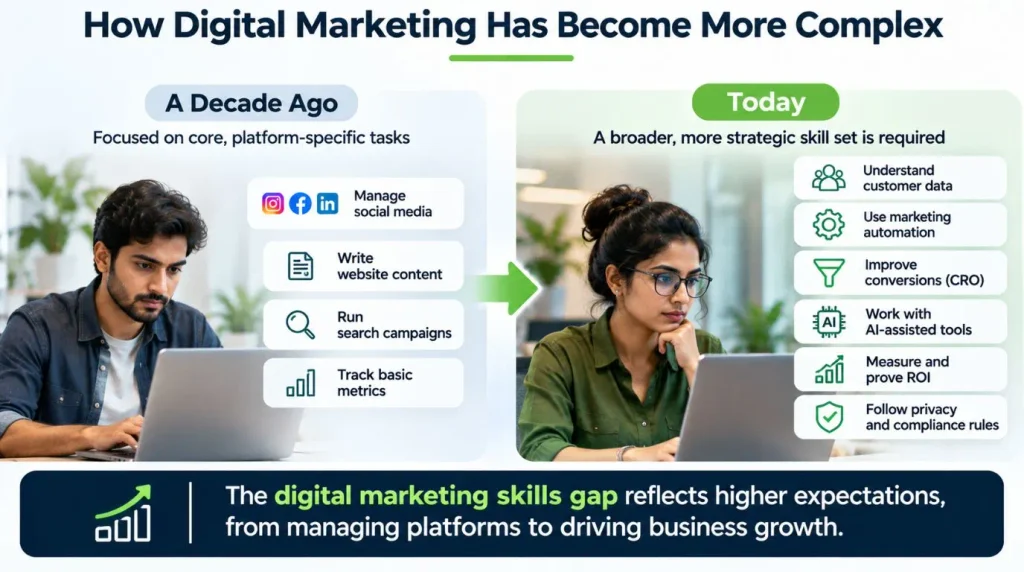
A decade ago, many marketing jobs focused on managing social media accounts. They also involved writing website content and running search campaigns. People tracked basic performance metrics, too.
Those responsibilities still matter. However, modern marketing teams must also understand customer data, marketing automation, conversion optimisation, AI-assisted workflows, attribution, and privacy requirements.
Research from the American Marketing Association (AMA) highlights this challenge. Its 2025 Marketing Skills Report used a survey of more than 1,200 marketers.
It also analyzed over 450 job postings and included expert interviews. It found major skill gaps in digital marketing, data and analytics, proving ROI, and data privacy and compliance.
The AMA’s 2026 State of Marketing Careers Report offers another perspective.
Its research surveyed 1,412 marketing professionals. It found that AI was the top skill marketers expected to need. This was for the next five years. The share of marketing job postings mentioning AI also doubled in 2025.
The problem extends beyond international markets.
India’s marketing workforce is experiencing the effects of wider digital transformation. The NIIT India Skills Gap Report 2026, developed with YouGov, surveyed 3,500 respondents across different professional and academic groups. It identified digital and data capabilities among the most important skills for the next three to five years.
The report covers several industries rather than digital marketing alone. However, its findings reflect the wider workforce changes affecting marketing, where data, technology and digital capabilities increasingly influence everyday responsibilities.
Together, these findings point towards a clear shift: businesses need marketers who understand more than individual platforms. They need professionals who can connect technology, customer behaviour and commercial performance.
The digital marketing skills gap is therefore not simply about a lack of technical knowledge. It also reflects changing expectations around how marketing teams contribute to business growth.
Why It Matters
The digital marketing skills gap affects more than recruitment. It can influence campaign performance, marketing budgets, customer experience, and business growth.
One reason the digital marketing skills gap matters is that even well-funded marketing teams can struggle when they lack the skills to interpret performance and make informed decisions.
Consider a company spending several lakh rupees every month on digital advertising.
Its marketing team may know how to create campaigns, select audiences, and monitor clicks. But can the team identify why leads are not converting? Can it calculate customer acquisition costs accurately? Can it connect advertising expenditure to actual revenue?
These questions separate campaign execution from marketing effectiveness.
When businesses lack these capabilities, they may continue investing in campaigns without understanding what is working.
AI is making this distinction even more important. Generative AI can help produce content, analyse information, and support campaign workflows. But using an AI tool does not automatically create a good marketing strategy.
Someone still needs to review the output and understand the audience. They must check accuracy and protect customer information. They also must decide if the work supports business goals.
There is also a recruitment challenge. Businesses often look for professionals who understand SEO, paid advertising, social media, analytics, content, and AI simultaneously. Finding someone with practical experience across all these areas can be difficult.
The result is a widening gap between job expectations and the capabilities available in the market.
What Businesses And Marketers Need To Know
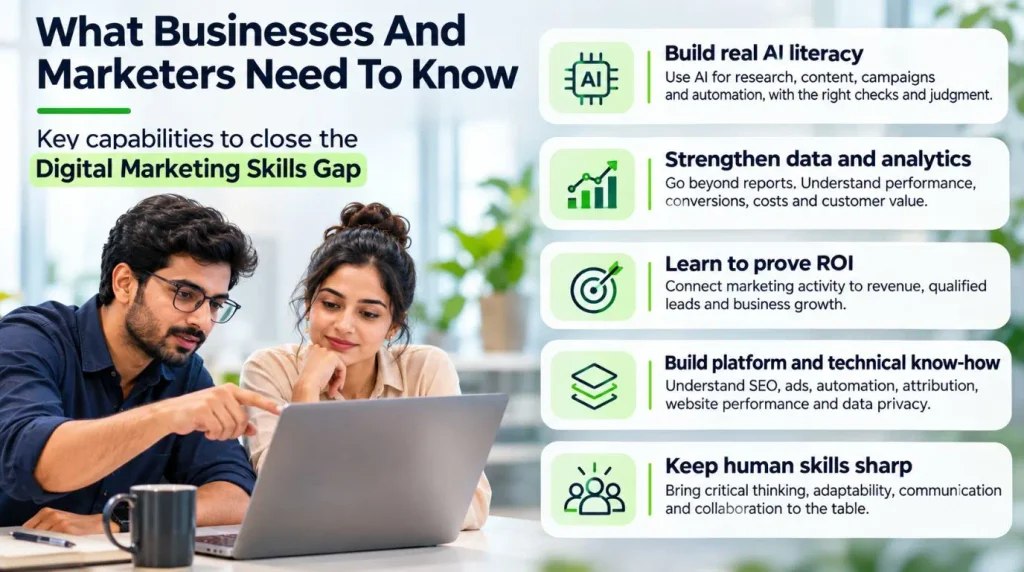
The solution is not to make every marketer an expert in every marketing discipline. It is to identify the capabilities that modern teams need and develop them systematically.
Closing the digital marketing skills gap requires a combination of technical training, analytical thinking, and practical marketing experience.
- AI Literacy must go beyond prompt writing
Knowing how to write prompts is a useful starting point, but it is not a complete AI skill set.
Marketers should understand how to use AI for research, content development, campaign analysis, customer segmentation and workflow automation. They should also know how to verify AI-generated information, recognise limitations and maintain brand consistency.
Addressing the digital marketing skills gap will require marketers to understand how AI fits into their existing workflows rather than treating it as a standalone tool.
The AMA’s 2026 research identifies AI fluency as an increasingly important baseline expectation. This suggests that knowing how to access an AI tool may no longer set a candidate apart from other applicants.
The biggest advantage comes from knowing where AI can improve marketing and where people still need to apply human judgment.
- Data and analytics skills are essential
Marketing decisions increasingly depend on data.
Professionals should understand website analytics, conversion rates, customer acquisition costs, return on advertising spend, lead quality, and customer lifetime value.
Tools like Google Analytics 4, Google Search Console, Looker Studio, and ad platform dashboards help marketers track performance. However, knowing how to generate a report is different from interpreting it.
A marketer should know why traffic increased, why conversions dropped, and whether the campaign attracts valuable customers. Data interpretation is what turns reporting into decision-making.
Stronger data interpretation skills can help reduce the digital marketing skills gap by enabling professionals to make decisions based on actual campaign performance.
- Marketers must learn to prove ROI
One of the biggest problems in marketing is the gap between activity and business impact.
Publishing more content, generating impressions, or increasing website traffic does not automatically mean a business is growing.
Marketing professionals must understand how their work contributes to revenue, qualified leads, customer retention, and other business objectives. This requires knowledge of attribution, conversion tracking, funnel analysis, and performance measurement.
The AMA identified proving ROI as one of the major current marketing competency gaps in its 2025 report.
Businesses should therefore evaluate marketers on more than the number of campaigns they manage. They should also consider whether those campaigns produce measurable results.
This is another important part of the digital marketing skills gap because businesses increasingly expect marketing professionals to demonstrate commercial value.
- Technical knowledge and platform understanding matter
Digital marketing platforms change frequently. Search engines update their systems, advertising platforms introduce new features, and marketing technology becomes more integrated.
Marketers need to understand how these systems work rather than depend entirely on predefined processes.
Important areas include:
- Search engine optimisation and AI search visibility.
- Google Ads and Meta Ads campaign management.
- Marketing automation and CRM platforms.
- Conversion tracking and advertising attribution.
- Website performance and conversion optimisation.
- Customer data, consent and privacy.
Not every professional needs deep expertise in all these areas. However, understanding how they connect makes collaboration across marketing teams more effective.
- Human skills remain valuable
Technical knowledge is only one part of the equation.
Marketing involves understanding people, identifying problems, communicating ideas, and making decisions under uncertainty.
The AMA’s 2026 report highlights adaptability, critical thinking, collaboration, and communication as capabilities that AI is less able to replicate independently.
This is important because marketers increasingly work alongside automated systems. They need to question results, identify opportunities, and make decisions that reflect customer expectations and business priorities.
A professional may understand technology. However, if they cannot explain their recommendations, they may struggle to make an impact. If they cannot work well with other teams, they may also struggle to make an impact.
Developing these capabilities is equally important when addressing the digital marketing skills gap across modern marketing teams.
The Number That Matters
43%
In its 2025 Marketing Skills Report, the American Marketing Association found that 43% of surveyed marketers expected generative AI to become more important as a marketing skill over the following five years.
The finding reflects the growing importance of AI knowledge in marketing careers.
However, AI is only one part of the wider skills gap. The same research identified digital marketing, data and analytics, proving ROI, and data privacy and compliance as major areas where marketers need stronger capabilities.
The takeaway is that learning AI alone will not solve the problem. Marketers need to combine AI fluency with analytical, technical, and strategic skills.
What Happens Next?
The digital marketing skills gap is unlikely to disappear simply because more tools become available. If anything, the growing number of platforms and AI workflows may increase the need for professionals. They can evaluate technology and use it responsibly.
Businesses will need to reconsider how they hire, train, and evaluate marketing teams.
Instead of expecting one employee to master every channel, organisations may benefit from building teams with complementary strengths. A performance marketer, SEO specialist, content strategist, and marketing analyst work more effectively when they understand their shared responsibilities.
Training also needs to become continuous rather than occasional.
NIIT’s 2026 research found that 69% of surveyed organisations increased their learning and development budgets in the previous year. This is a broader workforce finding. It is not specific to marketing departments. It highlights the growing importance of internal skill development.
For individual marketers, the next step is to build practical experience. Completing a course or collecting certifications can demonstrate learning, but real projects show whether someone can apply that knowledge.
The bigger question is whether marketing education, recruitment and workplace training can keep pace with the industry’s changing requirements.
How businesses respond to the digital marketing skills gap will influence their ability to adapt to new platforms, technologies and customer expectations.
DMT Take on Digital Marketing Skills Gap
The digital marketing skills gap is often described as a shortage of skilled professionals. But the problem is more complicated.
The digital marketing skills gap will not close through technology adoption alone. It requires businesses and professionals to rethink how marketing skills are developed.
Businesses sometimes expect marketers to manage SEO, paid campaigns, content, analytics, automation, and AI. They often do this without the training or resources needed to do the work well.
At the same time, professionals can become too dependent on individual platforms and tools. They may know how to operate a campaign dashboard without understanding the commercial decisions behind it.
Our view at DMT is that the industry needs to move beyond tool-based learning. Marketers should understand how to attract customers, interpret data, improve conversions and connect marketing activity to business growth.
AI will change the amount of routine work people do. It will not remove the need for sound judgement, clear communication and strategic thinking.
The most valuable marketers will not necessarily be the ones who know the most tools. They will be the ones who know which tools to use, why they matter, and how to measure the results.
Sources:
- American Marketing Association (2025) – 2025 Marketing Skills Report.
- American Marketing Association (2026) – 2026 State of Marketing Careers Report.
- NIIT (2026) – NIIT India Skills Gap Report 2026.
- Econsultancy (2025) – The Future of Marketing 2025.
- World Economic Forum (2025) – Future of Jobs Report: Skills Outlook.
See Also: AI Productivity In India: How Much Time Is Saved?

Daksh Juneja is a performance marketing expert, trainer, and content creator featured in HT Tech. He helps businesses drive up to 4X ROI through Google and Meta Ads.