

Google is getting more searches, its AI products are attracting millions of users, and its cloud business is growing quickly. Yet, on October 29, 2026, its parent company, Alphabet, saw around $500 billion wiped off its market value in a single day.
At first, the Alphabet stock fall seems surprising. How can a company report strong revenue growth and growing demand for its AI services, yet see its stock price drop so sharply? The answer lies in a bigger problem. Google is changing how people search for information, but it also needs to protect the advertising business that made it one of the world’s biggest technology companies.
This is the challenge behind Google’s AI plans. The company must make AI useful for people while finding a way to make it profitable.
The $500 billion question: What happened to Alphabet’s stock?
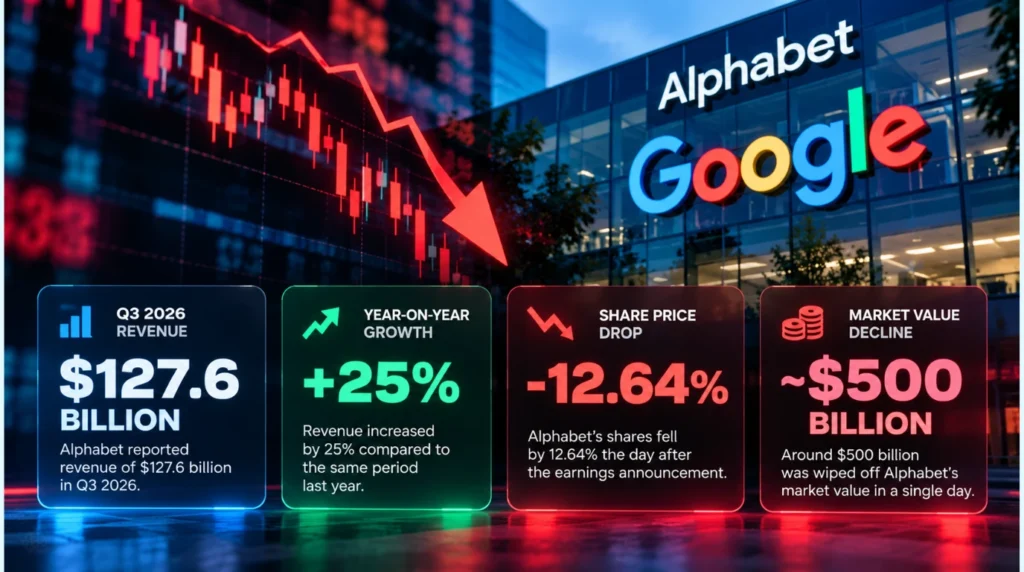
Alphabet shared its third-quarter 2026 results on October 28. The company reported revenue of $127.6 billion, which was 25% higher than the same period last year. This sounds like a strong result. However, the company missed some market expectations. Investors were also worried about its advertising business and the huge amount of money it was spending on AI.
The next day, Alphabet’s shares fell by 12.64%. This wiped around $500 billion off the company’s market value. But this does not mean Alphabet lost $500 billion in cash. Market value is the total value of a company’s shares. When its share price falls, its market value falls too.
So, what made investors nervous? It was not just the earnings results. Investors were concerned about slower advertising growth, rising AI costs, and how long it might take for these investments to generate more revenue.
The Alphabet stock fall showed that investors want more than strong growth. They also want to know whether the company’s spending will lead to higher profits.
Why are search growth and ad revenue different?
One detail in Alphabet’s results stood out. Google Search queries grew at their fastest yearly rate in five years.
In simple terms, more people were using Google to find information. Google Search revenue also grew by 12%, reaching around $63.3 billion in the third quarter. However, this growth was not enough to meet market expectations.
Why does that matter? Google makes a large part of its money by showing advertisements alongside search results. For example, when someone searches for running shoes, Google may show paid listings from shoe brands and online stores.
When users click on these advertisements, Google earns money. But AI is changing how people search. Instead of showing a list of websites, Google’s AI tools can give users a direct answer, explain a topic or compare different products. This can save time, but it may also mean fewer visits to websites and fewer chances to show traditional advertisements.
Google has also said that searches made through AI Mode currently earn less advertising revenue than traditional searches. This is an important difference. More searches do not always mean more money. The Alphabet stock fall reflects these concerns about the future of Google’s advertising business.
Now, Google Search revenue remains a concern, and Google needs to find ways to earn money from its new AI search tools without making the experience worse for users.
Changing Search without hurting its main business
Google cannot ignore AI. People are getting used to AI tools that can answer questions, explain difficult topics and compare products through simple conversations. If Google does not improve its search experience, users may turn to other tools.
This makes AI important for Google’s future, but there is a problem. Google must change how Search works without hurting the business that earns it billions of dollars.
Think about a person searching for a new laptop. In traditional Search, they may see several websites, product listings and advertisements. They can visit different websites before making a choice. With AI search, they may simply ask Google to compare five laptops and recommend the best one. The AI can give them a summary without requiring them to visit many websites.

This may be easier for the user, but it changes how Google can earn money from that search. This is where AI monetisation becomes important. It means finding ways to earn money from AI products and services.
Google is testing different ways to show advertisements in its AI search experience but it needs to be careful. Too many ads could annoy users, while too few could make the service less profitable.
The Alphabet stock fall raises an important question: Can Google make AI search profitable while keeping users happy and protecting its advertising business?
The price of staying competitive: The huge cost of AI
AI needs more than good software. It also needs powerful computers, data centres, special chips, electricity and cooling systems. All of this costs a lot of money. Alphabet is spending heavily to build the infrastructure needed for its AI products, including Gemini and AI-powered Search.
In the third quarter of 2026, its spending on major equipment and infrastructure reached around $51.4 billion. The company also expected its total spending for the full year to reach between $195 billion and $205 billion, which is a huge investment.
The pressure becomes clearer when we look at free cash flow. This is the money a company has left after paying for its regular operations and major investments. Alphabet reported negative free cash flow of around $9.1 billion for the quarter.
This does not mean the company is running out of money. Alphabet still has strong financial resources. However, it shows how much its AI plans are costing.
This is the challenge of AI infrastructure spending. Google needs to spend enough to compete with other technology companies. But it also needs to make sure that the money it spends brings in enough returns. If it spends too little, competitors could move ahead. If it spends too much without earning enough, its profits and cash flow could come under pressure.
Investors want to know when these large investments will start paying off, and this is another reason behind the Alphabet stock fall.
Explore how Google is tackling AI content detection through its SynthID technology, highlighting the growing challenges and investments surrounding Google’s AI ecosystem and profitability.
Cloud is growing fast, but is it enough?
Not every part of Alphabet’s business is facing the same pressure. Google Cloud is growing rapidly. It provides businesses with online storage, computing power and tools to build and run AI products.
In the third quarter of 2026, Google Cloud revenue reached around $30.7 billion, growing 103% compared with the same period last year. Its operating income also increased to around $11.1 billion. The company also reported a cloud backlog of around $561 billion. This represents future business linked to customer contracts. These numbers show that businesses are spending more on cloud services and AI technology.
This is good news for Alphabet because it has another business that can benefit from the growing demand for AI.
However, Google Cloud growth cannot solve every problem. Cloud earns money by providing services to businesses. Search earns a large part of its money through advertising. These are two different business models.
Even if Cloud continues to grow, Google still needs to protect its Search business and find better ways to earn money from AI-powered searches.
So, although Google Cloud growth is a positive sign, it does not remove all the concerns behind the Alphabet stock fall.
DMT take on the $500 billion market loss
Google’s next challenge is making AI profitable. One thing is clear: Google is not struggling to attract people to its products. More people are using Search. Gemini has reached one billion users, and Google Cloud is growing quickly. But there is a difference between getting users, earning revenue and making a profit. The Alphabet stock fall shows that investors want to see how Google’s AI investments will turn into real business results.
Google now has two big tasks. It must make Search better for people who want quick, useful answers. At the same time, it must find ways to earn money from this new search experience without weakening its advertising business. The company has the technology, money and resources to make this change. But building AI products and making them profitable are two very different challenges.
The next test for Google is not simply getting more people to use AI. It is finding a way to make AI profitable while protecting the business that built Google.
Sources:
- Alphabet’s Q3 2026 results, including revenue, Search, Cloud and net income.
- Market reaction and the reported decline in market value.
- Capital expenditure, free cash flow and advertising concerns.

Daksh Juneja is a performance marketing expert, trainer, and content creator featured in HT Tech. He helps businesses drive up to 4X ROI through Google and Meta Ads.