

You signed up for a fitness app to get in shape, subscribed to a streaming platform for one show, and paid for a software tool to finish a project. Months later, payments still leave your bank account, even though you barely remember using the services.
Individually, these charges might seem harmless. Together, they raise an uncomfortable question: how much of the subscription economy depends on people forgetting to cancel?
AI could make that question harder for businesses to ignore. As financial assistants get better at spotting recurring payments, they can help people cancel services they do not want. Companies may then find it harder to rely on people not paying attention. For the software industry, the consequences could extend beyond cancellations and could change how companies price and sell products.
Quick answer
AI-powered subscription management could help consumers identify forgotten payments, review recurring expenses and cancel eligible services. If these tools become widely used, businesses may feel more pressure to show ongoing value. They cannot rely on customers forgetting to leave. For SaaS companies, this could speed up tests with usage-based, task-based, and hybrid pricing. However, subscriptions are unlikely to disappear in every industry.
The Research Behind the “Forgetfulness Tax“
The idea that forgotten subscriptions can benefit businesses is not new. Economists Liran Einav, Benjamin Klopack, and Neale Mahoney have already talked about subscription payments using data from different services.
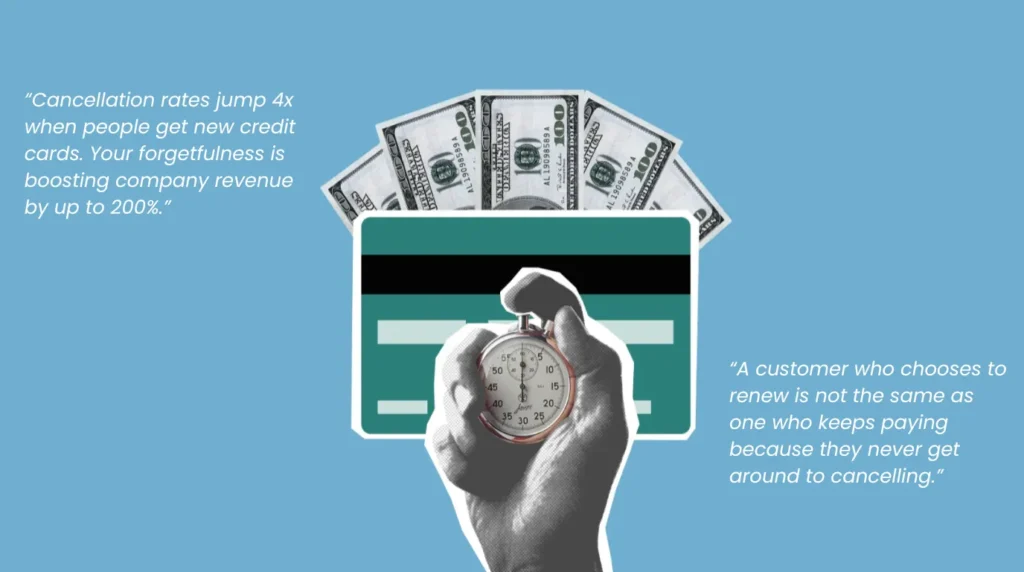
The researchers studied what happened when customers got replacement debit or credit cards. Customers then had to update their payment details to keep their subscriptions. This effectively forced them to make an active renewal decision.
The results were striking. Cancellation rates were four times higher during months when consumers received replacement cards. The researchers estimated that consumer inattention raised seller revenues by 14% to over 200%.
The exact increase depended on the service and the model used. For the average plan in the study, estimated revenue was 85% higher than if consumers chose each month.
These findings do not mean that 85% of subscription revenue comes from forgotten payments. They estimate the effect of consumer inattention in the services studied.
The underlying point is still important. A customer who chooses to renew is not the same as one who keeps paying because they never get around to cancelling. AI could narrow that gap by making recurring charges easier to notice and act upon.
When Your Financial Assistant Starts Taking Action
Until recently, managing subscriptions largely depended on consumers checking bank statements, remembering which services they had joined and navigating each company’s cancellation process. The process is beginning to change.
Chime’s official documentation introduced Jade Financial Partner as an AI-powered tool for some members. It can help cancel eligible subscriptions through a third-party service. Rocket Money also allows eligible members to submit cancellation requests through its Subscription Cancellation Assistant.
These examples matter because they move beyond simply displaying spending data. They show how financial tools can help users act on information about recurring payments.
Imagine an assistant that flags three subscriptions you barely use. It shows their total yearly cost. It asks if you want to keep them. With the right permission and merchant support, it could start a cancellation. It could also report if the request is complete.
The opportunity behind AI subscription management is simple: reducing the time and effort between recognising an unwanted expense and doing something about it.
However, current tools have limitations. Not every merchant supports automated cancellation, and some processes require account authentication or additional steps. An AI assistant that identifies a payment cannot automatically be assumed to have cancelled the underlying contract.
Curious how Google identifies AI-generated content? Explore our guide on Google’s SynthID Detector to learn how SynthID works and what it means for content creators and digital marketers.
Why SaaS Companies Should Pay Attention
The implications extend beyond streaming services and gym memberships.
Software-as-a-service, or SaaS, companies often rely on monthly or annual subscriptions to generate predictable recurring revenue. Customers pay for access to applications that help them manage projects, create content, analyse data or run their businesses.
The model works well when the software provides continuous value. Problems arise when customers keep paying for tools they rarely use, or when new AI products make existing workflows easier to complete elsewhere.
Consider a small business paying for separate tools to prepare reports, analyse campaign performance and organise customer information. If an AI agent can perform some of those tasks through a single interface, the business may begin questioning whether every existing subscription is still necessary.
This does not mean the software itself becomes worthless. Businesses may still need secure data storage, reliable infrastructure, integrations, support and specialised features. However, the value of simply providing access to another application could become harder to defend.
A survey published by Stripe on October 19, 2026, illustrates the pressure. Among 200 SaaS platform leaders surveyed across North America and Europe, 57% said they were concerned about losing customers to AI-driven competitors. Stripe also found that companies were testing usage- and outcome-based charges alongside subscriptions.
The survey is evidence of changing industry priorities and should not be taken as a proof that the entire SaaS model is collapsing.
From Monthly Subscriptions to Pay-Per-Task Pricing
If customers increasingly expect to pay for the value they receive, SaaS pricing models may need to evolve.
Traditional subscriptions charge a recurring fee for access. Usage-based pricing links the bill to measurable consumption, such as transactions, processing volume or API calls. Pay-per-task pricing would charge for a defined piece of work, such as generating a report or processing an invoice.

These models are different, but they point towards a common question: should customers pay primarily for access to a tool or for the work it helps them complete?
Now if we talk about a business that uses a research platform only a few times each month. A fixed subscription may feel expensive if the need is occasional. A charge for each completed research brief could be easier to justify, provided the price and definition of completion are clear.
The same logic could apply to certain design, reporting and administrative tools. Customers might pay for individual outputs, while businesses with continuous needs retain monthly plans.
This shift is already being explored across the industry. Deloitte’s analysis of SaaS and AI agents describes the possibility of hybrid models combining subscriptions with usage or outcome-based pricing. Stripe’s survey similarly found that some platforms plan to retain per-seat fees while charging separately for AI agent work.
The future of the subscription business model may therefore involve a mixture of pricing structures rather than a complete switch to pay-per-task billing.
Why Subscriptions Will Not Disappear Overnight
There is a reason subscriptions remain popular. They provide predictable costs for customers and recurring revenue for companies. They also work naturally for services that deliver value continuously.
Cloud storage, cybersecurity, website hosting and accounting platforms may remain essential even when customers are not actively using them every day. Charging separately for every action could make these services unnecessarily complicated or expensive.
AI introduces its own risks. An assistant might incorrectly identify a rarely used service as unnecessary, overlook an upcoming renewal or misunderstand why a customer needs a particular plan. Financial data also requires careful handling, and cancellations should happen only with appropriate authorisation.
Usage-based pricing has a potential drawback too: unpredictable bills. Customers may prefer a fixed monthly payment to a system where every AI action adds another charge.
For businesses, the challenge is not simply to abandon subscriptions. It is to choose a pricing structure that reflects how customers actually receive value.
DMT Take on AI Subscription Management
The most significant change may not be the disappearance of subscriptions, but the declining ability of businesses to benefit from customer inattention.
As AI tools make recurring expenses easier to review and cancellation easier to initiate, consumers could become more deliberate about where their money goes. Companies that rely on complicated cancellation processes or forgotten renewals may face greater pressure to justify their charges.
For SaaS businesses, that pressure could encourage clearer pricing, more flexible plans and greater experimentation with usage-based or task-based fees. Recurring revenue will remain valuable, but earning it may increasingly depend on customers seeing a reason to stay.
The subscription economy was built partly on convenience. AI could preserve that convenience for customers while making it harder for companies to charge for services they no longer value.
The real test for businesses may be simple: if a customer had an assistant reviewing every recurring payment, would they still choose to pay for your product?
Sources
- Stanford Institute for Economic Policy Research, Selling Subscriptions
- Stripe, Four Trends Reshaping How SaaS Platforms Compete in the AI Era, October 19, 2026
- Chime Help Center, About Subscription Cancellation in Jade Financial Partner
- Rocket Money Help Center, How Do I Cancel a Subscription on Rocket Money?
- Deloitte Insights, SaaS Meets AI Agents

Daksh Juneja is a performance marketing expert, trainer, and content creator featured in HT Tech. He helps businesses drive up to 4X ROI through Google and Meta Ads.