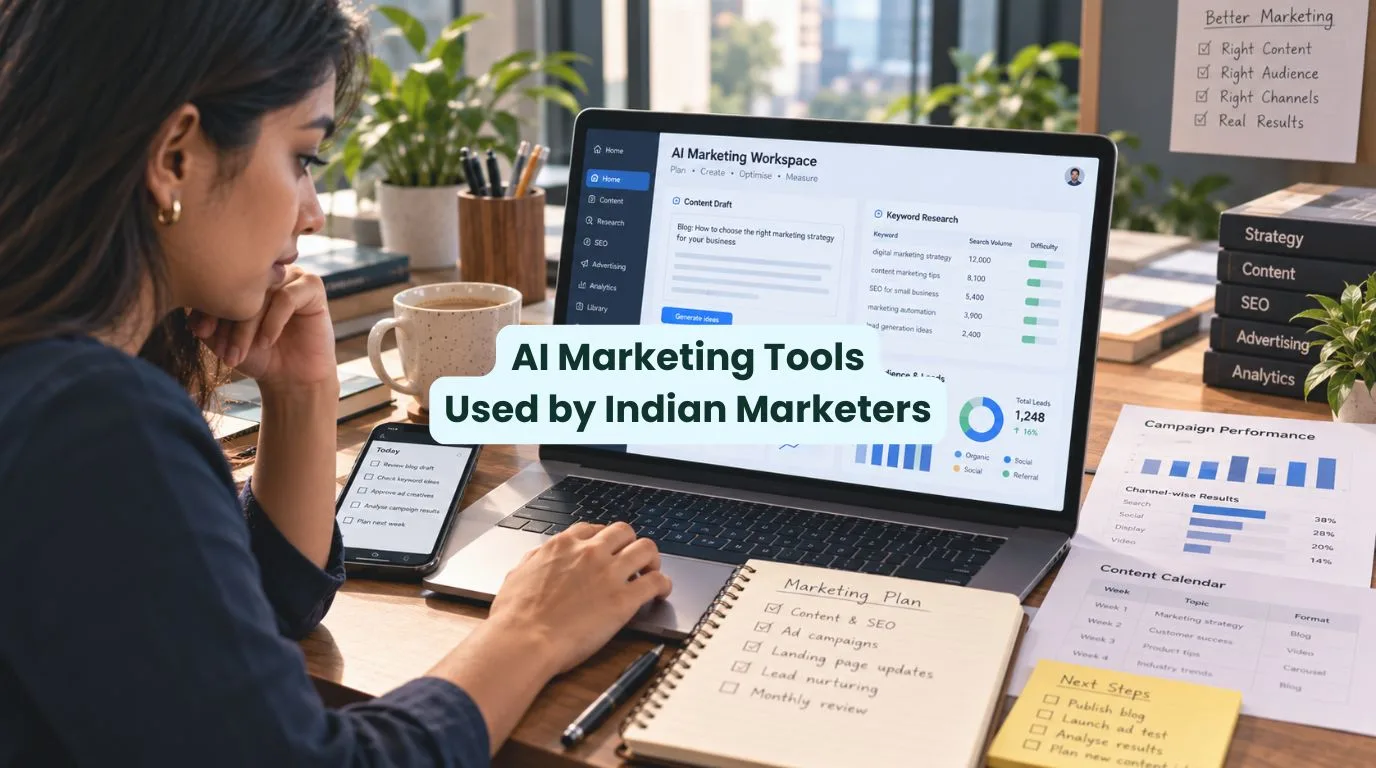


Ask a marketer how they use AI, and content creation is likely to come up quickly. Ask what happens after someone writes the content, however, and the answer becomes more complicated. Research, search visibility, ad optimisation, customer data, and reporting all involve different tools, skills, and decisions.
Indian marketing teams are starting to use AI marketing tools in these tasks. But the bigger question is this. Do these AI marketing tools improve the work, or increase its volume?
Quick Answer
Indian marketers use AI marketing tools for content, research, SEO, advertising, personalisation, and analytics. ChatGPT, Claude, and Gemini stand out in a 2026 survey of Indian B2B marketing practitioners. Google and Meta are also adding AI to advertising workflows. The emerging challenge is connecting these AI marketing tools to reliable data, sound strategy, and measurable business outcomes.
What Happened?
AI has moved beyond a standalone writing assistant and into several parts of the marketing workflow.
Salesforce shared its India findings in its tenth State of Marketing report. They published the report in July 2026.
It showed that 81% of surveyed Indian marketers used AI. The research also highlighted data quality and disconnected systems as barriers to effective personalisation. The survey included 250 marketing decision-makers in India as part of a global sample of 4,450.
A more tool-specific snapshot comes from Digital Uncovered’s India B2B AI Marketing Benchmark Report 2026. General-purpose AI assistants were common in their tool stacks. Its survey included 30 Indian B2B marketing practitioners.
83% of respondents reported using ChatGPT, 80% reported using Claude, and 57% reported using Gemini. Content creation and copywriting was the most common use case, reported by 97%.
The small sample matters. These percentages describe the report’s respondents.
Many people actively worked in AI. Most worked in B2B or technology-related businesses. Do not read them as national adoption rankings.
Meanwhile, platforms are embedding AI into existing marketing products. Google’s AI marketing tools include AI-supported campaign creation, bidding, creative workflows, and measurement. Meta has also expanded AI-supported advertising and business tools.
The result is a bigger set of AI marketing tools.
There are general assistants for thinking and work. There is specialist software for key marketing tasks. There are also AI features built into platforms marketers already use.
Why It Matters
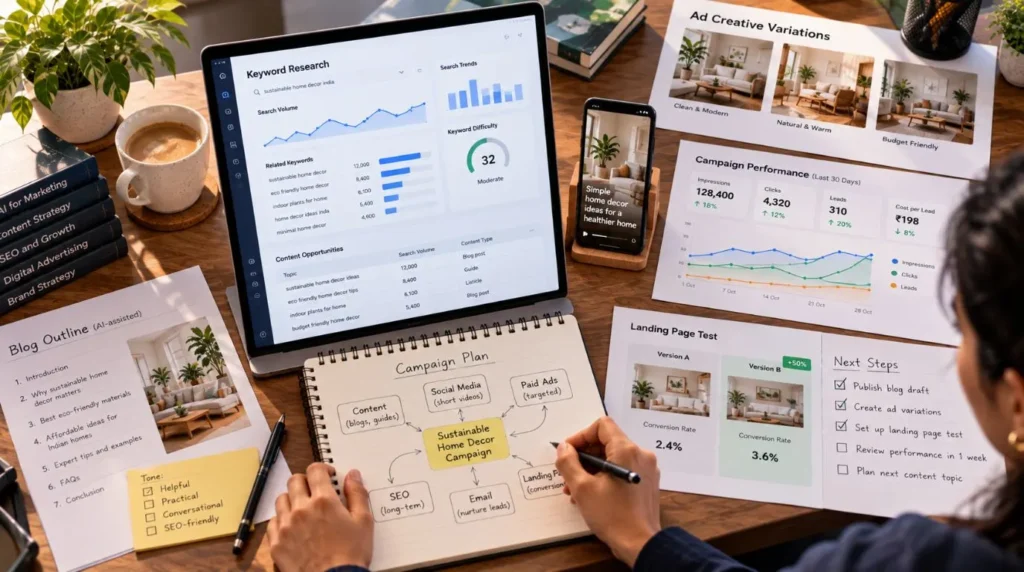
Using AI well can lower the cost of making a first draft, researching a topic, or creating new variations. That gives small teams and agencies more ways to test ideas without expanding every part of their operation.
But easier production creates a new problem: output can increase faster than quality.
A team can generate dozens of social posts without improving its positioning. It can produce more landing-page copy without fixing a weak offer. It can automate reports without knowing which numbers should guide the next decision.
There is also a growing gap between using AI to finish a task and using AI to improve a marketing system. The first might save time writing an email. The second connects customer information, campaign activity, and results so the team can make a better decision.
The value depends on the workflow around the tool, not just the model powering it.
What Businesses And Marketers Need To Know

1. General-purpose assistants are becoming the starting point
AI marketing tools such as ChatGPT, Claude, and Gemini can support brainstorming, research, outlining, copy drafts, campaign concepts, and data interpretation.
They are useful when marketers provide context: the target audience, offer, brand voice, source material, and intended outcome. Without that context, different AI marketing tools can produce similarly generic answers.
For a small business or agency, one well-integrated assistant can be more useful. It may cost less than several overlapping subscriptions. The decision should depend on the team’s recurring tasks, output quality, privacy requirements, and existing software.
2. SEO and research require more than generated text
AI-assisted research can help marketers explore topics, compare competitors, identify content gaps, and organise keyword ideas. Tools like Perplexity can help you find sources.
SEO platforms like Semrush and Ahrefs offer keyword research and search performance tools.
These AI marketing tools serve different purposes. A research assistant is not always a specialist SEO platform. An AI-generated answer does not prove a factual claim is correct.
Marketers still need to verify sources, understand search intent, and create content that reflects genuine expertise. As search uses AI-made answers, teams should also track how people find brands beyond normal website clicks.
3. Creative and advertising tools are becoming more integrated
Canva’s AI features can help you develop visual ideas. Image-generation tools like Adobe Firefly can help you create different versions. They can also help you produce campaign assets.
Google’s advertising products use AI for activities including bidding, campaign optimisation and creative assistance. Meta’s Advantage+ tools apply AI to parts of campaign delivery and optimisation.
The practical benefit is faster experimentation. Teams can develop variations of a message or visual and learn which approaches deserve further investment.
However, AI-generated creative still needs brand review, factual checks and appropriate rights and usage checks. Faster production is not the same as stronger creative strategy.
4. Automation and personalisation depend on usable data
Marketing automation and CRM platforms can help teams organise leads, personalise communications and coordinate follow-ups. AI can support these workflows, but the results depend on whether customer records are accurate, relevant and connected.
Salesforce’s 2026 India findings underline this issue: disconnected or irrelevant customer data remains a barrier even among marketers who have adopted AI.
For businesses, this means data cleanup and workflow design may deserve attention before another AI subscription. An automated message based on incorrect customer information can make an experience worse, not more personal.
5. Build a small stack around measurable jobs
Instead of choosing AI marketing tools because they are popular, map them to recurring tasks:
- Research and planning: topic discovery, competitor analysis and campaign briefs.
- Content and creative: drafts, editing, design concepts and variations.
- Search and advertising: keyword analysis, campaign support and optimisation.
- Automation and customer engagement: lead routing, follow-ups and personalisation.
- Analytics: reporting, pattern identification and performance questions.
Start with one workflow, measure time saved and assess the quality of the output. Add AI marketing tools only when they solve a distinct problem or work better with the existing stack.
The Number That Matters
81% of surveyed Indian marketers had adopted AI, according to Salesforce’s 2026 India findings. The finding comes from Salesforce’s tenth State of Marketing report.
A global survey of 4,450 marketing decision-makers forms the basis of it. The survey includes 250 decision-makers in India. They published it in July 2026.
The significance is not that every marketer is using the same tool or achieving the same results. Adoption is becoming common enough that the more useful questions concern implementation, data, skills, and measurable impact.
Survey respondents provided the data for the figure, and it does not reflect a census of every Indian marketer. It also measures AI adoption. It does not measure use of any one tool. It does not measure the share of marketing work automated well.
What Happens Next?
The next thing to watch is how AI assistants connect more with campaign platforms. They will also link to analytics tools. They will tie into customer systems. They will become part of daily workflows.
Google’s 2026 marketing announcements, for example, describe AI-supported tools for campaign insights, recommendations, and measurement. These developments suggest a move from generating individual assets towards helping marketers interpret information and take action.
The bigger question is how much control marketers should hand over. Suggestions and automated execution are not the same thing. Teams need clear approval points for budget changes, customer-facing communications, and claims that could affect brand trust.
Training and governance will also matter. Marketers must assess outputs, protect sensitive data, check claims, and recognize when they need human judgement.
DMT Take
The winning AI marketing stack will not necessarily be the one with the most AI marketing tools. It will be the one that connects the right AI marketing tools to the right decisions.
A general-purpose assistant can help a team think and produce faster. Specialist platforms can improve particular tasks. Advertising systems can automate parts of delivery. But none of these automatically creates a strong positioning, useful content, or a compelling offer.
For Indian businesses and agencies, our view at DMT is to start with the bottleneck, not the tool list. Identify the task that takes time or gives uneven results. Test a suitable tool. Measure whether the outcome improves.
AI can increase marketing capacity. Strategy, verification, and customer understanding determine what that capacity is worth.
Sources:
- Salesforce — 81% of Marketers in India Have Adopted AI — India-specific adoption data and research methodology.
- Digital Uncovered — India B2B AI Marketing Benchmark Report 2026 — tool usage, marketing use cases and survey limitations.
- Google India — Google Marketing Live 2026 — AI-supported advertising, measurement and marketer workflows.
- Google — AI Tools for Marketing with Gemini — examples of AI-supported content, research and workflow tasks.
- Meta — Tools to Help Businesses Boost Engagement and Discoverability — business messaging and AI-supported advertising capabilities.
See Also – Indian Marketing Budget 2026: 5 Errors to Avoid

Daksh Juneja is a performance marketing expert, trainer, and content creator featured in HT Tech. He helps businesses drive up to 4X ROI through Google and Meta Ads.