
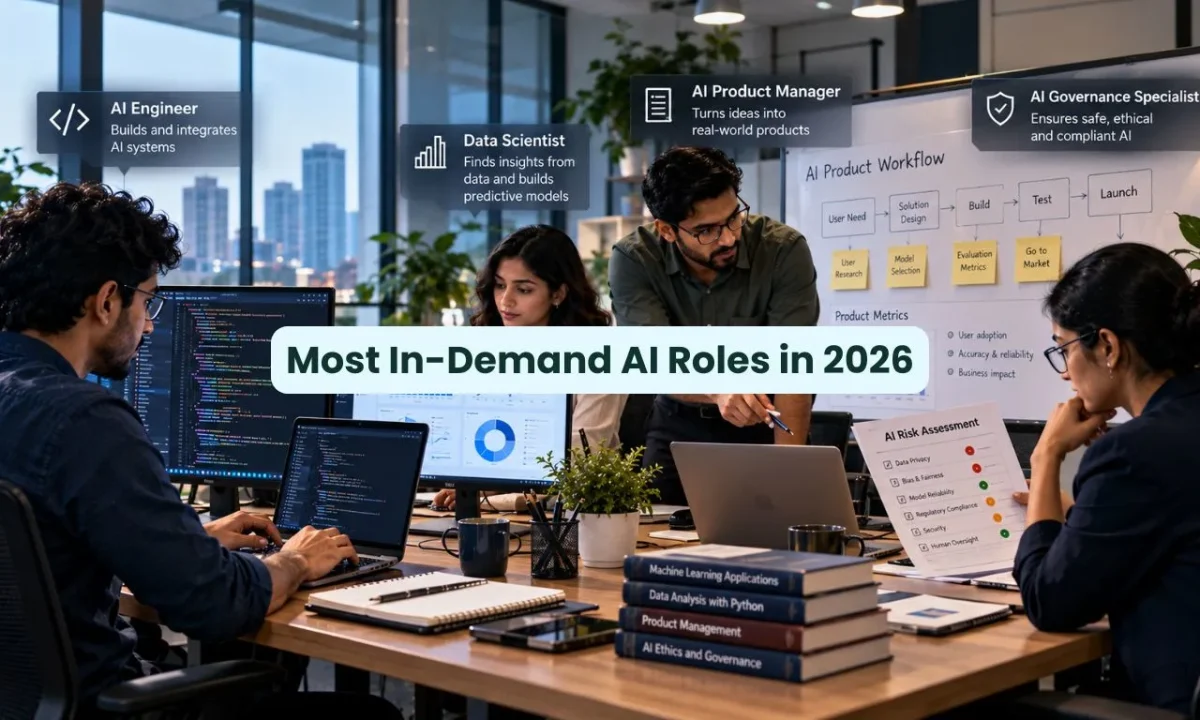

The AI job market is no longer just about hiring people who can build machine learning models. Businesses also need professionals who can add AI to products.
They must manage the systems behind it. They must connect it to customer workflows. They must make sure it works reliably. That is creating more career paths. These include engineering, data science, product management, automation, and AI governance.
For people planning their next career move, the key question isn’t simply which are the most in-demand AI roles currently trending. It is which problems businesses need people to solve.
Quick Answer
AI engineers, prompt engineers, AI managers, machine learning specialists, and data professionals are the most in-demand AI roles gaining attention in 2026. Demand is also growing around AI deployment, product development, security, and governance. The best career choice depends on a person’s technical ability, industry knowledge, and the kind of work they want to do.
What Happened?
Hiring reports point to a wider range of the most in-demand AI roles.
LinkedIn’s Jobs on the Rise 2026 report for India lists Prompt Engineer, AI Engineer, and AI Manager. These are among the most in-demand AI roles.
The report uses job and member data from the past three years. Its findings suggest employers are looking beyond traditional software development. They want people who can work with AI systems. They also want people who can use AI in practical ways.
The World Economic Forum’s Future of Jobs Report 2025 lists fast-growing jobs and the most in-demand AI roles through 2030.
These most in-demand AI roles include AI and machine learning specialists, data specialists, and software and applications developers worldwide. These are employer expectations, not a guarantee that every role will grow at the same rate in every country.
Together, the reports point towards a market that needs both technical depth and practical implementation skills.
Why It Matters

AI adoption creates work at several levels. Someone must build or adapt the model.
- They must prepare the data.
- They must connect the system to existing software.
- They must design the product experience.
- They must evaluate its output.
- They must manage the risks.
Not every company needs a dedicated research scientist. A business adding an AI customer support assistant may need an AI engineer and a software developer. It may also need a product manager and someone who understands customer operations. A company developing its own models may need specialised machine learning researchers and infrastructure engineers.
This matters for job seekers because the AI industry is not one career path. It is a collection of related specialisations, each with different entry requirements.
What Businesses And Marketers Need To Know

Here are the 10 most in-demand AI roles worth understanding in 2026.
1. AI Engineer
AI engineers build applications that use AI models. Their work can include connecting models to company data, developing AI-powered features, and integrating models into existing products. Therefore, it is on the list of the most in-demand AI roles in 2026.
Skills to develop: Python, APIs, model integration, software engineering, and evaluation of AI outputs.
2. Machine Learning Engineer
Machine learning engineers develop, train, test, and deploy machine learning systems. They often work closer to model development and optimisation than professionals who mainly integrate existing AI services.
Skills to develop: Python, statistics, machine learning frameworks, model evaluation and deployment.
3. Prompt Engineer
Prompt engineers design and refine instructions for AI systems to improve the relevance and reliability of their responses. The role can involve testing prompts, structuring context and evaluating outputs.
Skills to develop: Prompt design, structured testing, critical thinking, domain knowledge and an understanding of language models.
The practical caveat: prompt engineering is a recognised job title, but prompt-writing skills also appear within broader roles. Candidates should examine the responsibilities of an actual vacancy rather than assume every business needs a dedicated prompt engineer.
4. AI Product Manager
AI product managers decide what an AI-powered product should do, which user problems it should solve, and how teams should measure its performance. They work across engineering, design, business and risk teams. Thus, making it to the list of the most in-demand AI roles in 2026.
Skills to develop: Product strategy, user research, experimentation, AI fundamentals and communication.
5. Data Scientist
Data scientists analyse data, identify patterns, build predictive models and help organisations make better decisions. AI systems are only as useful as the data and evaluation methods supporting them.
Skills to develop: Statistics, SQL, Python, experimentation and data visualisation.
6. MLOps or LLMOps Engineer
These professionals help move AI systems from development into reliable production. They work on deployment, monitoring, version control, evaluation, and operational performance. LLMOps focuses specifically on systems built around large language models.
Skills to develop: Cloud platforms, automation, monitoring, deployment pipelines, and model evaluation.
7. AI Solutions Architect
AI solutions architects design how AI systems fit into a company’s technology environment. They consider system design, data access, security, cost, and integration with existing applications.
Skills to develop: Cloud architecture, APIs, system design, data infrastructure, and security fundamentals.
8. AI Automation Specialist
AI automation specialists identify repetitive workflows and connect AI tools with business software to reduce manual work. Their projects might involve document processing, lead qualification, customer support, or internal reporting.
Skills to develop: Workflow mapping, APIs, automation platforms, testing and business process analysis.
9. AI Security and Governance Specialist
These professionals help organisations manage risks such as sensitive-data exposure, unreliable outputs, unauthorised access, and regulatory non-compliance. Their work matters even more when AI guides customer-facing interactions or high-impact decisions.
Therefore, it is on the list of the most in-demand AI roles in 2026.
Skills to develop: Cybersecurity, risk assessment, privacy, governance frameworks and AI evaluation.
10. AI Research Scientist
AI research scientists investigate new methods, architectures, and techniques for improving AI systems. These positions often require strong mathematical foundations and advanced research experience, although requirements vary.
Skills to develop: Mathematics, statistics, deep learning, research methods, and programming.
Not every role requires the same level of technical depth. AI research and machine learning engineering usually need strong math and coding skills. Product management and automation can be easier entry points. They suit people with business or operations experience.
The Number That Matters
39% of workers’ existing skill sets are expected to change or become outdated between 2025 and 2030.
Source: World Economic Forum, Future of Jobs Report 2025.
This is a projection based on employer expectations, not a count of workers who will lose their jobs. Its significance is that AI careers will require continuous learning. A qualification or toolset that helps today may require updates as models, development methods, and business applications change.
What Happens Next?
The next phase of AI hiring will depend on how organisations move from experimentation to dependable systems. As deployments become more complex, businesses need skilled people.
These people keep quality high. They manage costs. They protect data. They show clear results.
Job seekers should also look beyond job titles. A company hiring an AI engineer may focus on software development and APIs. Another may expect model training, data pipelines, or cloud infrastructure experience. Reading job descriptions and examining recurring requirements is more useful than following a generic list of trending skills.
For beginners, a good starting point is to build skills in programming, data analysis, or business.
Then create projects that show how AI can solve a real problem. For experienced professionals, combining existing expertise with AI skills may be more practical than starting an entirely new career.
DMT Take on Most In-Demand AI Roles in 2026
The biggest mistake people can make is treating AI as one profession with one set of required skills.
The market needs builders. It also needs people who connect systems. It needs people who understand customers. It needs people who manage risk.
It needs people who decide whether AI is worth using. Technical ability matters, but so does the ability to solve a real business problem.
Our view at DMT:
Choose the problem you want to become good at solving before choosing the AI job title you want to pursue. Build evidence of that ability through projects, practical experience, and measurable outcomes. In a fast-changing market, proven skill tells a stronger career story than a list of AI tools on a résumé.
Sources:
- LinkedIn News India: Jobs on the Rise 2026 — India’s fastest-growing roles, including AI Engineer, Prompt Engineer, and Manager of AI.
- World Economic Forum: Future of Jobs Report 2025 — Global employer expectations for AI, data, and technology careers.
- World Economic Forum: The Jobs of the Future and the Skills You Need — Context on job growth, changing skills and future employment.
- India Today: 25 Fastest-Growing Jobs in India in 2026 — Supporting coverage of LinkedIn’s India findings.
Read Our Last DMT Original Blog Here – AI Marketing in India: 5 Powerful Trends for 2026

Daksh Juneja is a performance marketing expert, trainer, and content creator featured in HT Tech. He helps businesses drive up to 4X ROI through Google and Meta Ads.