
When AI Leadership Meets Influence Beyond the Org Chart
The AI industry loves to talk about founders, CEOs, engineers and investors.
But sometimes, the people influencing the biggest decisions aren’t listed on the company’s organisational chart.
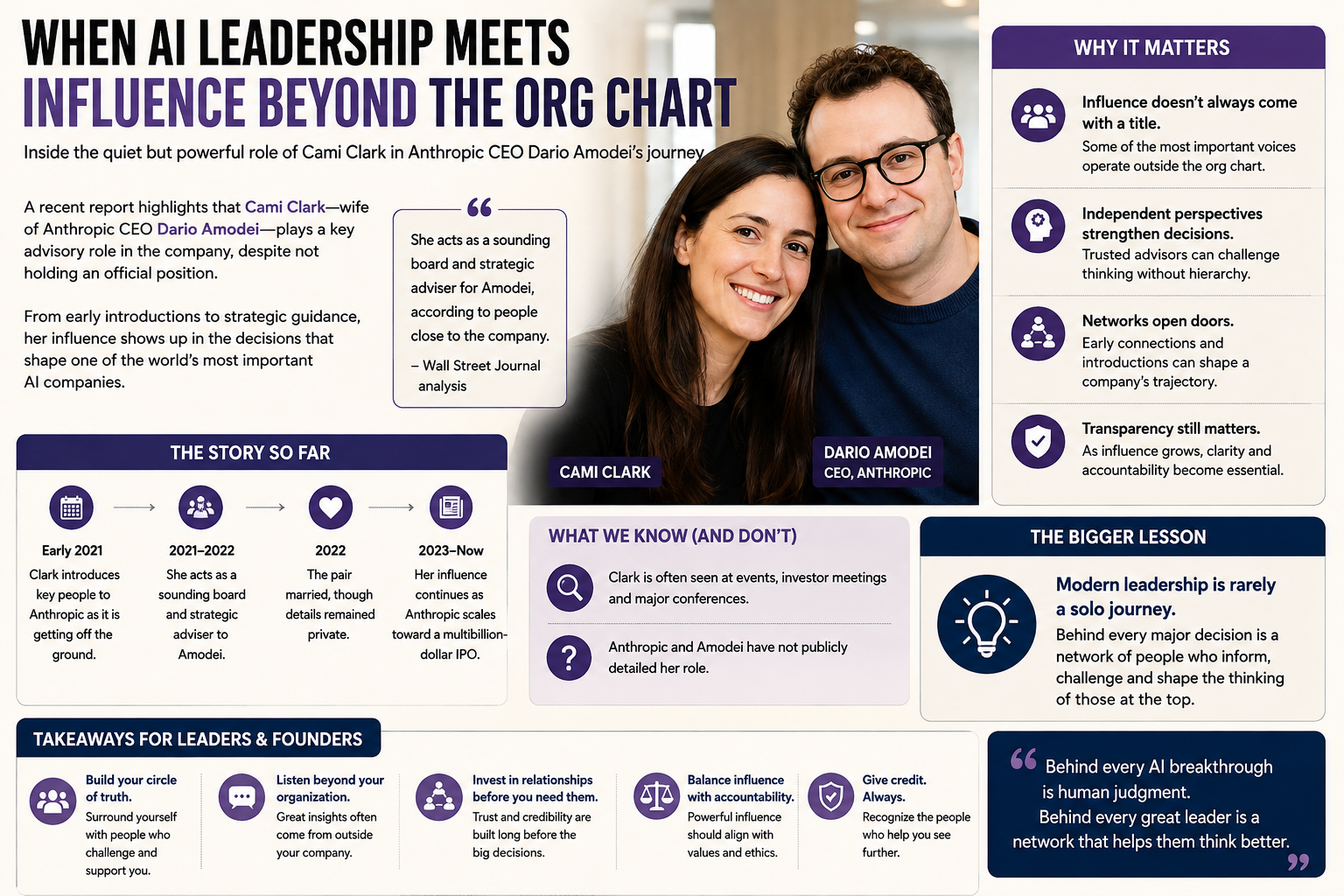
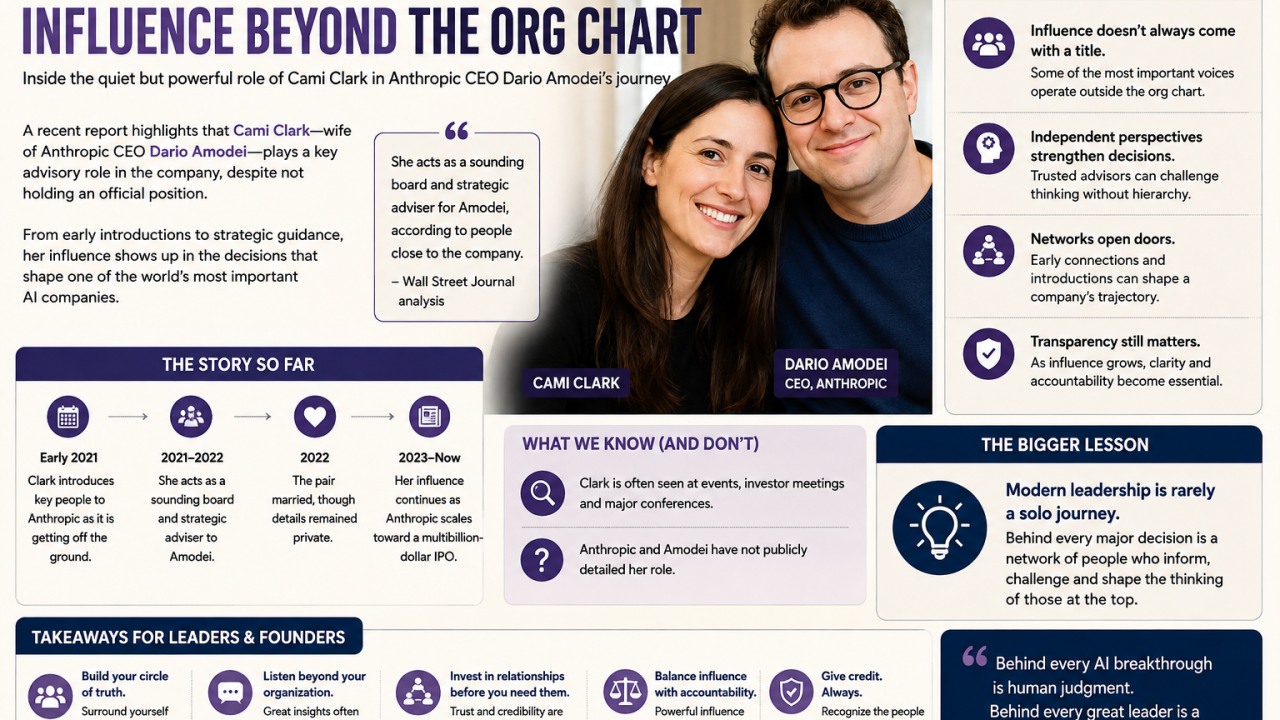
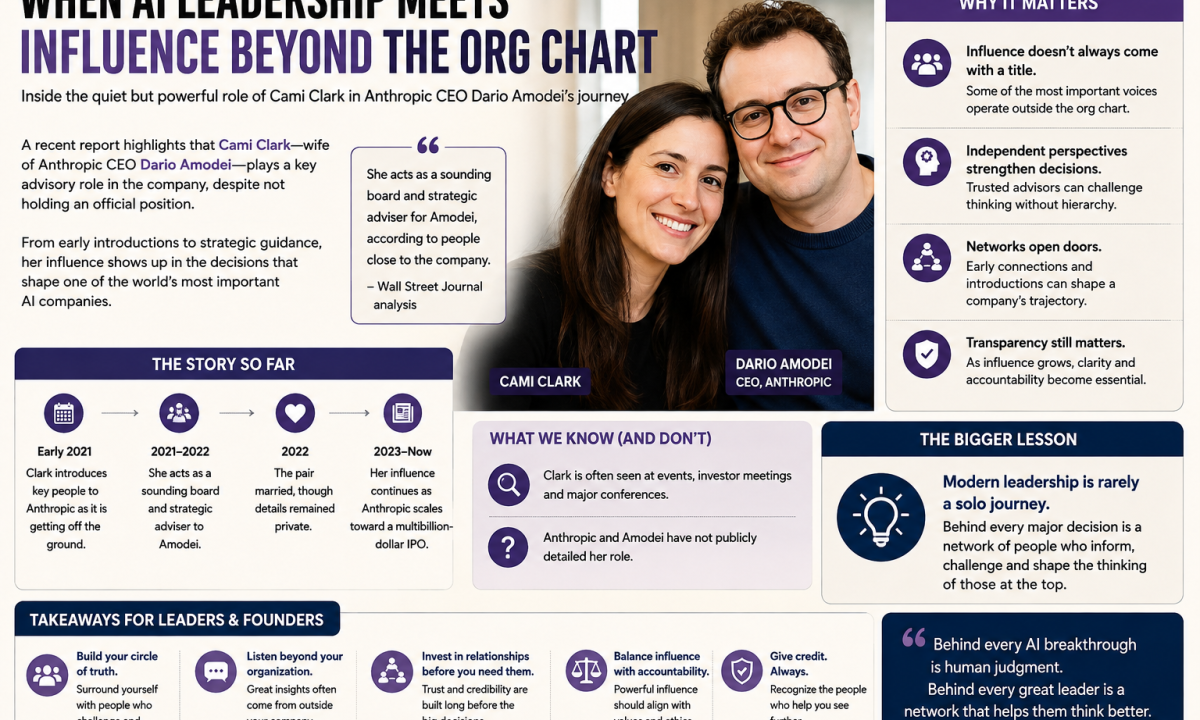
A recent report on Anthropic CEO Dario Amodei and his wife, Cami Clark, offers an interesting lens into this less visible side of leadership.
According to the article, Clark does not work at Anthropic, but is described by people close to the company as a sounding board and strategic adviser to Amodei. She has also reportedly played a role in introducing influential people to Anthropic as the company was getting started.
And that raises a much bigger question:
How much of a leader’s decision-making ecosystem exists outside the formal organisation?
The invisible boardroom
We often imagine corporate influence as something structured—board meetings, investors, CXOs, consultants and strategy teams.
But CEOs also make decisions through conversations with people they trust.
A spouse.
A mentor.
A former colleague.
An investor.
A friend who challenges their thinking.
These relationships may never appear in an annual report, but they can still influence how leaders evaluate opportunities, risks and people.
That becomes particularly interesting in AI, where companies are making decisions at extraordinary speed and dealing with questions that don’t always have established playbooks.
Influence isn’t the same as authority
There is an important distinction here.
Being influential doesn’t necessarily mean having formal authority.
A person can shape someone’s thinking without having the power to make the final decision.
And perhaps that’s exactly why informal advisers can be valuable.
They can ask the uncomfortable question.
They can challenge the prevailing narrative.
They can provide a perspective that isn’t constrained by the company’s hierarchy.
For CEOs operating in an environment as intense as AI, having someone who can provide an independent sounding board could be incredibly valuable.
The bigger lesson for organisations
This story also makes me think about something broader.
We spend a lot of time mapping organisational structures, but very little time mapping influence.
Who does the CEO call before making a difficult decision?
Who challenges the founder’s assumptions?
Who has access to the person making the decision?
Who can say, “I don’t think you’re looking at this the right way”?
These informal networks can sometimes matter as much as formal reporting lines.
But transparency matters
There is another side to this conversation.
When informal influence intersects with billion-dollar companies, major investments or strategic decisions, transparency becomes important.
Influence should not automatically be equated with control. Nor should someone’s relationship with a powerful executive become the basis for assumptions about their role.
The interesting question isn’t who is secretly running the company?
It is:
What does modern leadership look like when influence extends far beyond the organisational chart?
As Anthropic—and the broader AI industry—moves into an increasingly consequential phase, that question may become just as important as the technology itself.
Because behind every AI model is a leadership team.
And behind every leadership team is a network of people shaping how those leaders think.
#AI #Leadership #Anthropic #ArtificialIntelligence #BusinessStrategy #LeadershipLessons #TechIndustry #FutureOfWork