

AI’s New Problem is that the Companies Are Spending Millions Just to Talk to AI. The AI Gold Rush Has a New Bill Attached
For the last two years, companies have been obsessed with one question: “How do we use more AI?”
Now they’re asking a very different question: “Why is our AI bill so high?” As organizations scale up, evaluating the actual cost of AI in business has become a critical priority.
A recent report highlighted something fascinating. One company reportedly spent $500 million in a single month on Anthropic’s Claude AI. Others, including major global firms, are discovering that while AI can boost productivity, the cost of using these tools at scale is starting to become a serious business problem.
Ironically, the technology designed to save money is now creating a brand-new expense category – the cost of AI in business.
The Hidden Cost Nobody Talks About
When ChatGPT first exploded into the mainstream, most businesses looked at AI like a cheap intern.
Ask questions. Generate content. Write code. Summarize documents.
Simple.
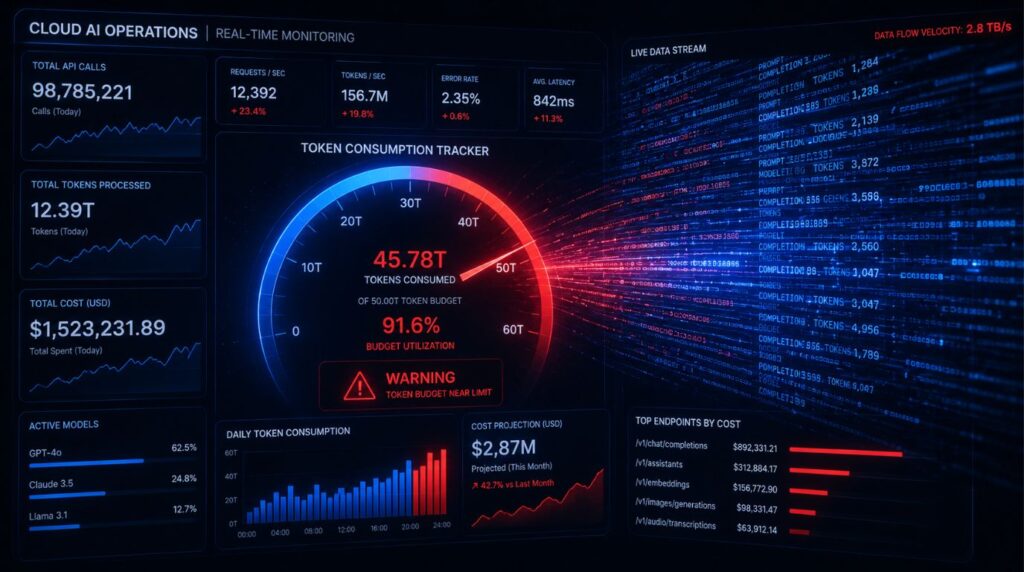
But as companies began integrating AI into daily operations, something changed. Every prompt, every API call, every uploaded document, every automated workflow consumes tokens. And tokens cost money. Lots of it.
The challenge isn’t that AI is expensive per interaction. The challenge is that organizations are now making millions or even billions of AI interactions every month.
A small cost multiplied by millions becomes a massive cost of AI in business.
Welcome to The Era of “Token Anxiety”
Just a few years ago, businesses worried about:
- Cloud hosting costs
- Employee salaries
- Software subscriptions
- Digital advertising budgets
Today, a new line item is appearing: Cost of AI in Business
Companies are beginning to monitor employee AI usage the same way they monitor internet bandwidth or cloud infrastructure. Some organizations have already started:
- Setting usage limits
- Restricting model access
- Monitoring prompt volumes
- Evaluating ROI per department
In other words, AI usage is becoming a management problem.
More AI Doesn’t Mean More Productivity
This is where things get interesting.
Many organizations assumed: More AI = More Output
Reality is proving more complicated. Employees sometimes use AI to:
- Rewrite already-good emails
- Summarize short documents
- Generate endless variations of content
- Run repetitive prompts with minimal business value
This phenomenon is creating what some experts call “Token Maximization.”
The AI equivalent of leaving all the lights on because someone else is paying the electricity bill.
The Productivity Paradox

Here’s the uncomfortable truth. Most companies still don’t have clear metrics for measuring AI success and the cost of AI in business. They’re spending aggressively because they don’t want to miss out on the AI revolution. But many struggle to answer:
- Did the cost of AI in business reduce?
- Did AI increase revenue?
- Did AI improve customer satisfaction?
- Did AI save employee time?
Without those answers, AI spending starts looking less like investment and more like experimentation. And experimentation at enterprise scale can become very expensive.
The Winners Will Be The Companies That Use Less AI
That statement sounds strange. But think about it. The companies that win won’t necessarily be the ones generating the most prompts. They’ll be the ones generating the most business outcomes.
The future belongs to organizations that can answer: “Which AI tasks create measurable value?”
Instead of: “How can we use AI everywhere?”
The difference is enormous.
My Take on the Cost of AI in Business
We’re entering the next phase of the AI revolution. The first phase was excitement. The second phase was adoption. The third phase is accountability.
For the last two years, companies have competed to announce AI initiatives. Over the next two years, they’ll compete to prove those initiatives actually make money. Because eventually every CFO asks the same question: “This AI thing is great. But what exactly are we getting for the millions we’re spending?”
And that might become the most important AI prompt of all.
Final Thought on The Cost of AI in Business
The biggest risk for businesses today isn’t falling behind on AI. It’s adopting AI without measuring outcomes. Technology has never been the hard part. Knowing when it’s worth the cost always has been.
As the industry shifts, staying informed about AI trends is essential for anyone. Click through to read another thread!