
Random acts of marketing infographic

Random Acts of Marketing vs. Building a Real System

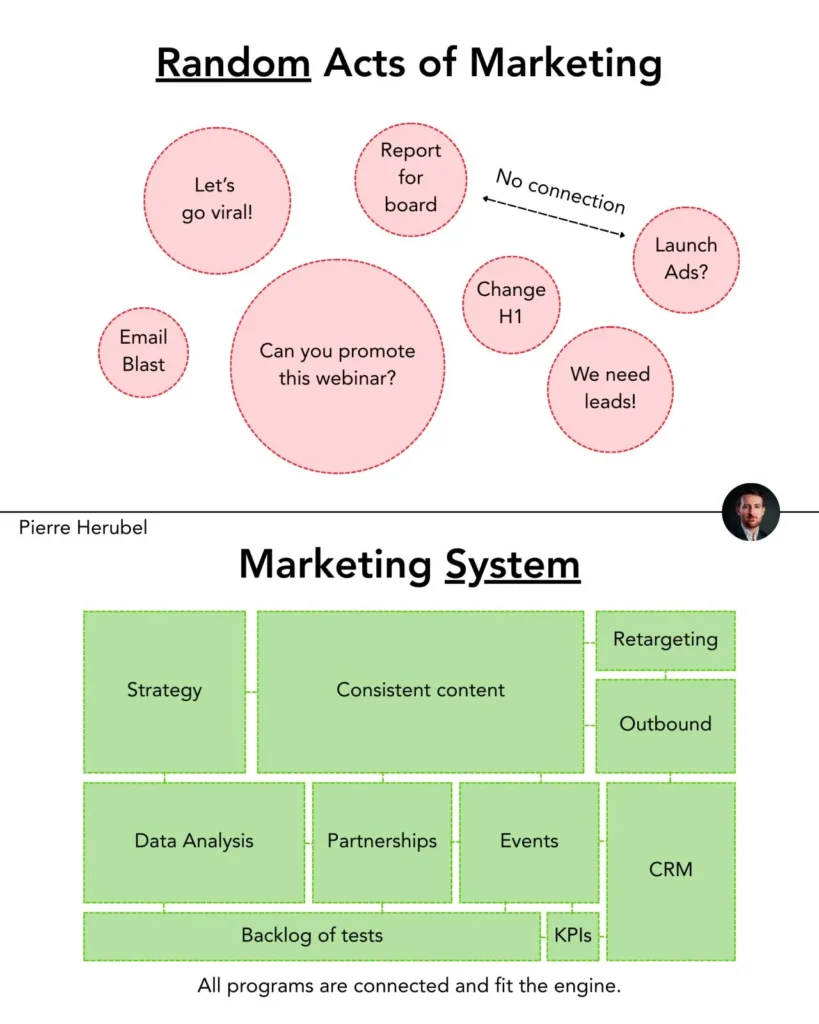
This visual perfectly captures something I see far too often.

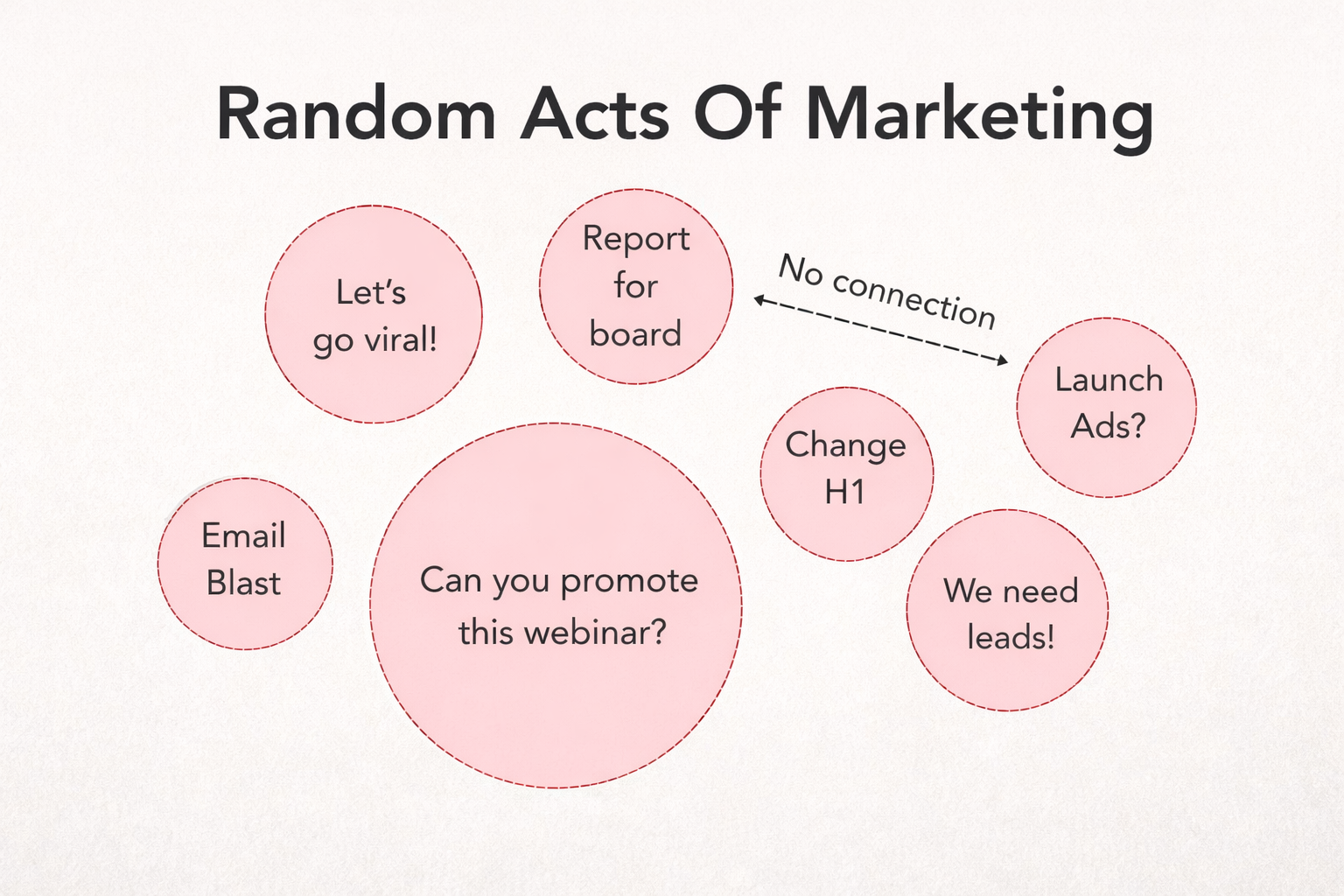
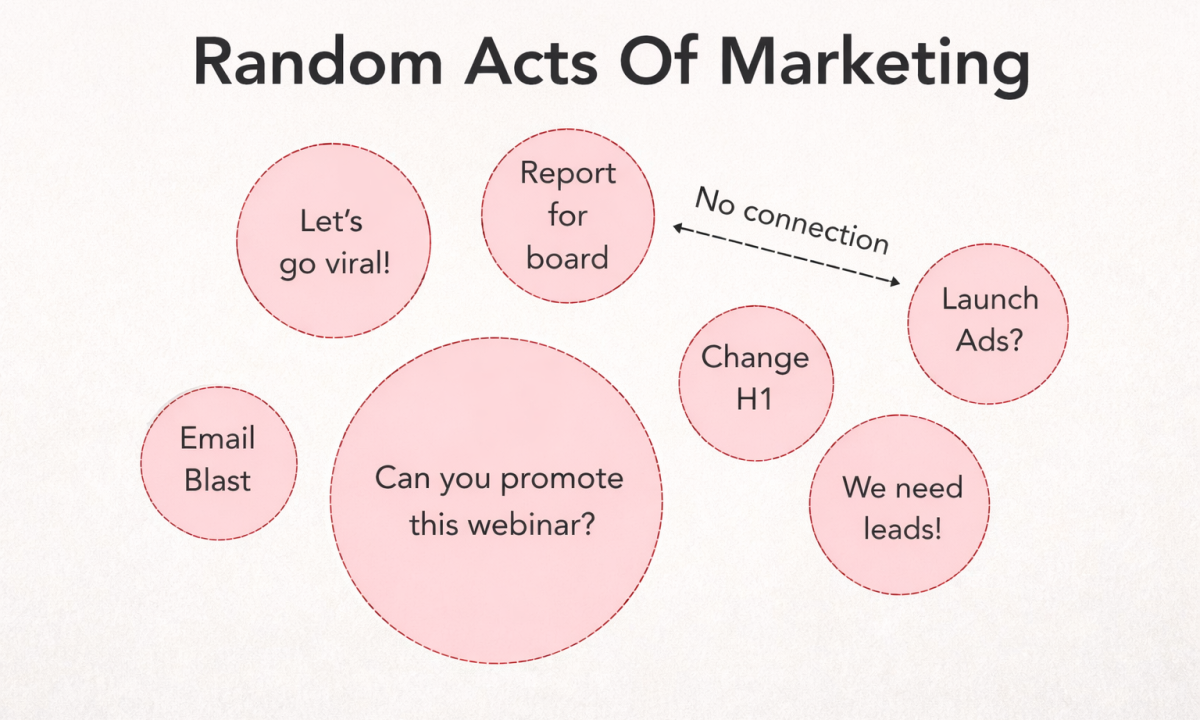
On one side:
“Let’s go viral.”
“Launch ads?”
“We need leads!”
“Change the H1.”
“Email blast.”
“Promote this webinar.”

All valid ideas. But disconnected.

This is what I call random acts of marketing — activity without architecture. Every request feels urgent. None of it is anchored to a larger system.

On the other side is what actually drives scale: a marketing system.

Strategy.
Consistent content.
Retargeting.
Outbound.
Data analysis.
Partnerships.
Events.
CRM.
KPIs.
A backlog of tests.

Everything connected. Everything feeding the engine.

What this means for a marketer

The difference between chaos and compounding growth is not budget — it’s structure.

When marketing becomes reactive, teams burn energy but don’t build momentum. When marketing becomes systemic, every activity strengthens something else. Content fuels retargeting. Data sharpens messaging. CRM increases LTV. Tests improve performance.

My takeaway is simple:
If your marketing feels busy but not scalable, you probably don’t have a system — you have tasks.

And tasks don’t compound. Systems do.
Latest Threads...

Summary The traditional television playbook is officially broken. While the screen itself has survived, consumer behavior has completely fragmented across multiple devices, forcing marketing budgets to follow the attention. Driven

Summary Your home isn’t just a living space anymore—it’s a premium commodities market. As tech companies move beyond scraping textbooks and websites, the race for physical AI training data has

Summary Modern cybercrime no longer relies on cracking passwords; it focuses on hacking human psychology. Driven by sophisticated manipulation rather than technical exploits, criminals are deploying ruthless social engineering tactics

Summary When legacy companies run out of purely transactional growth, they are forced to rebrand emotion. Using Victoria’s Secret’s shift back to its aspirational roots as a prime case study,

Summary The traditional professional playbook is broken. For decades, a Master’s degree or an expensive MBA was an automatic guarantee of career security. Today, current labor data indicates a massive

Summary Somewhere between formal emails and instant messaging apps, organizational alignment fractured. Shifts in modern workplace communication highlight a deep generation gap where younger workers view messages as strictly informational,