
Most people treat prompting like guesswork.
It’s not.
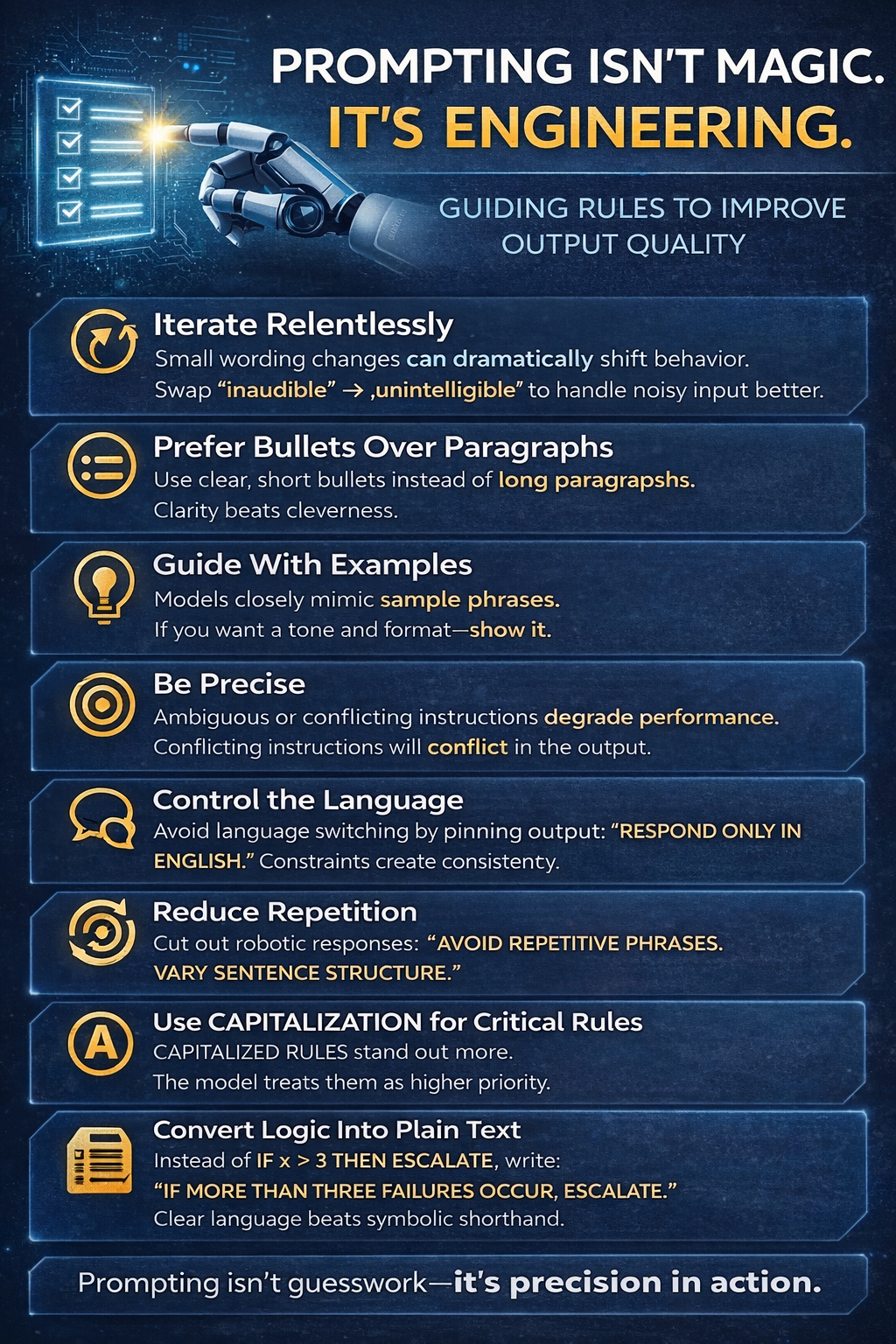
It’s iteration, precision, and structure.
Here are a few principles that consistently improve output quality — especially in real-time systems.
1. Iterate Relentlessly
Small wording changes can shift behavior dramatically.
Example: swapping “inaudible” → “unintelligible” improved noisy audio handling.
One word. Different outcome.
2. Prefer Bullets Over Paragraphs
Short, structured bullets outperform long blocks of text.
Clarity beats cleverness.
3. Guide With Examples
Models strongly follow sample phrasing.
If you want a tone, structure, or style — SHOW IT.
4. Be Precise
Ambiguity or conflicting instructions degrade performance.
If instructions fight each other, the output will too.
5. Control the Language
If you see unwanted language switching, explicitly pin the output:
“RESPOND ONLY IN ENGLISH.”
Constraints create consistency.
6. Reduce Repetition
If responses feel robotic, add a rule like:
“AVOID REPETITIVE PHRASES. VARY SENTENCE STRUCTURE.”
7. Use CAPITALIZATION for Critical Rules
Important constraints stand out better when capitalized.
The model treats them as higher priority.
8. Convert Logic Into Plain Text
Instead of writing:
IF x > 3 THEN ESCALATE
Write:
“IF MORE THAN THREE FAILURES OCCUR, ESCALATE.”
Clear language > symbolic shorthand.
The takeaway?
Prompting isn’t about being creative.
It’s about being deliberate.
Precision compounds.
Source: https://developers.openai.com/cookbook/examples/realtime_prompting_guide