
Fake News

India’s Fake News Problem Isn’t Slowing Down

I was going through recent data on misinformation in India, and the trend is worrying. Despite laws and fact-checking units in place, fake news cases have continued to rise — and AI could make the challenge even more complex going forward.

Key Highlights

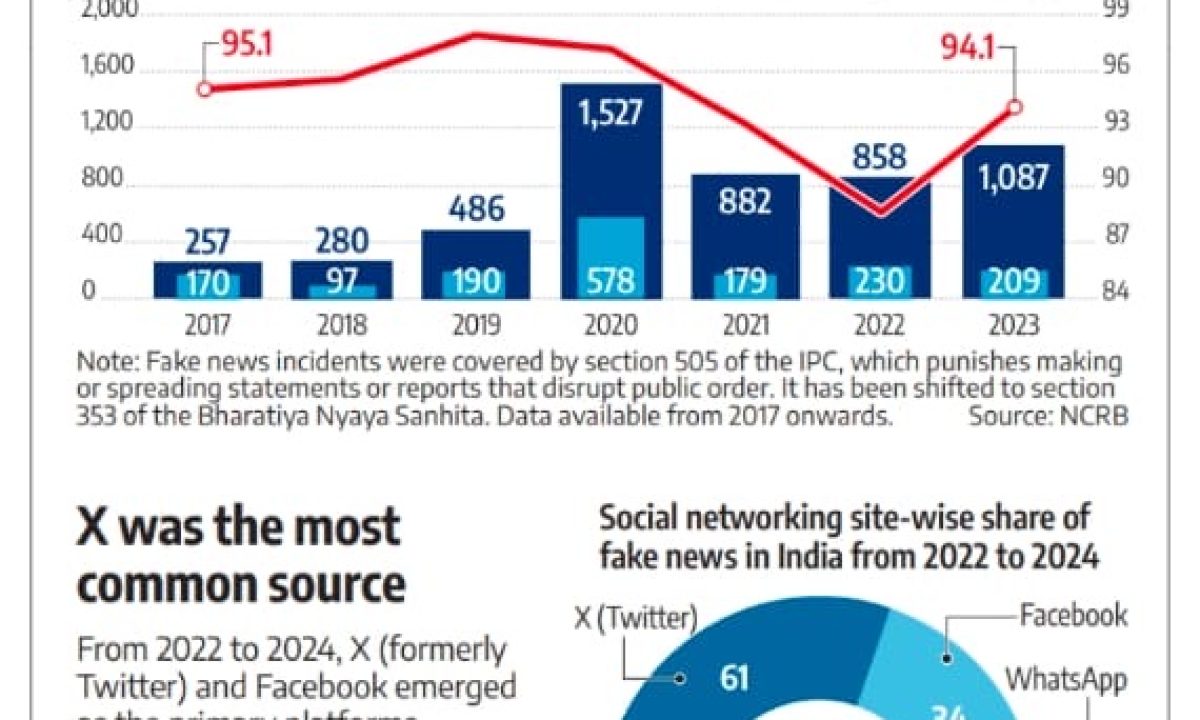
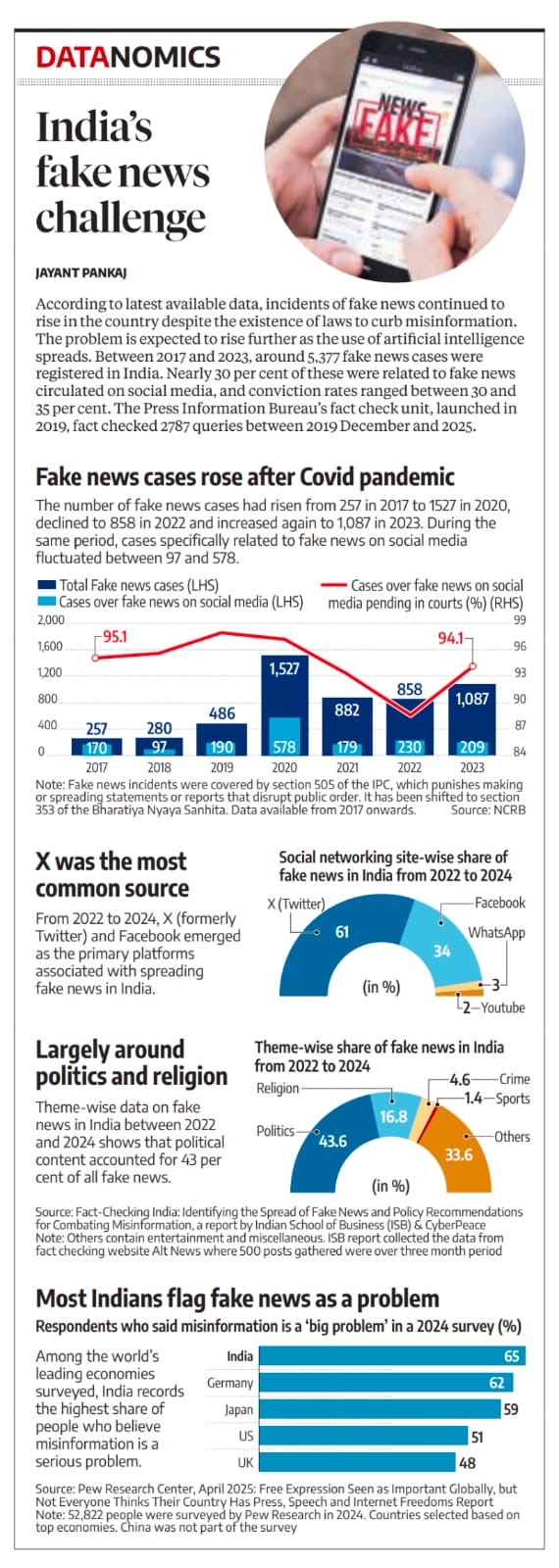
Between 2017 and 2023, over 5,300 fake news cases were registered in India. The spike post-Covid is particularly noticeable. Cases jumped sharply in 2020, dipped slightly, and then rose again in 2023.

Social media remains central to the issue. A significant portion of fake news cases are linked to online platforms. From 2022 to 2024, X (formerly Twitter) emerged as the most common source, followed by Facebook and WhatsApp.

When you look at themes, politics dominates — accounting for roughly 43% of fake news cases. Religion follows. That tells me misinformation isn’t random; it clusters around emotionally charged, high-engagement topics.

Another striking insight: in a 2024 global survey, India recorded the highest percentage of respondents who believe misinformation is a “big problem.” Public awareness is high — but the scale of spread remains higher.

Fake News

Latest Threads...

Summary The traditional television playbook is officially broken. While the screen itself has survived, consumer behavior has completely fragmented across multiple devices, forcing marketing budgets to follow the attention. Driven

Summary Your home isn’t just a living space anymore—it’s a premium commodities market. As tech companies move beyond scraping textbooks and websites, the race for physical AI training data has

Summary Modern cybercrime no longer relies on cracking passwords; it focuses on hacking human psychology. Driven by sophisticated manipulation rather than technical exploits, criminals are deploying ruthless social engineering tactics

Summary When legacy companies run out of purely transactional growth, they are forced to rebrand emotion. Using Victoria’s Secret’s shift back to its aspirational roots as a prime case study,

Summary The traditional professional playbook is broken. For decades, a Master’s degree or an expensive MBA was an automatic guarantee of career security. Today, current labor data indicates a massive

Summary Somewhere between formal emails and instant messaging apps, organizational alignment fractured. Shifts in modern workplace communication highlight a deep generation gap where younger workers view messages as strictly informational,